| Compound ID | 3091 |
| Compound Structure |  |
| Plant Source | Prismatomeris fragrans E.T. Geddes Common Name:Khao - San |
| Source Family | Rubiaceae |
| Origin | Northeastern, Eastern and Southeastern parts of Thailand and in the Northwest of Laos |
| Plant Part Used | Root, stem |
| Extract | Hexane, dichloromethane |
| Target Bacteria | Mycobacterium tuberculosis H37Ra |
| Assay / Test Done | Microplate Alamar Blue Assay (MABA) |
| Positive Control Used (conc.) | Kanamycin Sulphate (2.5 µg/ml), Isoniazid (0.05 µg/ml) |
| Inhibition [%] | NR |
| Activity [MIC] µg/ml | 25 µg/ml |
| Activity (In terms of dilution) | NR |
| Activity (Zone of inhibition in mm) | NR |
| Active Compound Identified | Damnacanthal |
| PubChem ID | 2948 |
| Ethnomedicinal Information | Antimalarial, antifungal |
| PubMed ID [Source Literature] | 15885942 |
| Extract Preparation | Air dried roots and stems ground and extracted with solvents hexane and dichloromethane |
| Chemical Classification [Active Compound] | Aromatic, Tricyclic, Alkaloid, Anthraquinone, Aldehyde |
| Media / Broth Used [Antimicrobial Assay/Test] | NR |
| Cytotoxicity Assay [AID] | Against human epidermoid carcinoma in the mouth (KB), human breast cancer cells (BC), human lung cancer cells (NCI - H187) |
| Molecular Weight | 282.053 |
| Molecular Formula | C16H10O5 |
| SMILES | O(c1c2c(C(=O)c3c(C2=O)cccc3)cc(O)c1C=O)C |
| XLogP | 2.325 |
| PSA | 80.670 |
| H-bond Donor | 1 |
| H-bond Acceptor | 5 |
| No. of Rotatable Bond Count | 2 |
| No. of Rings | 3 |
| No. of N | 0 |
| No. of O | 5 |
| No. of S | 0 |
| Reference(s) | 1) Kanokmedhakul K, Kanokmedhakul S, Phatchana R.Biological activity of Anthraquinones and Triterpenoids from Prismatomeris fragrans.J Ethnopharmacol. 2005 Sep 14;100(3):284-8
|
| Curator | KeyaMukherjee |
| Compound ID | 3092 |
| Compound Structure |  |
| Plant Source | Prismatomeris fragrans E.T. Geddes Common Name:Khao - San |
| Source Family | Rubiaceae |
| Origin | Northeastern, Eastern and Southeastern parts of Thailand and in the Northwest of Laos |
| Plant Part Used | Root, stem |
| Extract | NR |
| Target Bacteria | Mycobacterium tuberculosis H37Ra |
| Assay / Test Done | Microplate Alamar Blue Assay (MABA) |
| Positive Control Used (conc.) | Kanamycin Sulphate (2.5 µg/ml), Isoniazid (0.05 µg/ml) |
| Inhibition [%] | NR |
| Activity [MIC] µg/ml | 100 µg/ml |
| Activity (In terms of dilution) | NR |
| Activity (Zone of inhibition in mm) | NR |
| Active Compound Identified | Rubiadin |
| PubChem ID | 124062 |
| Ethnomedicinal Information | Antimalarial, antifungal |
| PubMed ID [Source Literature] | 15885942 |
| Extract Preparation | Air dried roots and stems ground and extracted with solvents hexane and dichloromethane |
| Chemical Classification [Active Compound] | Aromatic, Tricyclic, Anthraquinone, Phenol |
| Media / Broth Used [Antimicrobial Assay/Test] | NR |
| Cytotoxicity Assay [AID] | Against human epidermoid carcinoma in the mouth (KB), human breast cancer cells (BC), human lung cancer cells (NCI - H187) |
| Molecular Weight | 254.058 |
| Molecular Formula | C15H10O4 |
| SMILES | Oc1c2c(C(=O)c3c(C2=O)cccc3)cc(O)c1C |
| XLogP | 1.838 |
| PSA | 74.600 |
| H-bond Donor | 2 |
| H-bond Acceptor | 4 |
| No. of Rotatable Bond Count | 0 |
| No. of Rings | 3 |
| No. of N | 0 |
| No. of O | 4 |
| No. of S | 0 |
| Reference(s) | 1) Kanokmedhakul K, Kanokmedhakul S, Phatchana R.Biological activity of Anthraquinones and Triterpenoids from Prismatomeris fragrans.J Ethnopharmacol. 2005 Sep 14;100(3):284-8
|
| Curator | KeyaMukherjee, vsheeba |
| Compound ID | 3093 |
| Compound Structure |  |
| Plant Source | Prismatomeris fragrans E.T. Geddes Common Name:Khao - San |
| Source Family | Rubiaceae |
| Origin | Northeastern, Eastern and Southeastern parts of Thailand and in the Northwest of Laos |
| Plant Part Used | Root, stem |
| Extract | NR |
| Target Bacteria | Mycobacterium tuberculosis H37Ra |
| Assay / Test Done | Microplate Alamar Blue Assay (MABA) |
| Positive Control Used (conc.) | Kanamycin Sulphate (2.5 µg/ml), Isoniazid (0.05 µg/ml) |
| Inhibition [%] | NR |
| Activity [MIC] µg/ml | 50 µg/ml |
| Activity (In terms of dilution) | NR |
| Activity (Zone of inhibition in mm) | NR |
| Active Compound Identified | 1 - Hydroxy - 2 - Hydroxymethyl - 3 - Methoxyanthraquinone |
| PubChem ID | 10085264 |
| Ethnomedicinal Information | NR |
| PubMed ID [Source Literature] | 15885942 |
| Extract Preparation | Air dried roots and stems ground and extracted with solvents hexane and dichloromethane |
| Chemical Classification [Active Compound] | Aromatic, Tricyclic, Anthraquinone, Alcohol, Ether, Phenol |
| Media / Broth Used [Antimicrobial Assay/Test] | NR |
| Cytotoxicity Assay [AID] | Against human epidermoid carcinoma in the mouth (KB), human breast cancer cells (BC), human lung cancer cells (NCI - H187) |
| Molecular Weight | 284.068 |
| Molecular Formula | C16H12O5 |
| SMILES | O(c1c(c(O)c2c(C(=O)c3c(C2=O)cccc3)c1)CO)C |
| XLogP | 1.654 |
| PSA | 83.830 |
| H-bond Donor | 2 |
| H-bond Acceptor | 5 |
| No. of Rotatable Bond Count | 2 |
| No. of Rings | 3 |
| No. of N | 0 |
| No. of O | 5 |
| No. of S | 0 |
| Reference(s) | 1) Kanokmedhakul K, Kanokmedhakul S, Phatchana R.Biological activity of Anthraquinones and Triterpenoids from Prismatomeris fragrans.J Ethnopharmacol. 2005 Sep 14;100(3):284-8
|
| Curator | KeyaMukherjee, vsheeba |
| Compound ID | 3667 |
| Compound Structure | 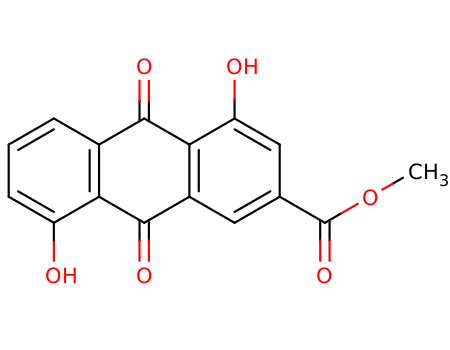 |
| Plant Source | Engelhardia roxburghiana Hay Common Name: |
| Source Family | Juglandaceae |
| Origin | |
| Plant Part Used | |
| Extract | |
| Target Bacteria | Mycobacterium tuberculosis H37Rv |
| Assay / Test Done | Agar - Dilution Test |
| Positive Control Used (conc.) | |
| Inhibition [%] | |
| Activity [MIC] µg/ml | NR |
| Activity (In terms of dilution) | |
| Activity (Zone of inhibition in mm) | |
| Active Compound Identified | 3-Methoxycarbonyl-1,5-dihydroxyanthraquinone |
| PubChem ID | NR |
| Ethnomedicinal Information | |
| PubMed ID [Source Literature] | 15729627 |
| Extract Preparation | |
| Chemical Classification [Active Compound] | Aromatic, Tricyclic, Anthraquinone, Ester, Phenol |
| Media / Broth Used [Antimicrobial Assay/Test] | |
| Cytotoxicity Assay [AID] | |
| Molecular Weight | 298.048 |
| Molecular Formula | C16H10O6 |
| SMILES | C1ccc(c2c1C(=O)c1c(C2=O)cc(cc1O)C(=O)OC)O |
| XLogP | 0.862 |
| PSA | 100.900 |
| H-bond Donor | 2 |
| H-bond Acceptor | 6 |
| No. of Rotatable Bond Count | 2 |
| No. of Rings | 3 |
| No. of N | 0 |
| No. of O | 6 |
| No. of S | 0 |
| Reference(s) | 1) Lin WY, Peng CF, Tsai IL, Chen JJ, Cheng MJ, Chen IS.Antitubercular constituents from the roots of Engelhardia roxburghiana.Planta Med. 2005 Feb;71(2):171-5
|
| Curator | Vsheeba, vikramjitmandal |
| Compound ID | 4083 |
| Compound Structure | 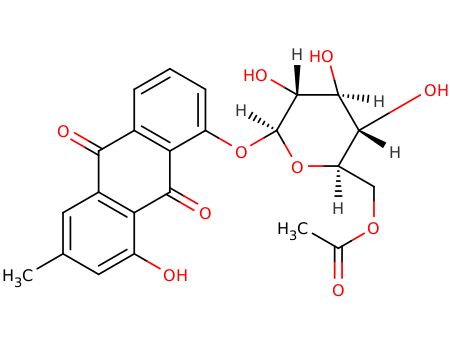 |
| Plant Source | Rumex nepalensis Common Name: |
| Source Family | Polygonaceae |
| Origin | |
| Plant Part Used | |
| Extract | |
| Target Bacteria | Mycobacterium tuberculosis |
| Assay / Test Done | |
| Positive Control Used (conc.) | |
| Inhibition [%] | |
| Activity [MIC] µg/ml | 1.8 µg/ml |
| Activity (In terms of dilution) | |
| Activity (Zone of inhibition in mm) | |
| Active Compound Identified | EJMC182 |
| PubChem ID | NR |
| Ethnomedicinal Information | |
| PubMed ID [Source Literature] | |
| Extract Preparation | |
| Chemical Classification [Active Compound] | Aromatic, Tricyclic, Anthraquinone, Phenol, O-Acetyl, Sugar |
| Media / Broth Used [Antimicrobial Assay/Test] | |
| Cytotoxicity Assay [AID] | |
| Molecular Weight | 458.121 |
| Molecular Formula | C23H22O10 |
| SMILES | O[C@H]1[C@H](O)[C@@H](COC(=O)C)O[C@@H](Oc2cccc3C(=O)c4c(c(O)cc(C)c4)C(=O)c23)[C@@H]1O |
| XLogP | 0.830 |
| PSA | 159.820 |
| H-bond Donor | 4 |
| H-bond Acceptor | 10 |
| No. of Rotatable Bond Count | 5 |
| No. of Rings | 4 |
| No. of N | 0 |
| No. of O | 10 |
| No. of S | 0 |
| Reference(s) | 1) In silico Comparison of Antimycobacterial Natural Products with Known Antituberculosis Drugs. Marlene Espinoza-Moraga, Nicholas M. Njuguna, Grace Mugumbate, Julio Caballero, and Kelly Chibale. Journal of Chemical Information and Modeling 2013 53 (3), 649-660
2) García, A., Bocanegra-García, V., Palma-Nicolás, J. P., Rivera, G. Vennerstrom, J. L. Recent Advances in Antitubercular Natural Products. Eur. J. Med. Chem. 2012, 49, 1-23
|
| Curator | |
| Compound ID | 4084 |
| Compound Structure | |
| Plant Source | Rumex hastatus Common Name: |
| Source Family | Polygonaceae |
| Origin | |
| Plant Part Used | |
| Extract | |
| Target Bacteria | Mycobacterium tuberculosis |
| Assay / Test Done | |
| Positive Control Used (conc.) | |
| Inhibition [%] | |
| Activity [MIC] µg/ml | 1.8 µg/ml |
| Activity (In terms of dilution) | |
| Activity (Zone of inhibition in mm) | |
| Active Compound Identified | EJMC182 |
| PubChem ID | NR |
| Ethnomedicinal Information | |
| PubMed ID [Source Literature] | |
| Extract Preparation | |
| Chemical Classification [Active Compound] | Aromatic, Tricyclic, Anthraquinone, Phenol, O-Acetyl, Sugar |
| Media / Broth Used [Antimicrobial Assay/Test] | |
| Cytotoxicity Assay [AID] | |
| Molecular Weight | 458.121 |
| Molecular Formula | C23H22O10 |
| SMILES | O[C@H]1[C@H](O)[C@@H](COC(=O)C)O[C@@H](Oc2cccc3C(=O)c4c(c(O)cc(C)c4)C(=O)c23)[C@@H]1O |
| XLogP | 0.830 |
| PSA | 159.820 |
| H-bond Donor | 4 |
| H-bond Acceptor | 10 |
| No. of Rotatable Bond Count | 5 |
| No. of Rings | 4 |
| No. of N | 0 |
| No. of O | 10 |
| No. of S | 0 |
| Reference(s) | 1) In silico Comparison of Antimycobacterial Natural Products with Known Antituberculosis Drugs. Marlene Espinoza-Moraga, Nicholas M. Njuguna, Grace Mugumbate, Julio Caballero, and Kelly Chibale. Journal of Chemical Information and Modeling 2013 53 (3), 649-660
2) García, A., Bocanegra-García, V., Palma-Nicolás, J. P., Rivera, G. Vennerstrom, J. L. Recent Advances in Antitubercular Natural Products. Eur. J. Med. Chem. 2012, 49, 1-23
|
| Curator | |
