| Compound ID | 1005 |
| Compound Structure |  |
| Plant Source | Abrus precatorius L. Common Name:Indian wild liquorice, Jequirity, Crab's Eye (English), Gunja, Gunjaka (Sanskrit) |
| Source Family | Fabaceae |
| Origin | India, Puerto Rico, Nigeria |
| Plant Part Used | Aerial |
| Extract | |
| Target Bacteria | Mycobacterium tuberculosis H37Ra |
| Assay / Test Done | |
| Positive Control Used (conc.) | |
| Inhibition [%] | |
| Activity [MIC] µg/ml | 12.5 µg/ml |
| Activity (In terms of dilution) | |
| Activity (Zone of inhibition in mm) | |
| Active Compound Identified | Abruquinone B |
| PubChem ID | 44257521 |
| Ethnomedicinal Information | Tuberculous glands, asthma, pain in chest, cough, bronchitis, folklore medicine of Puerto Rico |
| PubMed ID [Source Literature] | 15114511 |
| Extract Preparation | N/A |
| Chemical Classification [Active Compound] | Aromatic, Tricyclic, Benzopyran, Quinone, Ether |
| Media / Broth Used [Antimicrobial Assay/Test] | N/A |
| Cytotoxicity Assay [AID] | N/A |
| Molecular Weight | 390.131 |
| Molecular Formula | C20H22O8 |
| SMILES | O1CC(Cc2c1c(OC)c(OC)c(OC)c2)C1=CC(=O)C(=C(OC)C1=O)OC |
| XLogP | 0.780 |
| PSA | 89.520 |
| H-bond Donor | 0 |
| H-bond Acceptor | 8 |
| No. of Rotatable Bond Count | 6 |
| No. of Rings | 3 |
| No. of N | 0 |
| No. of O | 8 |
| No. of S | 0 |
| Reference(s) | 1) Limmatvapirat C, Sirisopanaporn S, Kittakoop P.Antitubercular and antiplasmodial constituents of Abrus precatorius.Planta Med. 2004 Mar;70(3):276-8
2) Indian Medicinal Plants: An Illustrated Dictionary By C.P. Khare
|
| Curator | |
| Compound ID | 1243 |
| Compound Structure | 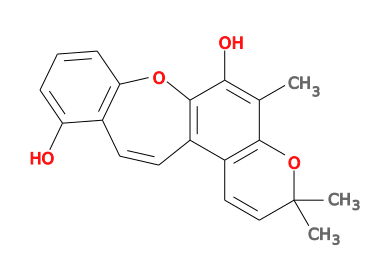 |
| Plant Source | Bauhinia saccocalyx Common Name: |
| Source Family | Fabaceae |
| Origin | Thailand |
| Plant Part Used | |
| Extract | |
| Target Bacteria | Mycobacterium tuberculosis H37Rv |
| Assay / Test Done | |
| Positive Control Used (conc.) | |
| Inhibition [%] | |
| Activity [MIC] µg/ml | 6.25 µg/ml |
| Activity (In terms of dilution) | |
| Activity (Zone of inhibition in mm) | |
| Active Compound Identified | Bauhinoxepins A |
| PubChem ID | 11723631 |
| Ethnomedicinal Information | Tuberculosis |
| PubMed ID [Source Literature] | |
| Extract Preparation | N/A |
| Chemical Classification [Active Compound] | Aromatic, Tetracyclic, Oxapin, Benzopyran, Phenol |
| Media / Broth Used [Antimicrobial Assay/Test] | N/A |
| Cytotoxicity Assay [AID] | Against Vero, human epidermoid carcinoma in the mouth (KB) and human breast cancer cells (BC) |
| Molecular Weight | 322.121 |
| Molecular Formula | C20H18O4
|
| SMILES | O1C(C=Cc2c1c(c(O)c1Oc3c(C=Cc21)c(O)ccc3)C)(C)C |
| XLogP | 3.407 |
| PSA | 58.920 |
| H-bond Donor | 2 |
| H-bond Acceptor | 4 |
| No. of Rotatable Bond Count | 0 |
| No. of Rings | 4 |
| No. of N | 0 |
| No. of O | 4 |
| No. of S | 0 |
| Reference(s) | 1) Prasat Kittakoop, Sombat Nopichai, Nuntawan Thongon, Panarat Charoenchai, Yodhathai Thebtaranonth.Bauhinoxepins A and B: New Antimycobacterial Dibenzo[b,f]oxepins from Bauhinia saccocalyx.Helvetica Chimica Acta, Volume 87, Issue 1, pages 175–179, January 2004
|
| Curator | |
| Compound ID | 1474 |
| Compound Structure | 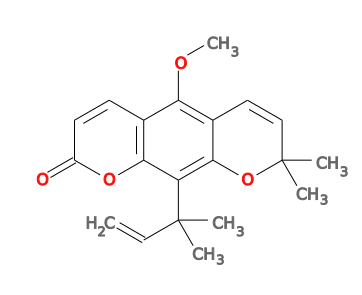 |
| Plant Source | Clausena excavata Burm. f. Common Name:Clausena (English) |
| Source Family | Rutaceae |
| Origin | India |
| Plant Part Used | Rhizome |
| Extract | Chloroform |
| Target Bacteria | Mycobacterium tuberculosis |
| Assay / Test Done | Microplate Alamar Blue Assay (MABA) |
| Positive Control Used (conc.) | Isoniazid (0.040 – 0.090 µg/ml), Kanamycin sulphate (2 – 5 µg/ml) |
| Inhibition [%] | |
| Activity [MIC] µg/ml | 50 µg/ml |
| Activity (In terms of dilution) | |
| Activity (Zone of inhibition in mm) | |
| Active Compound Identified | Dentatin |
| PubChem ID | 342801 |
| Ethnomedicinal Information | Fever, indigestion, malaria, colic, muscular pain, diuretic and as tonic; the allied species C. wampi Blanco for bronchitis, in Thai folk medicine for cold |
| PubMed ID [Source Literature] | 12624822 |
| Extract Preparation | N/A |
| Chemical Classification [Active Compound] | Aromatic, Tricyclic, Coumarin, Benzopyran, Alkene, Ether |
| Media / Broth Used [Antimicrobial Assay/Test] | N/A |
| Cytotoxicity Assay [AID] | Against KB and BC - 1 cell lines |
| Molecular Weight | 326.152 |
| Molecular Formula | C20H22O4
|
| SMILES | O1c2c(C(C)(C)C=C)c3oc(=O)ccc3c(OC)c2C=CC1(C)C |
| XLogP | 4.812 |
| PSA | 35.530 |
| H-bond Donor | 0 |
| H-bond Acceptor | 3 |
| No. of Rotatable Bond Count | 3 |
| No. of Rings | 3 |
| No. of N | 0 |
| No. of O | 4 |
| No. of S | 0 |
| Reference(s) | 1) Sunthitikawinsakul A, Kongkathip N, Kongkathip B, Phonnakhu S, Daly JW, Spande TF, Nimit Y, Rochanaruangrai S.Coumarins and carbazoles from Clausena excavata exhibited antimycobacterial and antifungal activities.Planta Med. 2003 Feb;69(2):155-7
2) Kirtikar, K.R., Basu, B.D., 1935. Indian Medicinal Plants, vols. 1–4. Lalit Mohan Basu, Allahabad, India
|
| Curator | |
| Compound ID | 1475 |
| Compound Structure |  |
| Plant Source | Clausena excavata Burm. f. Common Name:Clausena (English) |
| Source Family | Rutaceae |
| Origin | India |
| Plant Part Used | Rhizome |
| Extract | Chloroform |
| Target Bacteria | Mycobacterium tuberculosis |
| Assay / Test Done | Microplate Alamar Blue Assay (MABA) |
| Positive Control Used (conc.) | Isoniazid (0.040 – 0.090 µg/ml), Kanamycin sulphate (2 – 5 µg/ml) |
| Inhibition [%] | |
| Activity [MIC] µg/ml | 100 µg/ml |
| Activity (In terms of dilution) | |
| Activity (Zone of inhibition in mm) | |
| Active Compound Identified | Nor - Dentatin |
| PubChem ID | 5495613 |
| Ethnomedicinal Information | Fever, indigestion, malaria, colic, muscular pain, diuretic and as tonic; the allied species C. wampi Blanco for bronchitis, in Thai folk medicine for cold |
| PubMed ID [Source Literature] | 12624822 |
| Extract Preparation | N/A |
| Chemical Classification [Active Compound] | Aromatic, Tricyclic, Coumarin, Benzopyran, Alkene, Phenol |
| Media / Broth Used [Antimicrobial Assay/Test] | N/A |
| Cytotoxicity Assay [AID] | Against KB and BC - 1 cell lines |
| Molecular Weight | 312.136 |
| Molecular Formula | C19H20O4
|
| SMILES | O1c2c(C(C)(C)C=C)c3oc(=O)ccc3c(O)c2C=CC1(C)C |
| XLogP | 4.293 |
| PSA | 46.530 |
| H-bond Donor | 1 |
| H-bond Acceptor | 3 |
| No. of Rotatable Bond Count | 2 |
| No. of Rings | 3 |
| No. of N | 0 |
| No. of O | 4 |
| No. of S | 0 |
| Reference(s) | 1) Sunthitikawinsakul A, Kongkathip N, Kongkathip B, Phonnakhu S, Daly JW, Spande TF, Nimit Y, Rochanaruangrai S.Coumarins and carbazoles from Clausena excavata exhibited antimycobacterial and antifungal activities.Planta Med. 2003 Feb;69(2):155-7
2) Kirtikar, K.R., Basu, B.D., 1935. Indian Medicinal Plants, vols. 1–4. Lalit Mohan Basu, Allahabad, India
|
| Curator | |
| Compound ID | 1656 |
| Compound Structure |  |
| Plant Source | Erythrina variegata L. var. orientalis (L.) Merr.syn. Erythrina indica Lam. Common Name:Indian Coral Tree (English), Paaribhadra, Paaribhadraka, Paarijaataka, Mandaara (Sanskrit) |
| Source Family | Papilionaceae |
| Origin | India |
| Plant Part Used | Root bark |
| Extract | Phenol |
| Target Bacteria | Mycobacterium smegmatis (ATCC 607) |
| Assay / Test Done | Agar Dilution - Streak Assay |
| Positive Control Used (conc.) | Streptomycin (1.7 µg/ml) |
| Inhibition [%] | |
| Activity [MIC] µg/ml | > 450 µg/ml |
| Activity (In terms of dilution) | |
| Activity (Zone of inhibition in mm) | |
| Active Compound Identified | 5,4'-Di-O-Methylalpinumisoflavone |
| PubChem ID | 10384155 |
| Ethnomedicinal Information | Cough, microbial infections |
| PubMed ID [Source Literature] | 10820816 |
| Extract Preparation | N/A |
| Chemical Classification [Active Compound] | Aromatic, Tetracyclic, Flavonoid, Benzopyran, Ether |
| Media / Broth Used [Antimicrobial Assay/Test] | N/A |
| Cytotoxicity Assay [AID] | N/A |
| Molecular Weight | 364.131 |
| Molecular Formula | C22H20O5
|
| SMILES | O1C(C=Cc2c1cc1occ(c(=O)c1c2OC)c1ccc(OC)cc1)(C)C |
| XLogP | 3.663 |
| PSA | 44.760 |
| H-bond Donor | 0 |
| H-bond Acceptor | 4 |
| No. of Rotatable Bond Count | 3 |
| No. of Rings | 4 |
| No. of N | 0 |
| No. of O | 5 |
| No. of S | 0 |
| Reference(s) | 1) Waffo AK, Azebaze GA, Nkengfack AE, Fomum ZT, Meyer M, Bodo B, van Heerden FR.Indicanines B and C, two isoflavonoid derivatives from the root bark of Erythrina indica.Phytochemistry. 2000 Apr;53(8):981-5
|
| Curator | |
| Compound ID | 1743 |
| Compound Structure |  |
| Plant Source | Ficus nervosa Synonym : Ficus angustifolia Roxb Common Name:Wild Banyan Tree (English) |
| Source Family | Moraceae |
| Origin | India |
| Plant Part Used | Root |
| Extract | Methanol |
| Target Bacteria | Mycobacterium tuberculosis H37Rv |
| Assay / Test Done | Middlebrook 7 H10 agar method |
| Positive Control Used (conc.) | Ethambutol (6.25 µg/ml) |
| Inhibition [%] | |
| Activity [MIC] µg/ml | 16 µg/ml |
| Activity (In terms of dilution) | |
| Activity (Zone of inhibition in mm) | |
| Active Compound Identified | 3 - Hydroxyxanthyletin |
| PubChem ID | 46927870 |
| Ethnomedicinal Information | Used in treatment of cough and asthma |
| PubMed ID [Source Literature] | 20658670 |
| Extract Preparation | N/A |
| Chemical Classification [Active Compound] | Aromatic, Tricyclic, Coumarin, Benzopyran, Phenol |
| Media / Broth Used [Antimicrobial Assay/Test] | N/A |
| Cytotoxicity Assay [AID] | N/A |
| Molecular Weight | 244.074 |
| Molecular Formula | C14H12O4
|
| SMILES | O1C(C=Cc2c1cc1oc(=O)c(O)cc1c2)(C)C |
| XLogP | 3.940 |
| PSA | 46.530 |
| H-bond Donor | 1 |
| H-bond Acceptor | 3 |
| No. of Rotatable Bond Count | 0 |
| No. of Rings | 3 |
| No. of N | 0 |
| No. of O | 4 |
| No. of S | 0 |
| Reference(s) | 1) Chen LW, Cheng MJ, Peng CF, Chen IS. Secondary Metabolites and Antimycobacterial Activities from the Roots of Ficus nervosa, Chemistry & Biodiversity Volume 7, Issue 7, pages 1814–1821, July 2010
|
| Curator | |
| Compound ID | 1744 |
| Compound Structure |  |
| Plant Source | Ficus nervosa Synonym : Ficus angustifolia Roxb Common Name:Wild Banyan Tree (English) |
| Source Family | Moraceae |
| Origin | India |
| Plant Part Used | Root |
| Extract | Methanol |
| Target Bacteria | Mycobacterium tuberculosis H37Rv |
| Assay / Test Done | Middlebrook 7 H10 agar method |
| Positive Control Used (conc.) | Ethambutol (6.25 µg/ml) |
| Inhibition [%] | |
| Activity [MIC] µg/ml | 220 µg/ml |
| Activity (In terms of dilution) | |
| Activity (Zone of inhibition in mm) | |
| Active Compound Identified | Xanthyletin |
| PubChem ID | 65188 |
| Ethnomedicinal Information | Used in treatment of cough and asthma |
| PubMed ID [Source Literature] | 20658670 |
| Extract Preparation | N/A |
| Chemical Classification [Active Compound] | Aromatic, Tricyclic, Coumarin, Benzopyran |
| Media / Broth Used [Antimicrobial Assay/Test] | N/A |
| Cytotoxicity Assay [AID] | N/A |
| Molecular Weight | 228.079 |
| Molecular Formula | C14H12O3
|
| SMILES | O1C(C=Cc2c1cc1oc(=O)ccc1c2)(C)C |
| XLogP | 3.456 |
| PSA | 26.300 |
| H-bond Donor | 0 |
| H-bond Acceptor | 2 |
| No. of Rotatable Bond Count | 0 |
| No. of Rings | 3 |
| No. of N | 0 |
| No. of O | 3 |
| No. of S | 0 |
| Reference(s) | 1) Chen LW, Cheng MJ, Peng CF, Chen IS. Secondary Metabolites and Antimycobacterial Activities from the Roots of Ficus nervosa, Chemistry & Biodiversity Volume 7, Issue 7, pages 1814–1821, July 2010
|
| Curator | |
| Compound ID | 1747 |
| Compound Structure |  |
| Plant Source | Ficus nervosa Synonym : Ficus angustifolia Roxb Common Name:Wild Banyan Tree (English) |
| Source Family | Moraceae |
| Origin | India |
| Plant Part Used | Root |
| Extract | Methanol |
| Target Bacteria | Mycobacterium tuberculosis H37Rv |
| Assay / Test Done | Middlebrook 7 H10 agar method |
| Positive Control Used (conc.) | Ethambutol (6.25 µg/ml) |
| Inhibition [%] | |
| Activity [MIC] µg/ml | 110 µg/ml |
| Activity (In terms of dilution) | |
| Activity (Zone of inhibition in mm) | |
| Active Compound Identified | Carpachromene |
| PubChem ID | 10449654 |
| Ethnomedicinal Information | Used in treatment of cough and asthma |
| PubMed ID [Source Literature] | 20658670 |
| Extract Preparation | N/A |
| Chemical Classification [Active Compound] | Aromatic, Tetracyclic, Flavonoid, Benzopyran, Phenol |
| Media / Broth Used [Antimicrobial Assay/Test] | N/A |
| Cytotoxicity Assay [AID] | N/A |
| Molecular Weight | 336.100 |
| Molecular Formula | C20H16O5
|
| SMILES | O1C(C=Cc2c1cc1oc(cc(=O)c1c2O)c1ccc(O)cc1)(C)C |
| XLogP | 2.526 |
| PSA | 66.760 |
| H-bond Donor | 2 |
| H-bond Acceptor | 4 |
| No. of Rotatable Bond Count | 1 |
| No. of Rings | 4 |
| No. of N | 0 |
| No. of O | 5 |
| No. of S | 0 |
| Reference(s) | 1) Chen LW, Cheng MJ, Peng CF, Chen IS. Secondary Metabolites and Antimycobacterial Activities from the Roots of Ficus nervosa, Chemistry & Biodiversity Volume 7, Issue 7, pages 1814–1821, July 2010
|
| Curator | |
| Compound ID | 1815 |
| Compound Structure | 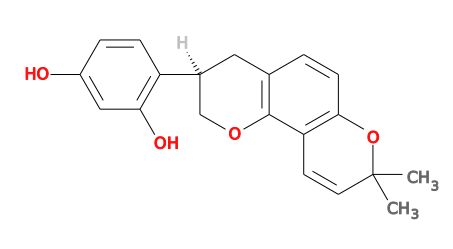 |
| Plant Source | Glycyrrhiza glabra L. Common Name:Licorice, Liquorice (English), Yashtimadhu (Sanskrit) |
| Source Family | Fabaceae |
| Origin | India, Africa |
| Plant Part Used | Root |
| Extract | |
| Target Bacteria | Mycobacterium tuberculosis H37Ra |
| Assay / Test Done | BACTEC Assay |
| Positive Control Used (conc.) | Rifampin (0.23 ± 0.06 µg/ml), Isoniazid (0.116 ± 0.03 µg/ml), Streptomycin (2.7 ± 0.36 µg/ml), Ethambutol (0.116 ± 0.03 µg/ml) |
| Inhibition [%] | |
| Activity [MIC] µg/ml | 29.16 ± 3.61 µg/ml |
| Activity (In terms of dilution) | |
| Activity (Zone of inhibition in mm) | |
| Active Compound Identified | Glabridin |
| PubChem ID | 124052 |
| Ethnomedicinal Information | Expectorant, consumption, bronchitis, chest complaint, cough |
| PubMed ID [Source Literature] | 18182260 |
| Extract Preparation | N/A |
| Chemical Classification [Active Compound] | Aromatic, Tetracyclic, Benzopyran, Phenol |
| Media / Broth Used [Antimicrobial Assay/Test] | N/A |
| Cytotoxicity Assay [AID] | N/A |
| Molecular Weight | 324.136 |
| Molecular Formula | C20H20O4
|
| SMILES | O1C[C@H](Cc2c1c1c(OC(C=C1)(C)C)cc2)c1c(O)cc(O)cc1 |
| XLogP | 3.207 |
| PSA | 58.920 |
| H-bond Donor | 2 |
| H-bond Acceptor | 4 |
| No. of Rotatable Bond Count | 1 |
| No. of Rings | 4 |
| No. of N | 0 |
| No. of O | 4 |
| No. of S | 0 |
| Reference(s) | 1) Gupta VK, Fatima A, Faridi U, Negi AS, Shanker K, Kumar JK, Rahuja N, Luqman S, Sisodia BS, Saikia D, Darokar MP, Khanuja SP.Antimicrobial potential of Glycyrrhiza glabra roots.J Ethnopharmacol. 2008 Mar 5;116(2):377-80
|
| Curator | |
| Compound ID | 1818 |
| Compound Structure | 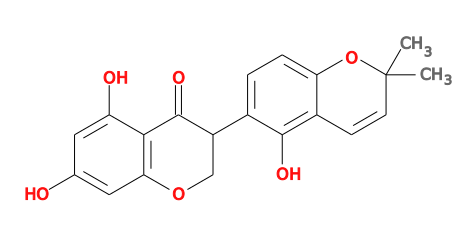 |
| Plant Source | Glycyrrhiza glabra L. Common Name:Licorice, Liquorice (English), Yashtimadhu (Sanskrit) |
| Source Family | Fabaceae |
| Origin | India, Africa |
| Plant Part Used | Root |
| Extract | |
| Target Bacteria | Mycobacterium tuberculosis |
| Assay / Test Done | |
| Positive Control Used (conc.) | |
| Inhibition [%] | |
| Activity [MIC] µg/ml | 25 µg/ml |
| Activity (In terms of dilution) | |
| Activity (Zone of inhibition in mm) | |
| Active Compound Identified | Lico - Isoflavone |
| PubChem ID | 392443 |
| Ethnomedicinal Information | Expectorant, consumption, bronchitis, chest complaint, cough |
| PubMed ID [Source Literature] | 17276637 |
| Extract Preparation | N/A |
| Chemical Classification [Active Compound] | Aromatic, Tetracyclic, Flavonoid, Benzopyran, Phenol |
| Media / Broth Used [Antimicrobial Assay/Test] | N/A |
| Cytotoxicity Assay [AID] | N/A |
| Molecular Weight | 354.110 |
| Molecular Formula | C20H18O6
|
| SMILES | O1C(C=Cc2c(O)c(C3COc4c(C3=O)c(O)cc(O)c4)ccc12)(C)C |
| XLogP | 1.167 |
| PSA | 96.220 |
| H-bond Donor | 3 |
| H-bond Acceptor | 6 |
| No. of Rotatable Bond Count | 1 |
| No. of Rings | 4 |
| No. of N | 0 |
| No. of O | 6 |
| No. of S | 0 |
| Reference(s) | 1) Gautam R, Saklani A, Jachak SM.Indian medicinal plants as a source of antimycobacterial agents.J Ethnopharmacol. 2007 Mar 21;110(2):200-34
|
| Curator | |
| Compound ID | 1819 |
| Compound Structure | |
| Plant Source | Glycyrrhiza glabra L. Common Name:Licorice, Liquorice (English), Yashtimadhu (Sanskrit) |
| Source Family | Fabaceae |
| Origin | India, Africa |
| Plant Part Used | Root |
| Extract | |
| Target Bacteria | Mycobacterium smegmatis |
| Assay / Test Done | |
| Positive Control Used (conc.) | |
| Inhibition [%] | |
| Activity [MIC] µg/ml | 50 µg/ml |
| Activity (In terms of dilution) | |
| Activity (Zone of inhibition in mm) | |
| Active Compound Identified | Lico - Isoflavone |
| PubChem ID | 392443 |
| Ethnomedicinal Information | Expectorant, consumption, bronchitis, chest complaint, cough |
| PubMed ID [Source Literature] | 17276637 |
| Extract Preparation | N/A |
| Chemical Classification [Active Compound] | Aromatic, Tetracyclic, Flavonoid, Benzopyran, Phenol |
| Media / Broth Used [Antimicrobial Assay/Test] | N/A |
| Cytotoxicity Assay [AID] | N/A |
| Molecular Weight | 354.110 |
| Molecular Formula | C20H18O6
|
| SMILES | O1C(C=Cc2c(O)c(C3COc4c(C3=O)c(O)cc(O)c4)ccc12)(C)C |
| XLogP | 1.167 |
| PSA | 96.220 |
| H-bond Donor | 3 |
| H-bond Acceptor | 6 |
| No. of Rotatable Bond Count | 1 |
| No. of Rings | 4 |
| No. of N | 0 |
| No. of O | 6 |
| No. of S | 0 |
| Reference(s) | 1) Gautam R, Saklani A, Jachak SM.Indian medicinal plants as a source of antimycobacterial agents.J Ethnopharmacol. 2007 Mar 21;110(2):200-34
|
| Curator | |
| Compound ID | 1974 |
| Compound Structure |  |
| Plant Source | Karwinskia humboldtiana Common Name:Wild Cherry |
| Source Family | Rhamnaceae |
| Origin | USA |
| Plant Part Used | Root |
| Extract | Dichloromethane, ethanol (95 %) |
| Target Bacteria | Mycobacterium smegmatis (ATCC 607) |
| Assay / Test Done | |
| Positive Control Used (conc.) | |
| Inhibition [%] | |
| Activity [MIC] µg/ml | 50 µg/ml |
| Activity (In terms of dilution) | |
| Activity (Zone of inhibition in mm) | |
| Active Compound Identified | Karwinaphthol B |
| PubChem ID | 442522 |
| Ethnomedicinal Information | Seeds are poisonous but fruit pulp is edible. Used locally in Mexico to treat convulsions |
| PubMed ID [Source Literature] | |
| Extract Preparation | N/A |
| Chemical Classification [Active Compound] | Aromatic, Tricyclic, Isochroman, Benzopyran, Ether, Phenol |
| Media / Broth Used [Antimicrobial Assay/Test] | N/A |
| Cytotoxicity Assay [AID] | N/A |
| Molecular Weight | 288.136 |
| Molecular Formula | C17H20O4
|
| SMILES | O1[C@@H](c2c(C[C@@H]1C)cc1c(c2O)c(OC)cc(OC)c1)C |
| XLogP | 2.444 |
| PSA | 47.920 |
| H-bond Donor | 1 |
| H-bond Acceptor | 4 |
| No. of Rotatable Bond Count | 2 |
| No. of Rings | 3 |
| No. of N | 0 |
| No. of O | 4 |
| No. of S | 0 |
| Reference(s) | 1) Mitscher LA, Gollapudi SR, Oburn DS, Drake S. 1985. Antimicrobial agents from higher plants: Two dimethylbenzisochromans from Karawinskia humboldtiana. Phytochemistry 24: 1681±1683.
2) Usher G. 1974. A Dictionary of Plants Used by Man. Macmillan: New York; 82
|
| Curator | |
| Compound ID | 2385 |
| Compound Structure |  |
| Plant Source | Piper sarmentosum Roxb. Common Name:Cha Plu |
| Source Family | Piperaceae |
| Origin | Probably Southeast Asia, Malaysia |
| Plant Part Used | Fresh root |
| Extract | Ethanol |
| Target Bacteria | Mycobacterium tuberculosis H37Ra |
| Assay / Test Done | Microplate Alamar Blue Assay (MABA) |
| Positive Control Used (conc.) | Isoniazid (0.04 - 0.09 µg/ml) and Kanamycin sulphate (2.0 - 5.0 µg/ml) |
| Inhibition [%] | |
| Activity [MIC] µg/ml | 25 µg/ml |
| Activity (In terms of dilution) | |
| Activity (Zone of inhibition in mm) | |
| Active Compound Identified | |
| PubChem ID | 17758236 |
| Ethnomedicinal Information | Cough, anti - tuberculosis and anti - plasmodial activities |
| PubMed ID [Source Literature] | 16462055 |
| Extract Preparation | N/A |
| Chemical Classification [Active Compound] | Aromatic, Pentacyclic, Alkaloid, Thiophene, Benzopyran, Ether, Phenol |
| Media / Broth Used [Antimicrobial Assay/Test] | N/A |
| Cytotoxicity Assay [AID] | N/A |
| Molecular Weight | 485.202 |
| Molecular Formula | C30H31NO3S
|
| SMILES | S1c(/C=C/2Oc3c(c4c2c2c(NC(C=C2C)(C)C)cc4)c(OC)c(O)cc3)c(/C(=C/CC)/C)cc1 |
| XLogP | 7.049 |
| PSA | 78.960 |
| H-bond Donor | 2 |
| H-bond Acceptor | 5 |
| No. of Rotatable Bond Count | 4 |
| No. of Rings | 5 |
| No. of N | 1 |
| No. of O | 3 |
| No. of S | 1 |
| Reference(s) | 1) Tuntiwachwuttikul P, Phansa P, Pootaeng-On Y, Taylor WC.Chemical constituents of the roots of Piper sarmentosum.Chem Pharm Bull (Tokyo). 2006 Feb;54(2):149-51
|
| Curator | |
| Compound ID | 1799 |
| Compound Structure | 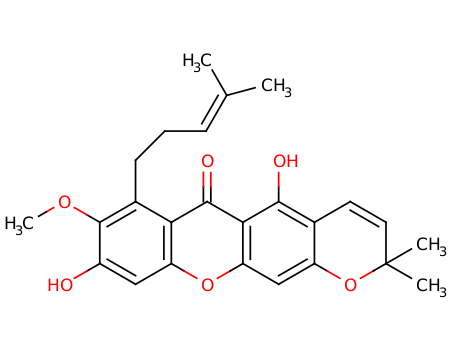 |
| Plant Source | Garcinia mangostana Common Name:Mangosteen |
| Source Family | Clusiaceae |
| Origin | Thailand, Malaysia |
| Plant Part Used | Arils and seed |
| Extract | Methanol |
| Target Bacteria | Mycobacterium tuberculosis H37Ra |
| Assay / Test Done | Microplate Alamar Blue Assay (MABA) |
| Positive Control Used (conc.) | Rifampicin (0.003 - 0.0047 µg/ml), Isoniazid (0.025 - 0.05 µg/ml), Kanamycin sulfate (1.25 - 2.5 µg/ml) |
| Inhibition [%] | |
| Activity [MIC] µg/ml | 12.5 µg/ml |
| Activity (In terms of dilution) | |
| Activity (Zone of inhibition in mm) | |
| Active Compound Identified | 9 - Hydroxycalabaxanthone |
| PubChem ID | NR |
| Ethnomedicinal Information | Treatment of diarrhea and dysentery and for skin diseases, to lower fever and for urinary disorders |
| PubMed ID [Source Literature] | 12843596 |
| Extract Preparation | N/A |
| Chemical Classification [Active Compound] | Aromatic, Tetracyclic, Xanthanoid, Benzopyran, Prenylated, Ether, Phenol |
| Media / Broth Used [Antimicrobial Assay/Test] | N/A |
| Cytotoxicity Assay [AID] | N/A |
| Molecular Weight | 422.173 |
| Molecular Formula | C25H26O6 |
| SMILES | C1(c(c(cc2c1c(=O)c1c(o2)cc2c(c1O)C=CC(O2)(C)C)O)OC)CCC=C(C)C |
| XLogP | 3.609 |
| PSA | 85.220 |
| H-bond Donor | 2 |
| H-bond Acceptor | 1 |
| No. of Rotatable Bond Count | 4 |
| No. of Rings | 4 |
| No. of N | 0 |
| No. of O | 6 |
| No. of S | 0 |
| Reference(s) | 1) Suksamrarn S, Suwannapoch N, Phakhodee W, Thanuhiranlert J, Ratananukul P, Chimnoi N, Suksamrarn A.Antimycobacterial activity of prenylated xanthones from the fruits of Garcinia mangostana.Chem Pharm Bull (Tokyo). 2003 Jul;51(7):857-9
2) http://www.montosogardens.com/garcinia_mangostana.htm
|
| Curator | |
| Compound ID | 3108 |
| Compound Structure |  |
| Plant Source | Calophyllum lanigerum var. austrocoriaceum Common Name:NR |
| Source Family | Clusiaceae |
| Origin | Malaysian rain forest |
| Plant Part Used | NR |
| Extract | NR |
| Target Bacteria | Mycobacterium tuberculosis H37Rv |
| Assay / Test Done | NR |
| Positive Control Used (conc.) | NR |
| Inhibition [%] | NR |
| Activity [MIC] µg/ml | 8 - 16 µg/ml |
| Activity (In terms of dilution) | NR |
| Activity (Zone of inhibition in mm) | NR |
| Active Compound Identified | (+)- Calanolide A |
| PubChem ID | 64972 |
| Ethnomedicinal Information | NR |
| PubMed ID [Source Literature] | 16138106 |
| Extract Preparation | NR |
| Chemical Classification [Active Compound] | Aromatic, Tetracyclic, Coumarin, Benzopyran, Alcohol |
| Media / Broth Used [Antimicrobial Assay/Test] | NR |
| Cytotoxicity Assay [AID] | NR |
| Molecular Weight | 370.178 |
| Molecular Formula | C22H26O5 |
| SMILES | O1[C@@H]([C@H]([C@H](O)c2c1c1c(OC(C=C1)(C)C)c1c2oc(=O)cc1CCC)C)C |
| XLogP | 4.029 |
| PSA | 55.760 |
| H-bond Donor | 1 |
| H-bond Acceptor | 4 |
| No. of Rotatable Bond Count | 2 |
| No. of Rings | 4 |
| No. of N | 0 |
| No. of O | 5 |
| No. of S | 0 |
| Reference(s) | 1) Pink R, Hudson A, Mouriès MA, Bendig M.Opportunities and challenges in antiparasitic drug discovery.Nat Rev Drug Discov. 2005 Sep;4(9):727-40
|
| Curator | Reshmi, gppreetha |
| Compound ID | 3971 |
| Compound Structure | |
| Plant Source | Glycyrrhiza glabra L. Common Name:Licorice, Liquorice (English), Yashtimadhu (Sanskrit) |
| Source Family | Fabaceae |
| Origin | India, Africa |
| Plant Part Used | Root |
| Extract | |
| Target Bacteria | Mycobacterium tuberculosis H37Rv |
| Assay / Test Done | BACTEC Assay |
| Positive Control Used (conc.) | Rifampin (0.23 ± 0.06 µg/ml), Isoniazid (0.116 ± 0.03 µg/ml), Streptomycin (2.7 ± 0.36 µg/ml), Ethambutol (0.116 ± 0.03 µg/ml) |
| Inhibition [%] | |
| Activity [MIC] µg/ml | 29.16 ± 3.61 µg/ml |
| Activity (In terms of dilution) | |
| Activity (Zone of inhibition in mm) | |
| Active Compound Identified | Glabridin |
| PubChem ID | 124052 |
| Ethnomedicinal Information | Expectorant, consumption, bronchitis, chest complaint, cough |
| PubMed ID [Source Literature] | |
| Extract Preparation | |
| Chemical Classification [Active Compound] | Aromatic, Tetracyclic, Benzopyran, Phenol |
| Media / Broth Used [Antimicrobial Assay/Test] | |
| Cytotoxicity Assay [AID] | |
| Molecular Weight | 324.136 |
| Molecular Formula | C20H20O4
|
| SMILES | O1C[C@H](Cc2c1c1c(OC(C=C1)(C)C)cc2)c1c(O)cc(O)cc1 |
| XLogP | 3.207 |
| PSA | 58.920 |
| H-bond Donor | 2 |
| H-bond Acceptor | 4 |
| No. of Rotatable Bond Count | 1 |
| No. of Rings | 4 |
| No. of N | 0 |
| No. of O | 4 |
| No. of S | 0 |
| Reference(s) | 1) Gupta VK, Fatima A, Faridi U, Negi AS, Shanker K, Kumar JK, Rahuja N, Luqman S, Sisodia BS, Saikia D, Darokar MP, Khanuja SP.Antimicrobial potential of Glycyrrhiza glabra roots.J Ethnopharmacol. 2008 Mar 5;116(2):377-80
|
| Curator | |
| Compound ID | 3113 |
| Compound Structure | 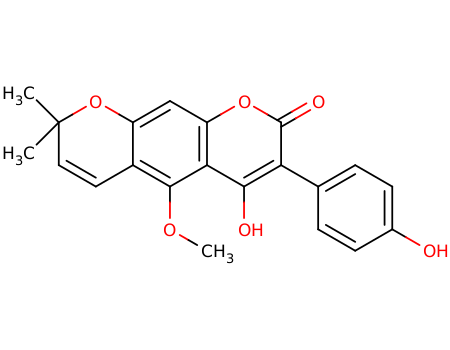 |
| Plant Source | Erythrina indica Common Name:Indian Coral Tree (English), Paaribhadra, Paaribhadraka, Paarijaataka, Mandaara (Sanskrit) |
| Source Family | Leguminosae |
| Origin | Ibadan, Nigeria |
| Plant Part Used | Root bark |
| Extract | Phenol |
| Target Bacteria | Mycobacterium smegmatis (ATCC 607) |
| Assay / Test Done | Agar Dilution - Streak Assay |
| Positive Control Used (conc.) | Streptomycin (1.7 µg/ml) |
| Inhibition [%] | NR |
| Activity [MIC] µg/ml | 18.5 µg/ml |
| Activity (In terms of dilution) | NR |
| Activity (Zone of inhibition in mm) | NR |
| Active Compound Identified | Indicanine B |
| PubChem ID | NR |
| Ethnomedicinal Information | Trachoma, Elephantiasis, Microbial infections |
| PubMed ID [Source Literature] | 10820816 |
| Extract Preparation | Dichloromethane - methanol (1:1) |
| Chemical Classification [Active Compound] | Aromatic, Tetracyclic, Flavonoid, Coumarin, Benzopyran, Ether, Phenol |
| Media / Broth Used [Antimicrobial Assay/Test] | NR |
| Cytotoxicity Assay [AID] | NR |
| Molecular Weight | 366.110 |
| Molecular Formula | C21H18O6 |
| SMILES | O1C(C=Cc2c1cc1c(c2OC)c(c(c(=O)o1)c1ccc(cc1)O)O)(C)C |
| XLogP | 4.028 |
| PSA | 75.990 |
| H-bond Donor | 2 |
| H-bond Acceptor | 5 |
| No. of Rotatable Bond Count | 2 |
| No. of Rings | 4 |
| No. of N | 0 |
| No. of O | 6 |
| No. of S | 0 |
| Reference(s) | 1) Waffo AK, Azebaze GA, Nkengfack A E, Fomum ZT, Meyer M, Bodo B, Heerden FR. Indicanines B and C, two isoflavonoids derivatives from the root bark of Erythrina indica. Phytochemistry. 2003;53:981–985. 2000.
|
| Curator | KeyaMukherjee, vsheeba |
| Compound ID | 3114 |
| Compound Structure |  |
| Plant Source | Erythrina indica Common Name:NR |
| Source Family | Fabaceae |
| Origin | Ibadan, Nigeria |
| Plant Part Used | Root bark |
| Extract | Phenol |
| Target Bacteria | Mycobacterium smegmatis (ATCC 607) |
| Assay / Test Done | Agar Dilution - Streak Assay |
| Positive Control Used (conc.) | Streptomycin (1.7 µg/ml) |
| Inhibition [%] | NR |
| Activity [MIC] µg/ml | > 150 µg/ml |
| Activity (In terms of dilution) | NR |
| Activity (Zone of inhibition in mm) | NR |
| Active Compound Identified | Indicanine C |
| PubChem ID | 10736576 |
| Ethnomedicinal Information | Trachoma, Elephantiasis, Microbial infections |
| PubMed ID [Source Literature] | 10820816 |
| Extract Preparation | Dichloromethane - methanol (1:1) |
| Chemical Classification [Active Compound] | Aromatic, Tetracyclic, Flavonoid, Benzopyran, Ether, Phenol |
| Media / Broth Used [Antimicrobial Assay/Test] | NR |
| Cytotoxicity Assay [AID] | NR |
| Molecular Weight | 350.115 |
| Molecular Formula | C21H18O5 |
| SMILES | O1C(C=Cc2c1cc1occ(c(=O)c1c2OC)c1ccc(O)cc1)(C)C |
| XLogP | 3.144 |
| PSA | 55.760 |
| H-bond Donor | 1 |
| H-bond Acceptor | 4 |
| No. of Rotatable Bond Count | 2 |
| No. of Rings | 4 |
| No. of N | 0 |
| No. of O | 5 |
| No. of S | 0 |
| Reference(s) | 1) Waffo AK, Azebaze GA, Nkengfack A E, Fomum ZT, Meyer M, Bodo B, Heerden FR. Indicanines B and C, two isoflavonoids derivatives from the root bark of Erythrina indica. Phytochemistry. 2003;53:981–985. 2000.
|
| Curator | KeyaMukherjee, vsheeba |
| Compound ID | 3115 |
| Compound Structure | |
| Plant Source | Erythrina indica Common Name:NR |
| Source Family | Fabaceae |
| Origin | Ibadan, Nigeria |
| Plant Part Used | Root bark |
| Extract | NR |
| Target Bacteria | Mycobacterium smegmatis (ATCC 607) |
| Assay / Test Done | Agar Dilution - Streak Assay |
| Positive Control Used (conc.) | Streptomycin (1.7 µg/ml) |
| Inhibition [%] | NR |
| Activity [MIC] µg/ml | > 450 µg/ml |
| Activity (In terms of dilution) | NR |
| Activity (Zone of inhibition in mm) | NR |
| Active Compound Identified | Dimethyl Alpinumisoflavone |
| PubChem ID | 10384155 |
| Ethnomedicinal Information | Trachoma, Elephantiasis, Microbial infections |
| PubMed ID [Source Literature] | 10820816 |
| Extract Preparation | Dichloromethane - methanol (1:1) |
| Chemical Classification [Active Compound] | Aromatic, Tetracyclic, Flavonoid, Benzopyran, Ether |
| Media / Broth Used [Antimicrobial Assay/Test] | NR |
| Cytotoxicity Assay [AID] | NR |
| Molecular Weight | 364.131 |
| Molecular Formula | C22H20O5 |
| SMILES | O1C(C=Cc2c1cc1occ(c(=O)c1c2OC)c1ccc(OC)cc1)(C)C |
| XLogP | 3.663 |
| PSA | 44.760 |
| H-bond Donor | 0 |
| H-bond Acceptor | 4 |
| No. of Rotatable Bond Count | 3 |
| No. of Rings | 4 |
| No. of N | 0 |
| No. of O | 5 |
| No. of S | 0 |
| Reference(s) | 1) Waffo AK, Azebaze GA, Nkengfack A E, Fomum ZT, Meyer M, Bodo B, Heerden FR. Indicanines B and C, two isoflavonoids derivatives from the root bark of Erythrina indica. Phytochemistry. 2003;53:981–985. 2000.
|
| Curator | KeyaMukherjee, vsheeba |
| Compound ID | 3390 |
| Compound Structure |  |
| Plant Source | Erythrina gibbosa Common Name:NR |
| Source Family | Fabaceae |
| Origin | Panamanian |
| Plant Part Used | NR |
| Extract | NR |
| Target Bacteria | Mycobacterium tuberculosis H37Rv |
| Assay / Test Done | Agar Dilution - Streak Assay |
| Positive Control Used (conc.) | NR |
| Inhibition [%] | NR |
| Activity [MIC] µg/ml | >=25 µg/ml |
| Activity (In terms of dilution) | NR |
| Activity (Zone of inhibition in mm) | NR |
| Active Compound Identified | Erygibisoflavone |
| PubChem ID | 392442 |
| Ethnomedicinal Information | NR |
| PubMed ID [Source Literature] | 9828037 |
| Extract Preparation | NR |
| Chemical Classification [Active Compound] | Aromatic, Tetracyclic, Flavonoid, Benzopyran, Phenol |
| Media / Broth Used [Antimicrobial Assay/Test] | |
| Cytotoxicity Assay [AID] | NR |
| Molecular Weight | 354.110 |
| Molecular Formula | C20H18O6 |
| SMILES | O1C(C=Cc2c1c(C1COc3c(C1=O)c(O)cc(O)c3)ccc2O)(C)C |
| XLogP | 1.167 |
| PSA | 96.220 |
| H-bond Donor | 3 |
| H-bond Acceptor | 6 |
| No. of Rotatable Bond Count | 1 |
| No. of Rings | 4 |
| No. of N | 0 |
| No. of O | 6 |
| No. of S | 0 |
| Reference(s) | 1) Mitscher LA, Baker W.Tuberculosis: a search for novel therapy starting with natural products.Med Res Rev. 1998 Nov;18(6):363-74
|
| Curator | Wvarsha, keyamukherjee, rachanake |
| Compound ID | 3391 |
| Compound Structure | 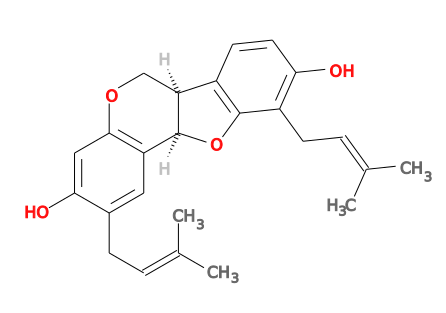 |
| Plant Source | Erythrina gibbosa Common Name:NR |
| Source Family | Fabaceae |
| Origin | Panamanian |
| Plant Part Used | NR |
| Extract | NR |
| Target Bacteria | Mycobacterium tuberculosis H37Rv |
| Assay / Test Done | Agar Dilution - Streak Assay |
| Positive Control Used (conc.) | NR |
| Inhibition [%] | |
| Activity [MIC] µg/ml | 8 - 25 µg/ml |
| Activity (In terms of dilution) | NR |
| Activity (Zone of inhibition in mm) | NR |
| Active Compound Identified | Erythrabyssin 2 |
| PubChem ID | 10408212 |
| Ethnomedicinal Information | NR |
| PubMed ID [Source Literature] | 9828037 |
| Extract Preparation | NR |
| Chemical Classification [Active Compound] | Aromatic, Tetracyclic, Chromene, Benzopyran, Phenol, Prenylated |
| Media / Broth Used [Antimicrobial Assay/Test] | |
| Cytotoxicity Assay [AID] | NR |
| Molecular Weight | 392.199 |
| Molecular Formula | C25H28O4 |
| SMILES | O1[C@@H]2[C@H](c3c1c(c(O)cc3)CC=C(C)C)COc1c2cc(c(O)c1)CC=C(C)C |
| XLogP | 4.735 |
| PSA | 58.920 |
| H-bond Donor | 2 |
| H-bond Acceptor | 4 |
| No. of Rotatable Bond Count | 4 |
| No. of Rings | 4 |
| No. of N | 0 |
| No. of O | 4 |
| No. of S | 0 |
| Reference(s) | 1) Mitscher LA, Baker W.Tuberculosis: a search for novel therapy starting with natural products.Med Res Rev. 1998 Nov;18(6):363-74
|
| Curator | Wvarsha,keyamukherjee, rachanake |
| Compound ID | 3392 |
| Compound Structure | 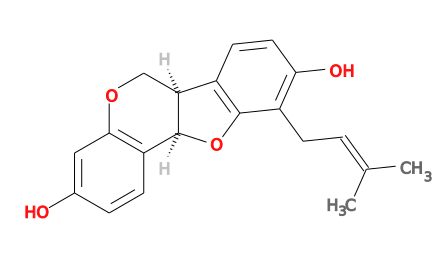 |
| Plant Source | Erythrina gibbosa Common Name:NR |
| Source Family | Fabaceae |
| Origin | Panamanian |
| Plant Part Used | NR |
| Extract | NR |
| Target Bacteria | Mycobacterium tuberculosis H37Rv |
| Assay / Test Done | Agar Dilution - Streak Assay |
| Positive Control Used (conc.) | NR |
| Inhibition [%] | NR |
| Activity [MIC] µg/ml | 8 - 25 µg/ml |
| Activity (In terms of dilution) | NR |
| Activity (Zone of inhibition in mm) | NR |
| Active Compound Identified | Phaseolidine |
| PubChem ID | 119268 |
| Ethnomedicinal Information | NR |
| PubMed ID [Source Literature] | 9828037 |
| Extract Preparation | NR |
| Chemical Classification [Active Compound] | Aromatic, Tetracyclic, Benzopyran, Benzofuranoid, Prenylated |
| Media / Broth Used [Antimicrobial Assay/Test] | |
| Cytotoxicity Assay [AID] | NR |
| Molecular Weight | 324.136 |
| Molecular Formula | C20H20O4 |
| SMILES | O1[C@@H]2[C@H](c3c1c(c(O)cc3)CC=C(C)C)COc1c2ccc(O)c1 |
| XLogP | 3.265 |
| PSA | 58.920 |
| H-bond Donor | 2 |
| H-bond Acceptor | 4 |
| No. of Rotatable Bond Count | 2 |
| No. of Rings | 4 |
| No. of N | 0 |
| No. of O | 4 |
| No. of S | 0 |
| Reference(s) | 1) Mitscher LA, Baker W.Tuberculosis: a search for novel therapy starting with natural products.Med Res Rev. 1998 Nov;18(6):363-74
|
| Curator | Wvarsha, keyamukherjee, rachanake |
| Compound ID | 3393 |
| Compound Structure | |
| Plant Source | Erythrina gibbosa Common Name:NR |
| Source Family | Fabaceae |
| Origin | Panamanian |
| Plant Part Used | NR |
| Extract | NR |
| Target Bacteria | Mycobacterium smegmatis |
| Assay / Test Done | Agar Dilution - Streak Assay |
| Positive Control Used (conc.) | NR |
| Inhibition [%] | NR |
| Activity [MIC] µg/ml | 0.78 µg/ml |
| Activity (In terms of dilution) | NR |
| Activity (Zone of inhibition in mm) | NR |
| Active Compound Identified | Erythrabyssin 2 |
| PubChem ID | 10408212 |
| Ethnomedicinal Information | NR |
| PubMed ID [Source Literature] | 9828037 |
| Extract Preparation | NR |
| Chemical Classification [Active Compound] | Aromatic, Tetracyclic, Chromene, Benzopyran, Phenol, Prenylated |
| Media / Broth Used [Antimicrobial Assay/Test] | |
| Cytotoxicity Assay [AID] | NR |
| Molecular Weight | 392.199 |
| Molecular Formula | C25H28O4 |
| SMILES | O1[C@@H]2[C@H](c3c1c(c(O)cc3)CC=C(C)C)COc1c2cc(c(O)c1)CC=C(C)C |
| XLogP | 4.735 |
| PSA | 58.920 |
| H-bond Donor | 2 |
| H-bond Acceptor | 4 |
| No. of Rotatable Bond Count | 4 |
| No. of Rings | 4 |
| No. of N | 0 |
| No. of O | 4 |
| No. of S | 0 |
| Reference(s) | 1) Mitscher LA, Baker W.Tuberculosis: a search for novel therapy starting with natural products.Med Res Rev. 1998 Nov;18(6):363-74
|
| Curator | Wvarsha, keyamukherjee, rachanake |
| Compound ID | 1798 |
| Compound Structure |  |
| Plant Source | Garcinia mangostana Common Name:Mangosteen |
| Source Family | Clusiaceae |
| Origin | Thailand, Malaysia |
| Plant Part Used | Fruit |
| Extract | Methanol |
| Target Bacteria | Mycobacterium tuberculosis H37Ra |
| Assay / Test Done | Microplate Alamar Blue Assay (MABA) |
| Positive Control Used (conc.) | Rifampicin (0.003 - 0.0047 µg/ml), Isoniazid (0.025 - 0.05 µg/ml), Kanamycin sulfate (1.25 - 2.5 µg/ml) |
| Inhibition [%] | |
| Activity [MIC] µg/ml | 6.25 µg/ml |
| Activity (In terms of dilution) | |
| Activity (Zone of inhibition in mm) | |
| Active Compound Identified | Garcinone B |
| PubChem ID | 5495928 |
| Ethnomedicinal Information | Treatment of diarrhea and dysentery and for skin diseases, to lower fever and for urinary disorders |
| PubMed ID [Source Literature] | 12843596 |
| Extract Preparation | N/A |
| Chemical Classification [Active Compound] | Aromatic, Tetracyclic, Xanthonoid, Benzopyran, Prenylated, Phenol |
| Media / Broth Used [Antimicrobial Assay/Test] | N/A |
| Cytotoxicity Assay [AID] | N/A |
| Molecular Weight | 394.142 |
| Molecular Formula | C23H22O6
|
| SMILES | O1C(C=Cc2c3c(oc4c(c3=O)c(O)c(c(O)c4)CC=C(C)C)cc(O)c12)(C)C |
| XLogP | 2.203 |
| PSA | 86.990 |
| H-bond Donor | 3 |
| H-bond Acceptor | 5 |
| No. of Rotatable Bond Count | 2 |
| No. of Rings | 4 |
| No. of N | 0 |
| No. of O | 6 |
| No. of S | 0 |
| Reference(s) | 1) Suksamrarn S, Suwannapoch N, Phakhodee W, Thanuhiranlert J, Ratananukul P, Chimnoi N, Suksamrarn A.Antimycobacterial activity of prenylated xanthones from the fruits of Garcinia mangostana.Chem Pharm Bull (Tokyo). 2003 Jul;51(7):857-9
2) http://www.montosogardens.com/garcinia_mangostana.htm
|
| Curator | |
| Compound ID | 3577 |
| Compound Structure |  |
| Plant Source | Garcinia mangostana L. Common Name:Mangosteen |
| Source Family | Clusiaceae |
| Origin | Southeast Asia |
| Plant Part Used | Fruit hull |
| Extract | Methanol |
| Target Bacteria | Mycobacterium tuberculosis H37Ra |
| Assay / Test Done | Microplate Alamar Blue Assay (MABA) |
| Positive Control Used (conc.) | Rifampin (0.003 - 0.0047 µg/ml), Isoniazid (0.025 - 0.05 µg/ml), Kanamycin sulphate (1.25 - 2.5 µg/ml) |
| Inhibition [%] | |
| Activity [MIC] µg/ml | 12.5 µg/ml |
| Activity (In terms of dilution) | |
| Activity (Zone of inhibition in mm) | |
| Active Compound Identified | Trapezifolixanthone |
| PubChem ID | 188341 |
| Ethnomedicinal Information | Skin infections, wounds and diarrhea |
| PubMed ID [Source Literature] | 12843596 |
| Extract Preparation | MeOH extract were obtained from the fresh green fruit hulls of Garcinia mangostana. Pulverized, fresh arils and seeds were extracted throroughly with MeOH and evaporation of the solvent gave crude extract. The crude extract was partitioned between CHCl3 and H2O to afford CHCl3 extract |
| Chemical Classification [Active Compound] | Aromatic, Tetracyclic, Xanthonoid, Benzopyran, Prenylated, Phenol |
| Media / Broth Used [Antimicrobial Assay/Test] | |
| Cytotoxicity Assay [AID] | NR |
| Molecular Weight | 378.147 |
| Molecular Formula | C23H22O5 |
| SMILES | O1C(C=Cc2c1c(c1oc3c(c(=O)c1c2O)cccc3O)CC=C(C)C)(C)C |
| XLogP | 3.166 |
| PSA | 66.760 |
| H-bond Donor | 2 |
| H-bond Acceptor | 4 |
| No. of Rotatable Bond Count | 2 |
| No. of Rings | 4 |
| No. of N | 0 |
| No. of O | 5 |
| No. of S | 0 |
| Reference(s) | 1) Suksamrarn S, Suwannapoch N, Phakhodee W, Thanuhiranlert J, Ratananukul P, Chimnoi N, Suksamrarn A.Antimycobacterial activity of prenylated xanthones from the fruits of Garcinia mangostana.Chem Pharm Bull (Tokyo). 2003 Jul;51(7):857-9
2) http://www.montosogardens.com/garcinia_mangostana.htm
|
| Curator | Gppreetha, vikramjitmandal, reshmi |