| Compound ID | 2836 |
| Compound Structure |  |
| Plant Source | Zingiber officinale Rosc. Common Name:Ginger (English), Fresh Rhizome - Aardraka, Aadrikaa, Shrngibera (Sanskrit) |
| Source Family | Zingiberaceae |
| Origin | India, Malaysia |
| Plant Part Used | Rhizome |
| Extract | Dichloromethane |
| Target Bacteria | Mycobacterium tuberculosis |
| Assay / Test Done | Radiorespirometric Bioassay |
| Positive Control Used (conc.) | |
| Inhibition [%] | |
| Activity [MIC] µg/ml | > 100 µg/ml |
| Activity (In terms of dilution) | |
| Activity (Zone of inhibition in mm) | |
| Active Compound Identified | 6 - Gingerol |
| PubChem ID | 3473 |
| Ethnomedicinal Information | Leprosy, expectorant, asthma, bronchitis, cough, phthisis, tuberculosis |
| PubMed ID [Source Literature] | |
| Extract Preparation | N/A |
| Chemical Classification [Active Compound] | Alicyclic, Butenolide, Lactone, Alkene |
| Media / Broth Used [Antimicrobial Assay/Test] | N/A |
| Cytotoxicity Assay [AID] | N/A |
| Molecular Weight | 294.183 |
| Molecular Formula | C17H26O4 |
| SMILES | OC(CCCCC)CC(=O)CCc1cc(OC)c(O)cc1 |
| XLogP | 2.887 |
| PSA | 66.760 |
| H-bond Donor | 2 |
| H-bond Acceptor | 4 |
| No. of Rotatable Bond Count | 10 |
| No. of Rings | 1 |
| No. of N | 0 |
| No. of O | 4 |
| No. of S | 0 |
| Reference(s) | 1) R.D. Hiserodt,S.G. Franzblau and R.T. Rosen.Isolation of 6-, 8-, and 10-Gingerol from Ginger Rhizome by HPLC and Preliminary Evaluation of Inhibition of Mycobacterium avium and Mycobacterium tuberculosis.J. Agric. Food Chem., 1998, 46 (7), pp 2504–2508
2) Kirtikar, K.R., Basu, B.D., 1935. Indian Medicinal Plants, vols. 1–4. Lalit Mohan Basu, Allahabad, India
3) Jain, S.K., Tarafder, C.R., 1970. Medicinal plant lore of the Santals. A revival of P.O. Boddings, work. Economic Botany 24, 241–278.
|
| Curator | |
| Compound ID | 3983 |
| Compound Structure | |
| Plant Source | Zingiber officinale Rosc. Common Name:Ginger (English), Fresh Rhizome - Aardraka, Aadrikaa, Shrngibera (Sanskrit) |
| Source Family | Zingiberaceae |
| Origin | India, Malaysia |
| Plant Part Used | Rhizome |
| Extract | Dichloromethane |
| Target Bacteria | Mycobacterium avium |
| Assay / Test Done | Radiorespirometric Bioassay |
| Positive Control Used (conc.) | |
| Inhibition [%] | |
| Activity [MIC] µg/ml | > 100 µg/ml |
| Activity (In terms of dilution) | |
| Activity (Zone of inhibition in mm) | |
| Active Compound Identified | 6 - Gingerol |
| PubChem ID | 3473 |
| Ethnomedicinal Information | Leprosy, expectorant, asthma, bronchitis, cough, phthisis, tuberculosis |
| PubMed ID [Source Literature] | |
| Extract Preparation | |
| Chemical Classification [Active Compound] | Alicyclic, Butenolide, Lactone, Alkene |
| Media / Broth Used [Antimicrobial Assay/Test] | |
| Cytotoxicity Assay [AID] | |
| Molecular Weight | 294.183 |
| Molecular Formula | C17H26O4 |
| SMILES | OC(CCCCC)CC(=O)CCc1cc(OC)c(O)cc1 |
| XLogP | 2.887 |
| PSA | 66.760 |
| H-bond Donor | 2 |
| H-bond Acceptor | 4 |
| No. of Rotatable Bond Count | 10 |
| No. of Rings | 1 |
| No. of N | 0 |
| No. of O | 4 |
| No. of S | 0 |
| Reference(s) | 1) R.D. Hiserodt,S.G. Franzblau and R.T. Rosen.Isolation of 6-, 8-, and 10-Gingerol from Ginger Rhizome by HPLC and Preliminary Evaluation of Inhibition of Mycobacterium avium and Mycobacterium tuberculosis.J. Agric. Food Chem., 1998, 46 (7), pp 2504–2508
2) Kirtikar, K.R., Basu, B.D., 1935. Indian Medicinal Plants, vols. 1–4. Lalit Mohan Basu, Allahabad, India
3) Jain, S.K., Tarafder, C.R., 1970. Medicinal plant lore of the Santals. A revival of P.O. Boddings, work. Economic Botany 24, 241–278.
|
| Curator | |
| Compound ID | 3670 |
| Compound Structure | 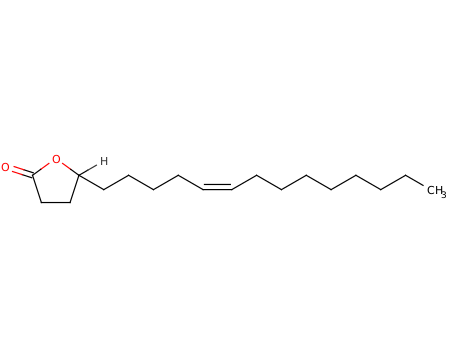 |
| Plant Source | Micromelum hirsutum Common Name: |
| Source Family | Rutaceae |
| Origin | |
| Plant Part Used | Stem bark |
| Extract | Dichloromethane |
| Target Bacteria | Mycobacterium tuberculosis H37Rv |
| Assay / Test Done | Fluorometric Alamar Blue Microassay (FMABA) |
| Positive Control Used (conc.) | Rifampin (0.040 ± 0.017 µg/ml) |
| Inhibition [%] | > 90 % |
| Activity [MIC] µg/ml | 1.5 ± 0.4 µg/ml |
| Activity (In terms of dilution) | NR |
| Activity (Zone of inhibition in mm) | NR |
| Active Compound Identified | (-) - Z - 9 - Octadecene - 4 - Olide [Micromolide] |
| PubChem ID | NR |
| Ethnomedicinal Information | |
| PubMed ID [Source Literature] | 15770548 |
| Extract Preparation | The dried, milled stem bark of Micromelum hirsutum was extracted with CH2Cl2 to yield 45.5 g extract, of which 32.1 g were chromatographed by vacuum liquid chromatography over a silica gel column |
| Chemical Classification [Active Compound] | Alicyclic, Butenolide, Lactone, Alkene |
| Media / Broth Used [Antimicrobial Assay/Test] | |
| Cytotoxicity Assay [AID] | Against Vero cells (ATCCCCL-
81) in the CellTiter 96 aqueous nonradioactive cell
proliferation assay |
| Molecular Weight | 280.240 |
| Molecular Formula | C18H32O2 |
| SMILES | O1C(=O)CCC1CCCC/C=CCCCCCCCC |
| XLogP | 7.349 |
| PSA | 26.300 |
| H-bond Donor | 0 |
| H-bond Acceptor | 2 |
| No. of Rotatable Bond Count | 12 |
| No. of Rings | 1 |
| No. of N | 0 |
| No. of O | 2 |
| No. of S | 0 |
| Reference(s) | 1) Ma C, Case RJ, Wang Y, Zhang HJ, Tan GT, Van Hung N, Cuong NM, Franzblau SG, Soejarto DD, Fong HH, Pauli GF.Anti-tuberculosis constituents from the stem bark of Micromelum hirsutum.Planta Med. 2005 Mar;71(3):261-7
|
| Curator | Vikramjitmandal |
| Compound ID | 3984 |
| Compound Structure |  |
| Plant Source | Cinnamomum kotoense Common Name: |
| Source Family | Lauraceae |
| Origin | |
| Plant Part Used | |
| Extract | |
| Target Bacteria | Mycobacterium tuberculosis |
| Assay / Test Done | |
| Positive Control Used (conc.) | |
| Inhibition [%] | |
| Activity [MIC] µg/ml | 2.8 µg/ml |
| Activity (In terms of dilution) | |
| Activity (Zone of inhibition in mm) | |
| Active Compound Identified | Lincomolide B |
| PubChem ID | NR |
| Ethnomedicinal Information | |
| PubMed ID [Source Literature] | |
| Extract Preparation | |
| Chemical Classification [Active Compound] | Alicyclic, Butenolides, Fattyacid, Lactone, Ether, Alcohol, Alkene, Alkyne, |
| Media / Broth Used [Antimicrobial Assay/Test] | |
| Cytotoxicity Assay [AID] | |
| Molecular Weight | 278.188 |
| Molecular Formula | C17H26O3 |
| SMILES | C[C@@H]1OC(=O)/C(=C/CCCCCCCCCC#C)/[C@@H]1O |
| XLogP | 5.004 |
| PSA | 46.530 |
| H-bond Donor | 2 |
| H-bond Acceptor | 3 |
| No. of Rotatable Bond Count | 9 |
| No. of Rings | 1 |
| No. of N | 0 |
| No. of O | 3 |
| No. of S | 0 |
| Reference(s) | 1) In silico Comparison of Antimycobacterial Natural Products with Known Antituberculosis Drugs. Marlene Espinoza-Moraga, Nicholas M. Njuguna, Grace Mugumbate, Julio Caballero, and Kelly Chibale. Journal of Chemical Information and Modeling 2013 53 (3), 649-660
2) Rogoza, L. N.; Salakhutdinov, N. F.; Tolstikov, G. A. Anti-tubercular Activity of Natural Products: Recent Developments. In Opportunity, Challenge and Scope of Natural Products in Medicinal Chemistry; Tiwari, V. K. Ed.; Research Signpost: India, 2011; pp 103-120
|
| Curator | |
| Compound ID | 4097 |
| Compound Structure | 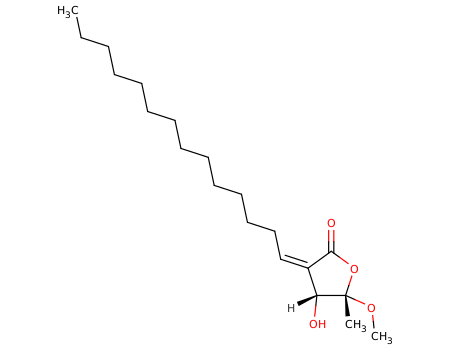 |
| Plant Source | Litsea hypophaea Common Name: |
| Source Family | Lauraceae |
| Origin | |
| Plant Part Used | |
| Extract | |
| Target Bacteria | Mycobacterium tuberculosis H37Rv |
| Assay / Test Done | |
| Positive Control Used (conc.) | |
| Inhibition [%] | |
| Activity [MIC] µg/ml | 25 µg/ml |
| Activity (In terms of dilution) | |
| Activity (Zone of inhibition in mm) | |
| Active Compound Identified | Litseakolide L |
| PubChem ID | NR |
| Ethnomedicinal Information | |
| PubMed ID [Source Literature] | |
| Extract Preparation | |
| Chemical Classification [Active Compound] | Alicyclic, Butenolides, Fattyacid, Lactone, Ether, Alcohol, Alkene |
| Media / Broth Used [Antimicrobial Assay/Test] | |
| Cytotoxicity Assay [AID] | |
| Molecular Weight | 340.261 |
| Molecular Formula | C20H36O4 |
| SMILES | O=C1O[C@](C)(OC)[C@H](O)/C/1=C/CCCCCCCCCCCCC |
| XLogP | 7.218 |
| PSA | 55.760 |
| H-bond Donor | 1 |
| H-bond Acceptor | 4 |
| No. of Rotatable Bond Count | 13 |
| No. of Rings | 1 |
| No. of N | 0 |
| No. of O | 4 |
| No. of S | 0 |
| Reference(s) | 1) In silico Comparison of Antimycobacterial Natural Products with Known Antituberculosis Drugs. Marlene Espinoza-Moraga, Nicholas M. Njuguna, Grace Mugumbate, Julio Caballero, and Kelly Chibale. Journal of Chemical Information and Modeling 2013 53 (3), 649-660
2) García, A., Bocanegra-García, V., Palma-Nicolás, J. P., Rivera, G. Vennerstrom, J. L. Recent Advances in Antitubercular Natural Products. Eur. J. Med. Chem. 2012, 49, 1-23
|
| Curator | |
| Compound ID | 4111 |
| Compound Structure |  |
| Plant Source | Polyalthia debilis Common Name: |
| Source Family | Annonaceae |
| Origin | |
| Plant Part Used | |
| Extract | |
| Target Bacteria | Mycobacterium tuberculosis H37Ra |
| Assay / Test Done | |
| Positive Control Used (conc.) | |
| Inhibition [%] | |
| Activity [MIC] µg/ml | 25 µg/ml |
| Activity (In terms of dilution) | |
| Activity (Zone of inhibition in mm) | |
| Active Compound Identified | Debilisone B |
| PubChem ID | NR |
| Ethnomedicinal Information | |
| PubMed ID [Source Literature] | |
| Extract Preparation | |
| Chemical Classification [Active Compound] | Alicyclic, Butenolides, Fattyacid, Lactone, Alcohol, Alkyne |
| Media / Broth Used [Antimicrobial Assay/Test] | |
| Cytotoxicity Assay [AID] | |
| Molecular Weight | 404.293 |
| Molecular Formula | C25H40O4 |
| SMILES | CCCCC[C@H](O)C#CC#CCCCCCCCCCC[C@H]1C[C@@H](CO)OC1=O |
| XLogP | 7.566 |
| PSA | 66.760 |
| H-bond Donor | 2 |
| H-bond Acceptor | 4 |
| No. of Rotatable Bond Count | 15 |
| No. of Rings | 1 |
| No. of N | 0 |
| No. of O | 4 |
| No. of S | 0 |
| Reference(s) | 1) In silico Comparison of Antimycobacterial Natural Products with Known Antituberculosis Drugs. Marlene Espinoza-Moraga, Nicholas M. Njuguna, Grace Mugumbate, Julio Caballero, and Kelly Chibale. Journal of Chemical Information and Modeling 2013 53 (3), 649-660
2) García, A., Bocanegra-García, V., Palma-Nicolás, J. P., Rivera, G. Vennerstrom, J. L. Recent Advances in Antitubercular Natural Products. Eur. J. Med. Chem. 2012, 49, 1-23
|
| Curator | |
| Compound ID | 4112 |
| Compound Structure |  |
| Plant Source | Polyalthia debilis Common Name: |
| Source Family | Annonaceae |
| Origin | |
| Plant Part Used | |
| Extract | |
| Target Bacteria | Mycobacterium tuberculosis H37Ra |
| Assay / Test Done | |
| Positive Control Used (conc.) | |
| Inhibition [%] | |
| Activity [MIC] µg/ml | 12.5 µg/ml |
| Activity (In terms of dilution) | |
| Activity (Zone of inhibition in mm) | |
| Active Compound Identified | Debilisone C |
| PubChem ID | NR |
| Ethnomedicinal Information | |
| PubMed ID [Source Literature] | |
| Extract Preparation | |
| Chemical Classification [Active Compound] | Alicyclic, Butenolides, Fattyacid, Lactone, Alcohol, Alkyne, Alkene, |
| Media / Broth Used [Antimicrobial Assay/Test] | |
| Cytotoxicity Assay [AID] | |
| Molecular Weight | 386.282 |
| Molecular Formula | C25H38O3 |
| SMILES | CCCC/C=C/C#CC#CCCCCCCCCCC[C@H]1C[C@@H](CO)OC1=O |
| XLogP | 8.849 |
| PSA | 46.530 |
| H-bond Donor | 1 |
| H-bond Acceptor | 3 |
| No. of Rotatable Bond Count | 14 |
| No. of Rings | 1 |
| No. of N | 0 |
| No. of O | 3 |
| No. of S | 0 |
| Reference(s) | 1) In silico Comparison of Antimycobacterial Natural Products with Known Antituberculosis Drugs. Marlene Espinoza-Moraga, Nicholas M. Njuguna, Grace Mugumbate, Julio Caballero, and Kelly Chibale. Journal of Chemical Information and Modeling 2013 53 (3), 649-660
2) García, A., Bocanegra-García, V., Palma-Nicolás, J. P., Rivera, G. Vennerstrom, J. L. Recent Advances in Antitubercular Natural Products. Eur. J. Med. Chem. 2012, 49, 1-23
|
| Curator | |
| Compound ID | 4113 |
| Compound Structure |  |
| Plant Source | Polyalthia debilis Common Name: |
| Source Family | Annonaceae |
| Origin | |
| Plant Part Used | |
| Extract | |
| Target Bacteria | Mycobacterium tuberculosis H37Ra |
| Assay / Test Done | |
| Positive Control Used (conc.) | |
| Inhibition [%] | |
| Activity [MIC] µg/ml | 25 µg/ml |
| Activity (In terms of dilution) | |
| Activity (Zone of inhibition in mm) | |
| Active Compound Identified | Debilisone E |
| PubChem ID | NR |
| Ethnomedicinal Information | |
| PubMed ID [Source Literature] | |
| Extract Preparation | |
| Chemical Classification [Active Compound] | Alicyclic, Butenolide, Fattyacid, Lactone, Alkyne, Alkene, Alcohol |
| Media / Broth Used [Antimicrobial Assay/Test] | |
| Cytotoxicity Assay [AID] | |
| Molecular Weight | 384.266 |
| Molecular Formula | C25H36O3 |
| SMILES | C=CCC/C=C/C#CC#CCCCCCCCCCC[C@H]1C[C@@H](CO)OC1=O |
| XLogP | 8.483 |
| PSA | 46.530 |
| H-bond Donor | 1 |
| H-bond Acceptor | 3 |
| No. of Rotatable Bond Count | 14 |
| No. of Rings | 1 |
| No. of N | 0 |
| No. of O | 3 |
| No. of S | 0 |
| Reference(s) | 1) In silico Comparison of Antimycobacterial Natural Products with Known Antituberculosis Drugs. Marlene Espinoza-Moraga, Nicholas M. Njuguna, Grace Mugumbate, Julio Caballero, and Kelly Chibale. Journal of Chemical Information and Modeling 2013 53 (3), 649-660
2) García, A., Bocanegra-García, V., Palma-Nicolás, J. P., Rivera, G. Vennerstrom, J. L. Recent Advances in Antitubercular Natural Products. Eur. J. Med. Chem. 2012, 49, 1-23
|
| Curator | |
