| Compound ID | 3412 |
| Compound Structure | 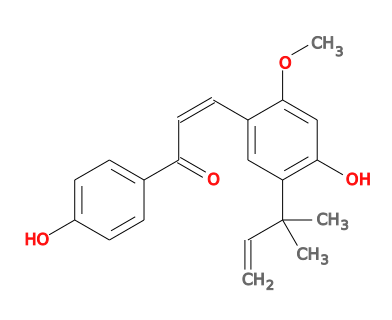 |
| Plant Source | Glycyrrhiza inflata Common Name:Chinese Licorice |
| Source Family | Fabaceae |
| Origin | India |
| Plant Part Used | Root |
| Extract | Methanol |
| Target Bacteria | Mycobacterium tuberculosis |
| Assay / Test Done | BACTEC Assay |
| Positive Control Used (conc.) | |
| Inhibition [%] | |
| Activity [MIC] µg/ml | < 20 µg/ml |
| Activity (In terms of dilution) | |
| Activity (Zone of inhibition in mm) | |
| Active Compound Identified | Licochalcone A |
| PubChem ID | 5318998 |
| Ethnomedicinal Information | |
| PubMed ID [Source Literature] | 12058317 |
| Extract Preparation | Soxhlet extraction, concentrated in vacuo to dryness |
| Chemical Classification [Active Compound] | Aromatic, Alkene, Chalcone, Ether, Phenol |
| Media / Broth Used [Antimicrobial Assay/Test] | |
| Cytotoxicity Assay [AID] | |
| Molecular Weight | 338.152 |
| Molecular Formula | C21H22O4 |
| SMILES | Oc1c(C(C)(C)C=C)cc(c(OC)c1)/C=C/C(=O)c1ccc(O)cc1 |
| XLogP | 4.443 |
| PSA | 66.760 |
| H-bond Donor | 2 |
| H-bond Acceptor | 4 |
| No. of Rotatable Bond Count | 6 |
| No. of Rings | 2 |
| No. of N | 0 |
| No. of O | 4 |
| No. of S | 0 |
| Reference(s) | 1) Friis-Møller A, Chen M, Fuursted K, Christensen SB, Kharazmi A.In vitro antimycobacterial and antilegionella activity of licochalcone A from Chinese licorice roots.Planta Med. 2002 May;68(5):416-9
|
| Curator | Gppreetha, vikramjitmandal |
| Compound ID | 3941 |
| Compound Structure |  |
| Plant Source | Butea monosperma (LAM.) TAUB. Common Name:Flame of the Forest |
| Source Family | Fabaceae |
| Origin | Tropical Southern Asia, Pakistan, India, Bangladesh |
| Plant Part Used | Flower |
| Extract | EtOAc and MeOH |
| Target Bacteria | Mycobacterium tuberculosis H37Ra |
| Assay / Test Done | Microplate Alamar Blue Assay (MABA) |
| Positive Control Used (conc.) | Kanamycin Sulphate (2.5 µg/ml), Isoniazid (0.06 µg/ml), Rifampin (0.004 µg/ml) |
| Inhibition [%] | NR |
| Activity [MIC] µg/ml | 12.5 µg/ml |
| Activity (In terms of dilution) | NR |
| Activity (Zone of inhibition in mm) | NR |
| Active Compound Identified | Butein |
| PubChem ID | 5281222 |
| Ethnomedicinal Information | NR |
| PubMed ID [Source Literature] | 19336944 |
| Extract Preparation | The dried flowers (15.0 kg) were milled and soaked successively with n - hexane, EtOAc and MeOH. The hexane, EtOAc and MeOH extracts were evaporated under reduced pressure to give the crude hexane extract (brownish syrup, 32.8 g), the EtOAc extract (dark brownish sticky solid, 102.7 g) and the MeOH extract (dark brownish sticky solid, 527.6 g) |
| Chemical Classification [Active Compound] | Aromatic, Alkene. Chalcone, Phenol |
| Media / Broth Used [Antimicrobial Assay/Test] | NR |
| Cytotoxicity Assay [AID] | NR |
| Molecular Weight | 272.068 |
| Molecular Formula | C15H12O5 |
| SMILES | Oc1c(C(=O)/C=C/c2cc(O)c(O)cc2)ccc(O)c1 |
| XLogP | 2.019 |
| PSA | 97.990 |
| H-bond Donor | 4 |
| H-bond Acceptor | 5 |
| No. of Rotatable Bond Count | 3 |
| No. of Rings | 2 |
| No. of N | 0 |
| No. of O | 5 |
| No. of S | 0 |
| Reference(s) | 1) Chokchaisiri R, Suaisom C, Sriphota S, Chindaduang A, Chuprajob T, Suksamrarn A.Bioactive flavonoids of the flowers of Butea monosperma.Chem Pharm Bull (Tokyo). 2009 Apr;57(4):428-32
|
| Curator | Vikramjitmandal, Keyamukherjee, najiya-beegum, swatigandhi |
| Compound ID | 3943 |
| Compound Structure |  |
| Plant Source | Butea monosperma (LAM.) TAUB. Common Name:Flame of the Forest |
| Source Family | Fabaceae |
| Origin | Tropical Southern Asia, Pakistan, India, Bangladesh |
| Plant Part Used | Flower |
| Extract | EtOAc and MeOH |
| Target Bacteria | Mycobacterium tuberculosis H37Ra |
| Assay / Test Done | Microplate Alamar Blue Assay (MABA) |
| Positive Control Used (conc.) | Kanamycin Sulphate (2.5 µg/ml), Isoniazid (0.06 µg/ml), Rifampin (0.004 µg/ml) |
| Inhibition [%] | NR |
| Activity [MIC] µg/ml | 25 µg/ml |
| Activity (In terms of dilution) | NR |
| Activity (Zone of inhibition in mm) | NR |
| Active Compound Identified | Monospermoside |
| PubChem ID | 42607524 |
| Ethnomedicinal Information | NR |
| PubMed ID [Source Literature] | 19336944 |
| Extract Preparation | The dried flowers (15.0 kg) were milled and soaked successively with n - hexane, EtOAc and MeOH. The hexane, EtOAc and MeOH extracts were evaporated under reduced pressure to give the crude hexane extract (brownish syrup, 32.8 g), the EtOAc extract (dark brownish sticky solid, 102.7 g) and the MeOH extract (dark brownish sticky solid, 527.6 g) |
| Chemical Classification [Active Compound] | Aromatic, Alkene, Chalcone, Phenol, Sugar |
| Media / Broth Used [Antimicrobial Assay/Test] | NR |
| Cytotoxicity Assay [AID] | NR |
| Molecular Weight | 434.121 |
| Molecular Formula | C21H22O10 |
| SMILES | O1[C@@H]([C@@H](O)[C@H](O)[C@@H](O)[C@@H]1Oc1cc(ccc1O)/C=C/C(=O)c1c(O)cc(O)cc1)CO |
| XLogP | 0.482 |
| PSA | 177.140 |
| H-bond Donor | 7 |
| H-bond Acceptor | 10 |
| No. of Rotatable Bond Count | 6 |
| No. of Rings | 3 |
| No. of N | 0 |
| No. of O | 10 |
| No. of S | 0 |
| Reference(s) | 1) Chokchaisiri R, Suaisom C, Sriphota S, Chindaduang A, Chuprajob T, Suksamrarn A.Bioactive flavonoids of the flowers of Butea monosperma.Chem Pharm Bull (Tokyo). 2009 Apr;57(4):428-32
|
| Curator | Vikramjitmandal, Keyamukherjee, najiya-beegum, swatigandhi |
| Compound ID | 3946 |
| Compound Structure |  |
| Plant Source | Butea monosperma (LAM.) TAUB. Common Name:Flame of the Forest |
| Source Family | Fabaceae |
| Origin | Tropical Southern Asia, Pakistan, India, Bangladesh |
| Plant Part Used | Flower |
| Extract | EtOAc and MeOH |
| Target Bacteria | Mycobacterium tuberculosis H37Ra |
| Assay / Test Done | Microplate Alamar Blue Assay (MABA) |
| Positive Control Used (conc.) | Kanamycin Sulphate (2.5 µg/ml), Isoniazid (0.06 µg/ml), Rifampin (0.004 µg/ml) |
| Inhibition [%] | NR |
| Activity [MIC] µg/ml | 50 µg/ml |
| Activity (In terms of dilution) | NR |
| Activity (Zone of inhibition in mm) | NR |
| Active Compound Identified | Dihydromonospermoside |
| PubChem ID | NR |
| Ethnomedicinal Information | NR |
| PubMed ID [Source Literature] | 19336944 |
| Extract Preparation | The dried flowers (15.0 kg) were milled and soaked successively with n - hexane, EtOAc and MeOH. The hexane, EtOAc and MeOH extracts were evaporated under reduced pressure to give the crude hexane extract (brownish syrup, 32.8 g), the EtOAc extract (dark brownish sticky solid, 102.7 g) and the MeOH extract (dark brownish sticky solid, 527.6 g) |
| Chemical Classification [Active Compound] | Aromatic, Chalcone, Ketone, Ether, Phenol, Sugar |
| Media / Broth Used [Antimicrobial Assay/Test] | NR |
| Cytotoxicity Assay [AID] | NR |
| Molecular Weight | 436.137 |
| Molecular Formula | C21H24O10 |
| SMILES | [C@@H]1([C@@H]([C@H]([C@@H]([C@H](O1)CO)O)O)O)Oc1c(ccc(c1)CCC(=O)c1ccc(cc1O)O)O |
| XLogP | 0.230 |
| PSA | 177.140 |
| H-bond Donor | 7 |
| H-bond Acceptor | 10 |
| No. of Rotatable Bond Count | 7 |
| No. of Rings | 3 |
| No. of N | 0 |
| No. of O | 10 |
| No. of S | 0 |
| Reference(s) | 1) Chokchaisiri R, Suaisom C, Sriphota S, Chindaduang A, Chuprajob T, Suksamrarn A.Bioactive flavonoids of the flowers of Butea monosperma.Chem Pharm Bull (Tokyo). 2009 Apr;57(4):428-32
|
| Curator | Vikramjitmandal, Keyamukherjee, najiya-beegum, swatigandhi |
| Compound ID | 3947 |
| Compound Structure |  |
| Plant Source | Butea monosperma (LAM.) TAUB. Common Name:Flame of the Forest |
| Source Family | Fabaceae |
| Origin | Tropical Southern Asia, Pakistan, India, Bangladesh |
| Plant Part Used | Flower |
| Extract | EtOAc and MeOH |
| Target Bacteria | Mycobacterium tuberculosis H37Ra |
| Assay / Test Done | Microplate Alamar Blue Assay (MABA) |
| Positive Control Used (conc.) | Kanamycin Sulphate (2.5 µg/ml), Isoniazid (0.06 µg/ml), Rifampin (0.004 µg/ml) |
| Inhibition [%] | NR |
| Activity [MIC] µg/ml | 25 µg/ml |
| Activity (In terms of dilution) | NR |
| Activity (Zone of inhibition in mm) | NR |
| Active Compound Identified | Isoliquiritigenin |
| PubChem ID | 638278 |
| Ethnomedicinal Information | NR |
| PubMed ID [Source Literature] | 19336944 |
| Extract Preparation | The dried flowers (15.0 kg) were milled and soaked successively with n - hexane, EtOAc and MeOH. The hexane, EtOAc and MeOH extracts were evaporated under reduced pressure to give the crude hexane extract (brownish syrup, 32.8 g), the EtOAc extract (dark brownish sticky solid, 102.7 g) and the MeOH extract (dark brownish sticky solid, 527.6 g) |
| Chemical Classification [Active Compound] | Aromatic, Alkene, Chalcone, Phenol |
| Media / Broth Used [Antimicrobial Assay/Test] | NR |
| Cytotoxicity Assay [AID] | NR |
| Molecular Weight | 256.074 |
| Molecular Formula | C15H12O4 |
| SMILES | Oc1c(C(=O)/C=C/c2ccc(O)cc2)ccc(O)c1 |
| XLogP | 2.764 |
| PSA | 77.760 |
| H-bond Donor | 3 |
| H-bond Acceptor | 4 |
| No. of Rotatable Bond Count | 3 |
| No. of Rings | 2 |
| No. of N | 0 |
| No. of O | 4 |
| No. of S | 0 |
| Reference(s) | 1) Chokchaisiri R, Suaisom C, Sriphota S, Chindaduang A, Chuprajob T, Suksamrarn A.Bioactive flavonoids of the flowers of Butea monosperma.Chem Pharm Bull (Tokyo). 2009 Apr;57(4):428-32
|
| Curator | Vikramjitmandal, Keyamukherjee, najiya-beegum, swatigandhi |
| Compound ID | 4061 |
| Compound Structure | 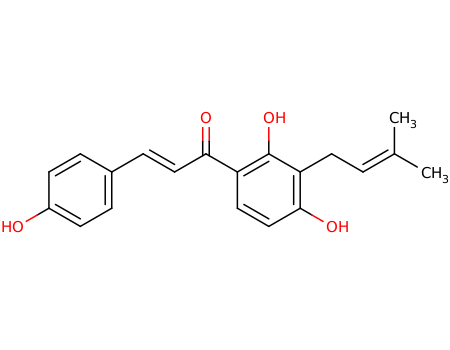 |
| Plant Source | Fatoua pilosa Common Name: |
| Source Family | Moraceae |
| Origin | |
| Plant Part Used | |
| Extract | |
| Target Bacteria | Mycobacterium tuberculosis H37Rv |
| Assay / Test Done | |
| Positive Control Used (conc.) | |
| Inhibition [%] | |
| Activity [MIC] µg/ml | 18 µg/ml |
| Activity (In terms of dilution) | |
| Activity (Zone of inhibition in mm) | |
| Active Compound Identified | Isobavachalcone |
| PubChem ID | NR |
| Ethnomedicinal Information | |
| PubMed ID [Source Literature] | |
| Extract Preparation | |
| Chemical Classification [Active Compound] | Aromatic, Chalcone, Ketone, Prenylated, Phenol |
| Media / Broth Used [Antimicrobial Assay/Test] | |
| Cytotoxicity Assay [AID] | |
| Molecular Weight | 324.136 |
| Molecular Formula | C20H20O4 |
| SMILES | O=C(/C=C/c1ccc(O)cc1)c1c(c(CC=C(C)C)c(cc1)O)O |
| XLogP | 4.234 |
| PSA | 77.760 |
| H-bond Donor | 3 |
| H-bond Acceptor | 4 |
| No. of Rotatable Bond Count | 5 |
| No. of Rings | 2 |
| No. of N | 0 |
| No. of O | 4 |
| No. of S | 0 |
| Reference(s) | 1) In silico Comparison of Antimycobacterial Natural Products with Known Antituberculosis Drugs. Marlene Espinoza-Moraga, Nicholas M. Njuguna, Grace Mugumbate, Julio Caballero, and Kelly Chibale. Journal of Chemical Information and Modeling 2013 53 (3), 649-660
2) García, A., Bocanegra-García, V., Palma-Nicolás, J. P., Rivera, G. Vennerstrom, J. L. Recent Advances in Antitubercular Natural Products. Eur. J. Med. Chem. 2012, 49, 1-23
|
| Curator | |
| Compound ID | 4062 |
| Compound Structure | 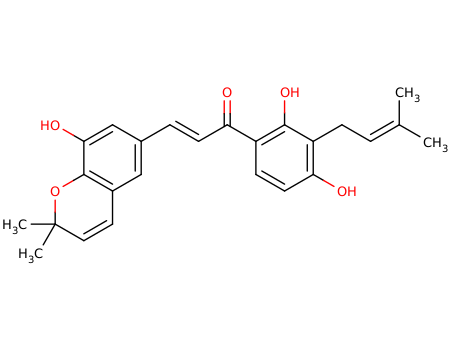 |
| Plant Source | Fatoua pilosa Common Name: |
| Source Family | Moraceae |
| Origin | |
| Plant Part Used | |
| Extract | |
| Target Bacteria | Mycobacterium tuberculosis H37Rv |
| Assay / Test Done | |
| Positive Control Used (conc.) | |
| Inhibition [%] | |
| Activity [MIC] µg/ml | 30 µg/ml |
| Activity (In terms of dilution) | |
| Activity (Zone of inhibition in mm) | |
| Active Compound Identified | EJMC158 |
| PubChem ID | NR |
| Ethnomedicinal Information | |
| PubMed ID [Source Literature] | |
| Extract Preparation | |
| Chemical Classification [Active Compound] | Aromatic, Alkene, Chalcone, Benzopyran, Prenylated, Phenol |
| Media / Broth Used [Antimicrobial Assay/Test] | |
| Cytotoxicity Assay [AID] | |
| Molecular Weight | 406.178 |
| Molecular Formula | C25H26O5
|
| SMILES | O=C(/C=C/c1cc2C=CC(C)(C)Oc2c(O)c1)c1c(c(CC=C(C)C)c(cc1)O)O |
| XLogP | 4.460 |
| PSA | 86.990 |
| H-bond Donor | 3 |
| H-bond Acceptor | 5 |
| No. of Rotatable Bond Count | 5 |
| No. of Rings | 3 |
| No. of N | 0 |
| No. of O | 5 |
| No. of S | 0 |
| Reference(s) | 1) In silico Comparison of Antimycobacterial Natural Products with Known Antituberculosis Drugs. Marlene Espinoza-Moraga, Nicholas M. Njuguna, Grace Mugumbate, Julio Caballero, and Kelly Chibale. Journal of Chemical Information and Modeling 2013 53 (3), 649-660
2) García, A., Bocanegra-García, V., Palma-Nicolás, J. P., Rivera, G. Vennerstrom, J. L. Recent Advances in Antitubercular Natural Products. Eur. J. Med. Chem. 2012, 49, 1-23
|
| Curator | |
| Compound ID | 4063 |
| Compound Structure |  |
| Plant Source | Helichrysum melanacme Common Name: |
| Source Family | Asteraceae (Compositae) |
| Origin | |
| Plant Part Used | |
| Extract | |
| Target Bacteria | Mycobacterium tuberculosis |
| Assay / Test Done | |
| Positive Control Used (conc.) | |
| Inhibition [%] | |
| Activity [MIC] µg/ml | 0.05 µg/ml |
| Activity (In terms of dilution) | |
| Activity (Zone of inhibition in mm) | |
| Active Compound Identified | EJMC159 |
| PubChem ID | NR |
| Ethnomedicinal Information | |
| PubMed ID [Source Literature] | |
| Extract Preparation | |
| Chemical Classification [Active Compound] | Aromatic, Chalcone, Ketone, Prenylated, Phenol |
| Media / Broth Used [Antimicrobial Assay/Test] | |
| Cytotoxicity Assay [AID] | |
| Molecular Weight | 324.136 |
| Molecular Formula | C20H20O4
|
| SMILES | Oc1c(CC=C(C)C)c(O)cc(O)c1C(=O)/C=C/c1ccccc1 |
| XLogP | 5.718 |
| PSA | 77.760 |
| H-bond Donor | 3 |
| H-bond Acceptor | 4 |
| No. of Rotatable Bond Count | 5 |
| No. of Rings | 2 |
| No. of N | 0 |
| No. of O | 4 |
| No. of S | 0 |
| Reference(s) | 1) In silico Comparison of Antimycobacterial Natural Products with Known Antituberculosis Drugs. Marlene Espinoza-Moraga, Nicholas M. Njuguna, Grace Mugumbate, Julio Caballero, and Kelly Chibale. Journal of Chemical Information and Modeling 2013 53 (3), 649-660
2) García, A., Bocanegra-García, V., Palma-Nicolás, J. P., Rivera, G. Vennerstrom, J. L. Recent Advances in Antitubercular Natural Products. Eur. J. Med. Chem. 2012, 49, 1-23
|
| Curator | |
| Compound ID | 4064 |
| Compound Structure | 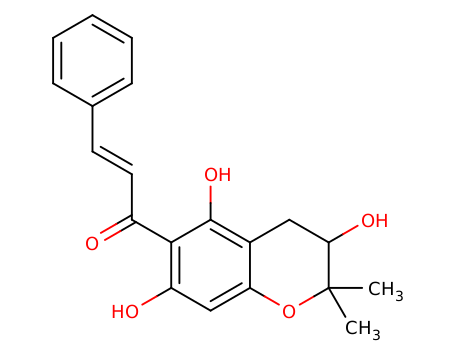 |
| Plant Source | Helichrysum melanacme Common Name: |
| Source Family | Asteraceae (Compositae) |
| Origin | |
| Plant Part Used | |
| Extract | |
| Target Bacteria | Mycobacterium tuberculosis |
| Assay / Test Done | |
| Positive Control Used (conc.) | |
| Inhibition [%] | |
| Activity [MIC] µg/ml | 0.05 µg/ml |
| Activity (In terms of dilution) | |
| Activity (Zone of inhibition in mm) | |
| Active Compound Identified | EJMC160 |
| PubChem ID | NR |
| Ethnomedicinal Information | |
| PubMed ID [Source Literature] | |
| Extract Preparation | |
| Chemical Classification [Active Compound] | Aromatic, Bicyclic, Chalcone, Benzopyran, Phenol |
| Media / Broth Used [Antimicrobial Assay/Test] | |
| Cytotoxicity Assay [AID] | |
| Molecular Weight | 340.131 |
| Molecular Formula | C20H20O5 |
| SMILES | Oc1c2c(OC(C)(C)C(O)C2)cc(O)c1C(=O)/C=C/c1ccccc1 |
| XLogP | 4.809 |
| PSA | 86.990 |
| H-bond Donor | 3 |
| H-bond Acceptor | 5 |
| No. of Rotatable Bond Count | 3 |
| No. of Rings | 3 |
| No. of N | 0 |
| No. of O | 5 |
| No. of S | 0 |
| Reference(s) | 1) In silico Comparison of Antimycobacterial Natural Products with Known Antituberculosis Drugs. Marlene Espinoza-Moraga, Nicholas M. Njuguna, Grace Mugumbate, Julio Caballero, and Kelly Chibale. Journal of Chemical Information and Modeling 2013 53 (3), 649-660
2) García, A., Bocanegra-García, V., Palma-Nicolás, J. P., Rivera, G. Vennerstrom, J. L. Recent Advances in Antitubercular Natural Products. Eur. J. Med. Chem. 2012, 49, 1-23
|
| Curator | |
