| Compound ID | 1412 |
| Compound Structure | 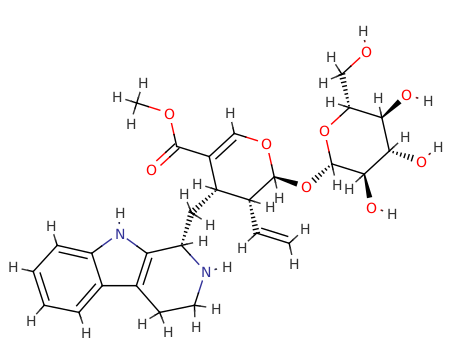 |
| Plant Source | Cephaelis dichroa Common Name: |
| Source Family | Rubiaceae |
| Origin | Mexico |
| Plant Part Used | Aerial |
| Extract | |
| Target Bacteria | Mycobacterium tuberculosis H37Rv |
| Assay / Test Done | Microplate Alamar Blue Assay (MABA) |
| Positive Control Used (conc.) | Isoniazid (0.06 µg/ml), Ethambutol (2 µg/ml), Rifampin (0.06 µg/ml), Streptomycin (0.50 µg/ml) |
| Inhibition [%] | |
| Activity [MIC] µg/ml | > 50 µg/ml |
| Activity (In terms of dilution) | |
| Activity (Zone of inhibition in mm) | |
| Active Compound Identified | Strictosidine |
| PubChem ID | 161336 |
| Ethnomedicinal Information | Tuberculosis |
| PubMed ID [Source Literature] | |
| Extract Preparation | N/A |
| Chemical Classification [Active Compound] | Aromatic, Tricyclic, Alkaloid, Indole, Pyran, Ester, Sugar |
| Media / Broth Used [Antimicrobial Assay/Test] | N/A |
| Cytotoxicity Assay [AID] | N/A |
| Molecular Weight | 530.226 |
| Molecular Formula | C27H34N2O9
|
| SMILES | O([C@@H]1OC=C([C@@H](C[C@@H]2NCCc3c2[nH]c2c3cccc2)[C@H]1C=C)C(=O)OC)[C@@H]1O[C@@H]([C@@H](O)[C@H](O)[C@H]1O)CO |
| XLogP | 1.559 |
| PSA | 162.730 |
| H-bond Donor | 6 |
| H-bond Acceptor | 11 |
| No. of Rotatable Bond Count | 8 |
| No. of Rings | 5 |
| No. of N | 2 |
| No. of O | 9 |
| No. of S | 0 |
| Reference(s) | 1) María del Rayo Camacho-Corona, Juan Manuel de Jesús Favela-Hernández, Omar González-Santiago, Elvira Garza-González, Gloria María Molina-Salinas, Salvador Said-Fernández, Guillermo Delgado, Julieta Luna-Herrerae.Evaluation of Some Plant-derived Secondary Metabolites Against Sensitive and Multidrug-resistant Mycobacterium tuberculosis.J. Mex. Chem. Soc. 2009, 53(2), 71-75
|
| Curator | |
| Compound ID | 1414 |
| Compound Structure | |
| Plant Source | Cephaelis dichroa Common Name: |
| Source Family | Rubiaceae |
| Origin | Mexico |
| Plant Part Used | Aerial |
| Extract | |
| Target Bacteria | Mycobacterium tuberculosis (345) |
| Assay / Test Done | Microplate Alamar Blue Assay (MABA) |
| Positive Control Used (conc.) | Streptomycin (3.125 µg/ml), Isoniazid (< 50 µg/ml), Ethambutol (12.50 µg/ml), Rifampin (< 50 µg/ml) |
| Inhibition [%] | |
| Activity [MIC] µg/ml | 100 µg/ml |
| Activity (In terms of dilution) | |
| Activity (Zone of inhibition in mm) | |
| Active Compound Identified | Strictosidine |
| PubChem ID | 161336 |
| Ethnomedicinal Information | Tuberculosis |
| PubMed ID [Source Literature] | |
| Extract Preparation | N/A |
| Chemical Classification [Active Compound] | Aromatic, Tricyclic, Alkaloid, Indole, Pyran, Ester, Sugar |
| Media / Broth Used [Antimicrobial Assay/Test] | N/A |
| Cytotoxicity Assay [AID] | N/A |
| Molecular Weight | 530.226 |
| Molecular Formula | C27H34N2O9
|
| SMILES | O([C@@H]1OC=C([C@@H](C[C@@H]2NCCc3c2[nH]c2c3cccc2)[C@H]1C=C)C(=O)OC)[C@@H]1O[C@@H]([C@@H](O)[C@H](O)[C@H]1O)CO |
| XLogP | 1.559 |
| PSA | 162.730 |
| H-bond Donor | 6 |
| H-bond Acceptor | 11 |
| No. of Rotatable Bond Count | 8 |
| No. of Rings | 5 |
| No. of N | 2 |
| No. of O | 9 |
| No. of S | 0 |
| Reference(s) | 1) María del Rayo Camacho-Corona, Juan Manuel de Jesús Favela-Hernández, Omar González-Santiago, Elvira Garza-González, Gloria María Molina-Salinas, Salvador Said-Fernández, Guillermo Delgado, Julieta Luna-Herrerae.Evaluation of Some Plant-derived Secondary Metabolites Against Sensitive and Multidrug-resistant Mycobacterium tuberculosis.J. Mex. Chem. Soc. 2009, 53(2), 71-75
|
| Curator | |
| Compound ID | 1416 |
| Compound Structure | |
| Plant Source | Cephaelis dichroa Common Name: |
| Source Family | Rubiaceae |
| Origin | Mexico |
| Plant Part Used | Aerial |
| Extract | |
| Target Bacteria | Mycobacterium tuberculosis (M12) |
| Assay / Test Done | Microplate Alamar Blue Assay (MABA) |
| Positive Control Used (conc.) | Streptomycin (12.50 µg/ml), Isoniazid (< 50 µg/ml), Ethambutol (12.50 µg/ml), Rifampin (< 50 µg/ml) |
| Inhibition [%] | |
| Activity [MIC] µg/ml | > 200 µg/ml |
| Activity (In terms of dilution) | |
| Activity (Zone of inhibition in mm) | |
| Active Compound Identified | Strictosidine |
| PubChem ID | 161336 |
| Ethnomedicinal Information | Tuberculosis |
| PubMed ID [Source Literature] | |
| Extract Preparation | N/A |
| Chemical Classification [Active Compound] | Aromatic, Tricyclic, Alkaloid, Indole, Pyran, Ester, Sugar |
| Media / Broth Used [Antimicrobial Assay/Test] | N/A |
| Cytotoxicity Assay [AID] | N/A |
| Molecular Weight | 530.226 |
| Molecular Formula | C27H34N2O9
|
| SMILES | O([C@@H]1OC=C([C@@H](C[C@@H]2NCCc3c2[nH]c2c3cccc2)[C@H]1C=C)C(=O)OC)[C@@H]1O[C@@H]([C@@H](O)[C@H](O)[C@H]1O)CO |
| XLogP | 1.559 |
| PSA | 162.730 |
| H-bond Donor | 6 |
| H-bond Acceptor | 11 |
| No. of Rotatable Bond Count | 8 |
| No. of Rings | 5 |
| No. of N | 2 |
| No. of O | 9 |
| No. of S | 0 |
| Reference(s) | 1) María del Rayo Camacho-Corona, Juan Manuel de Jesús Favela-Hernández, Omar González-Santiago, Elvira Garza-González, Gloria María Molina-Salinas, Salvador Said-Fernández, Guillermo Delgado, Julieta Luna-Herrerae.Evaluation of Some Plant-derived Secondary Metabolites Against Sensitive and Multidrug-resistant Mycobacterium tuberculosis.J. Mex. Chem. Soc. 2009, 53(2), 71-75
|
| Curator | |
| Compound ID | 1418 |
| Compound Structure | |
| Plant Source | Cephaelis dichroa Common Name: |
| Source Family | Rubiaceae |
| Origin | Mexico |
| Plant Part Used | Aerial |
| Extract | |
| Target Bacteria | Mycobacterium tuberculosis (M20) |
| Assay / Test Done | Microplate Alamar Blue Assay (MABA) |
| Positive Control Used (conc.) | Streptomycin (25 µg/ml), Isoniazid (< 50 µg/ml), Ethambutol (12.50 µg/ml), Rifampin (< 50 µg/ml) |
| Inhibition [%] | |
| Activity [MIC] µg/ml | 200 µg/ml |
| Activity (In terms of dilution) | |
| Activity (Zone of inhibition in mm) | |
| Active Compound Identified | Strictosidine |
| PubChem ID | 161336 |
| Ethnomedicinal Information | Tuberculosis |
| PubMed ID [Source Literature] | |
| Extract Preparation | N/A |
| Chemical Classification [Active Compound] | Aromatic, Tricyclic, Alkaloid, Indole, Pyran, Ester, Sugar |
| Media / Broth Used [Antimicrobial Assay/Test] | N/A |
| Cytotoxicity Assay [AID] | N/A |
| Molecular Weight | 530.226 |
| Molecular Formula | C27H34N2O9
|
| SMILES | O([C@@H]1OC=C([C@@H](C[C@@H]2NCCc3c2[nH]c2c3cccc2)[C@H]1C=C)C(=O)OC)[C@@H]1O[C@@H]([C@@H](O)[C@H](O)[C@H]1O)CO |
| XLogP | 1.559 |
| PSA | 162.730 |
| H-bond Donor | 6 |
| H-bond Acceptor | 11 |
| No. of Rotatable Bond Count | 8 |
| No. of Rings | 5 |
| No. of N | 2 |
| No. of O | 9 |
| No. of S | 0 |
| Reference(s) | 1) María del Rayo Camacho-Corona, Juan Manuel de Jesús Favela-Hernández, Omar González-Santiago, Elvira Garza-González, Gloria María Molina-Salinas, Salvador Said-Fernández, Guillermo Delgado, Julieta Luna-Herrerae.Evaluation of Some Plant-derived Secondary Metabolites Against Sensitive and Multidrug-resistant Mycobacterium tuberculosis.J. Mex. Chem. Soc. 2009, 53(2), 71-75
|
| Curator | |
| Compound ID | 1479 |
| Compound Structure | 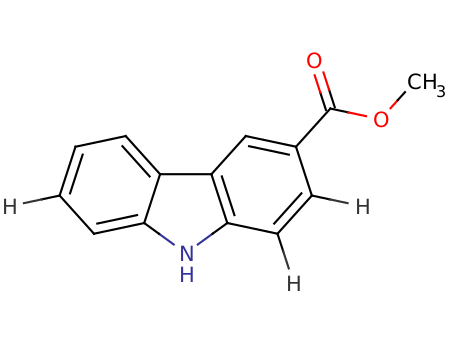 |
| Plant Source | Clausena excavata Burm. f. Common Name:Clausena (English) |
| Source Family | Rutaceae |
| Origin | India |
| Plant Part Used | Rhizome |
| Extract | Hexane |
| Target Bacteria | Mycobacterium tuberculosis |
| Assay / Test Done | Microplate Alamar Blue Assay (MABA) |
| Positive Control Used (conc.) | Isoniazid (0.040 – 0.090 µg/ml), Kanamycin sulphate (2 – 5 µg/ml) |
| Inhibition [%] | |
| Activity [MIC] µg/ml | 50 µg/ml |
| Activity (In terms of dilution) | |
| Activity (Zone of inhibition in mm) | |
| Active Compound Identified | 3 - Methoxycarbonylcarbazole |
| PubChem ID | NR |
| Ethnomedicinal Information | Fever, indigestion, malaria, colic, muscular pain, diuretic and as tonic; the allied species C. wampi Blanco for bronchitis, in Thai folk medicine for cold |
| PubMed ID [Source Literature] | 12624822 |
| Extract Preparation | N/A |
| Chemical Classification [Active Compound] | Aromatic, Tricyclic, Alkaloid, Carbazole, Ester |
| Media / Broth Used [Antimicrobial Assay/Test] | N/A |
| Cytotoxicity Assay [AID] | N/A |
| Molecular Weight | 225.079 |
| Molecular Formula | C14H11NO2 |
| SMILES | [nH]1c2c(c3c1ccc(c3)C(=O)OC)cccc2 |
| XLogP | 3.425 |
| PSA | 42.090 |
| H-bond Donor | 1 |
| H-bond Acceptor | 3 |
| No. of Rotatable Bond Count | 2 |
| No. of Rings | 3 |
| No. of N | 1 |
| No. of O | 2 |
| No. of S | 0 |
| Reference(s) | 1) Sunthitikawinsakul A, Kongkathip N, Kongkathip B, Phonnakhu S, Daly JW, Spande TF, Nimit Y, Rochanaruangrai S.Coumarins and carbazoles from Clausena excavata exhibited antimycobacterial and antifungal activities.Planta Med. 2003 Feb;69(2):155-7
2) Kirtikar, K.R., Basu, B.D., 1935. Indian Medicinal Plants, vols. 1–4. Lalit Mohan Basu, Allahabad, India
|
| Curator | |
| Compound ID | 1624 |
| Compound Structure | 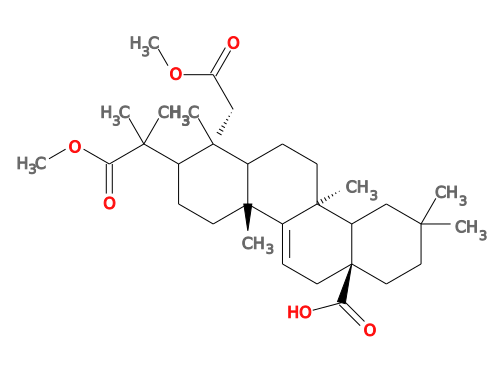 |
| Plant Source | Elateriospermum tapos Blume Common Name: |
| Source Family | Euphorbiaceae |
| Origin | Thailand |
| Plant Part Used | Leaf |
| Extract | |
| Target Bacteria | Mycobacterium tuberculosis H37Ra |
| Assay / Test Done | Microplate Alamar Blue assay (MABA) |
| Positive Control Used (conc.) | Isoniazid (0.05 µg/ml), Kanamycin (1.25 µg/ml) |
| Inhibition [%] | |
| Activity [MIC] µg/ml | 3.13 µg/ml |
| Activity (In terms of dilution) | |
| Activity (Zone of inhibition in mm) | |
| Active Compound Identified | 2, 3 - Seco - Taraxer - 14 - Ene - 2, 3, 28 - Trioic Acid 2, 3 - Dimethyl Ester |
| PubChem ID | 44448123 |
| Ethnomedicinal Information | Tuberculosis |
| PubMed ID [Source Literature] | 18179177 |
| Extract Preparation | N/A |
| Chemical Classification [Active Compound] | Alicyclic, Tetracyclic, Terpene, Triterpene, Ester, Acid |
| Media / Broth Used [Antimicrobial Assay/Test] | N/A |
| Cytotoxicity Assay [AID] | N/A |
| Molecular Weight | 530.361 |
| Molecular Formula | C32H50O6
|
| SMILES | OC(=O)[C@]12C([C@]3(C(=CC1)[C@]1(C([C@](C(CC1)C(C)(C)C(=O)OC)(CC(=O)OC)C)CC3)C)C)CC(CC2)(C)C |
| XLogP | 7.979 |
| PSA | 89.900 |
| H-bond Donor | 1 |
| H-bond Acceptor | 6 |
| No. of Rotatable Bond Count | 7 |
| No. of Rings | 4 |
| No. of N | 0 |
| No. of O | 6 |
| No. of S | 0 |
| Reference(s) | 1) Pattamadilok D, Suttisri R.Seco-terpenoids and other constituents from Elateriospermum tapos.J Nat Prod. 2008 Feb;71(2):292-4
|
| Curator | |
| Compound ID | 2052 |
| Compound Structure | 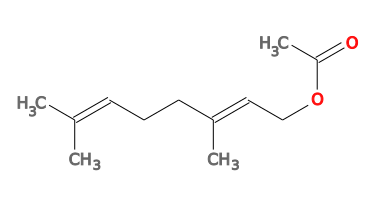 |
| Plant Source | Lippia alba (Miller) N. E.Brown Common Name: |
| Source Family | Verbenaceae |
| Origin | Colombia, Puerto Rico, India |
| Plant Part Used | Leaf, stem |
| Extract | Essential oil (2.5 %) |
| Target Bacteria | Mycobacterium tuberculosis H37Rv |
| Assay / Test Done | Macrodilution method in glass tubes |
| Positive Control Used (conc.) | Rifampin (0.50 µg/ml), Isoniazid (0.03 µg/ml) |
| Inhibition [%] | |
| Activity [MIC] µg/ml | 130 ± 95 µg/ml |
| Activity (In terms of dilution) | |
| Activity (Zone of inhibition in mm) | |
| Active Compound Identified | Geranyl acetate (3.6 %) |
| PubChem ID | 1549026 |
| Ethnomedicinal Information | Digestive troubles in general, nausea, bronchitis, sore throat, flu, cough, cold, hypertension, skin diseases, wounds, stomach ache, nervous complaints, folklore medicine of Puerto Rico |
| PubMed ID [Source Literature] | 19753839 |
| Extract Preparation | N/A |
| Chemical Classification [Active Compound] | Aliphatic, Alkene, Ester |
| Media / Broth Used [Antimicrobial Assay/Test] | N/A |
| Cytotoxicity Assay [AID] | N/A |
| Molecular Weight | 196.146 |
| Molecular Formula | C12H20O2
|
| SMILES | O(C/C=C(/CCC=C(C)C)C)C(=O)C |
| XLogP | 3.264 |
| PSA | 26.300 |
| H-bond Donor | 0 |
| H-bond Acceptor | 2 |
| No. of Rotatable Bond Count | 6 |
| No. of Rings | 0 |
| No. of N | 0 |
| No. of O | 2 |
| No. of S | 0 |
| Reference(s) | 1) Bueno-Sánchez JG, Martínez-Morales JR, Stashenko EE, Ribón W.Anti-tubercular activity of eleven aromatic and medicinal plants occurring in Colombia.Biomedica. 2009 Mar;29(1):51-60
2) Thierry Hennebelle, Sevser Sahpaz, Henry Joseph, François Bailleul.Ethnopharmacology of Lippia alba.Journal of Ethnopharmacology, Volume 116, Issue 2, 5 March 2008, Pages 211-222
|
| Curator | |
| Compound ID | 2614 |
| Compound Structure |  |
| Plant Source | Solidago canadensis L. Common Name:Goldenrod, Woundwort |
| Source Family | Asteraceae (Compositae) |
| Origin | North America |
| Plant Part Used | |
| Extract | |
| Target Bacteria | Mycobacterium tuberculosis H37Rv |
| Assay / Test Done | Radiorespirometric Bioassay |
| Positive Control Used (conc.) | Rifampin (0.25 - 0.125 µg/ml) |
| Inhibition [%] | |
| Activity [MIC] µg/ml | 25 µg/ml |
| Activity (In terms of dilution) | |
| Activity (Zone of inhibition in mm) | |
| Active Compound Identified | (2Z)-8-dehydromatricaria ester |
| PubChem ID | NR |
| Ethnomedicinal Information | Urinary and kidney infections and stones, catarrh. The plant has a cleansing action on the kidneys, and a reputation for clearing upper respiratory mucus |
| PubMed ID [Source Literature] | 9810277 |
| Extract Preparation | N/A |
| Chemical Classification [Active Compound] | Aliphatic, Alkene, Alkyne, Ester |
| Media / Broth Used [Antimicrobial Assay/Test] | N/A |
| Cytotoxicity Assay [AID] | N/A |
| Molecular Weight | 174.068 |
| Molecular Formula | C11H10O2
|
| SMILES | C(=O)(OC)/C=C/C#CC#C/C=C/C |
| XLogP | 3.071 |
| PSA | 26.300 |
| H-bond Donor | 0 |
| H-bond Acceptor | 2 |
| No. of Rotatable Bond Count | 2 |
| No. of Rings | 0 |
| No. of N | 0 |
| No. of O | 2 |
| No. of S | 0 |
| Reference(s) | 1) Lu T, Cantrell CL, Robbs SL, Franzblau SG, Fischer NH.Antimycobacterial matricaria esters and lactones from Astereae species.Planta Med. 1998 Oct;64(7):665-7
2) http://www.anniesremedy.com/herb_detail365.php
|
| Curator | |
| Compound ID | 2824 |
| Compound Structure | 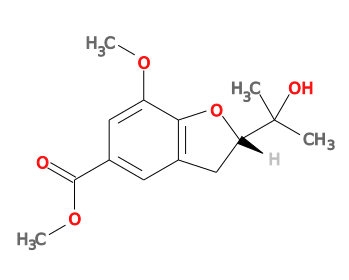 |
| Plant Source | Zanthoxylum wutaiense Common Name: |
| Source Family | Rutaceae |
| Origin | China |
| Plant Part Used | Root, wood |
| Extract | |
| Target Bacteria | Mycobacterium tuberculosis H37Rv |
| Assay / Test Done | |
| Positive Control Used (conc.) | |
| Inhibition [%] | |
| Activity [MIC] µg/ml | 35 µg/ml |
| Activity (In terms of dilution) | |
| Activity (Zone of inhibition in mm) | |
| Active Compound Identified | Methyl 7 - Methoxyanodendroate |
| PubChem ID | 24970510 |
| Ethnomedicinal Information | Tuberculosis |
| PubMed ID [Source Literature] | 18564877 |
| Extract Preparation | N/A |
| Chemical Classification [Active Compound] | Aromatic, Bicyclic, Furanoid, Ester, Ether |
| Media / Broth Used [Antimicrobial Assay/Test] | N/A |
| Cytotoxicity Assay [AID] | N/A |
| Molecular Weight | 266.115 |
| Molecular Formula | C14H18O5
|
| SMILES | O1[C@H](C(O)(C)C)Cc2c1c(OC)cc(c2)C(=O)OC |
| XLogP | 1.508 |
| PSA | 64.990 |
| H-bond Donor | 1 |
| H-bond Acceptor | 5 |
| No. of Rotatable Bond Count | 4 |
| No. of Rings | 2 |
| No. of N | 0 |
| No. of O | 5 |
| No. of S | 0 |
| Reference(s) | 1) Huang HY, Ishikawa T, Peng CF, Tsai IL, Chen IS.Constituents of the root wood of Zanthoxylum wutaiense with antitubercular activity.J Nat Prod. 2008 Jul;71(7):1146-51
|
| Curator | |
| Compound ID | 2960 |
| Compound Structure | 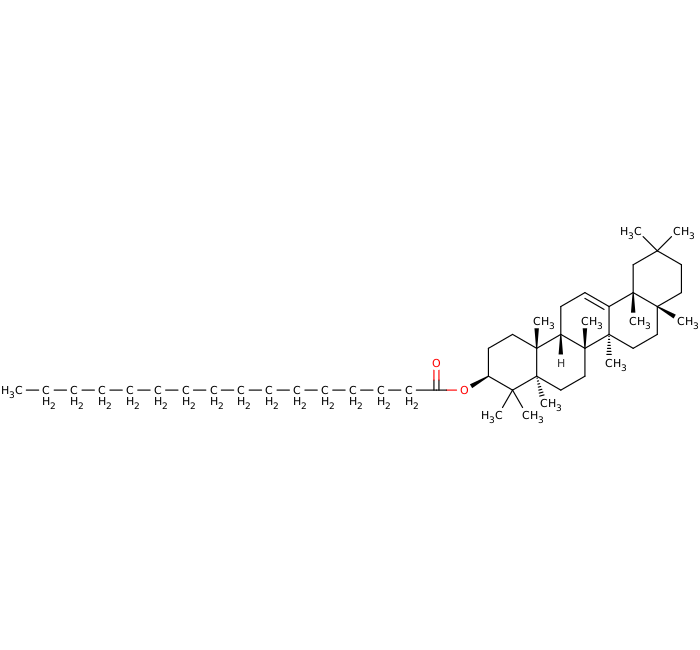 |
| Plant Source | Haloxylon salicornicum Bunge ex Boiss Common Name:NR |
| Source Family | Chenopodiaceae |
| Origin | Pakistan, Egypt, Jordan, Palestine, Iran, Iraq and Kuwait (in unfertile areas) |
| Plant Part Used | Whole plant |
| Extract | NR |
| Target Bacteria | Mycobacterium tuberculosis H37Rv |
| Assay / Test Done | Micro Broth Dilution Method |
| Positive Control Used (conc.) | Isoniazid (0.02 µg/ml) |
| Inhibition [%] | NR |
| Activity [MIC] µg/ml | 100 µg/ml |
| Activity (In terms of dilution) | NR |
| Activity (Zone of inhibition in mm) | NR |
| Active Compound Identified | Olean-12(13) en-3β-hexadecanoate |
| PubChem ID | NR |
| Ethnomedicinal Information | NR |
| PubMed ID [Source Literature] | 20542692 |
| Extract Preparation | Methanol extract further partitioned with water and hexane. The water layer was further extracted with chloroform and subjected to silica gel column chromatography |
| Chemical Classification [Active Compound] | Alicyclic, Pentacyclic, Terpene, Triterpene, Ester |
| Media / Broth Used [Antimicrobial Assay/Test] | Middlebrook 7H9 broth |
| Cytotoxicity Assay [AID] | NR |
| Molecular Weight | 692.647 |
| Molecular Formula | C48H84O2 |
| SMILES | C1C[C@@H](C([C@]2([C@]1([C@H]1[C@@](CC2)([C@]2(C(=CC1)[C@]1([C@@](CC2)(CCC(C1)(C)C)C)C)C)C)C)C)(C)C)OC(=O)CCCCCCCCCCCCCCC |
| XLogP | 20.954 |
| PSA | 26.300 |
| H-bond Donor | 0 |
| H-bond Acceptor | 2 |
| No. of Rotatable Bond Count | 16 |
| No. of Rings | 5 |
| No. of N | 0 |
| No. of O | 2 |
| No. of S | 0 |
| Reference(s) | 1) Bibi N, Tanoli SA, Farheen S, Afza N, Siddiqi S, Zhang Y, Kazmi SU, Malik A.In vitro antituberculosis activities of the constituents isolated from Haloxylon salicornicum.Bioorg Med Chem Lett. 2010 Jul 15;20(14):4173-6
|
| Curator | KeyaMukherjee, vsheeba |
| Compound ID | 3388 |
| Compound Structure | 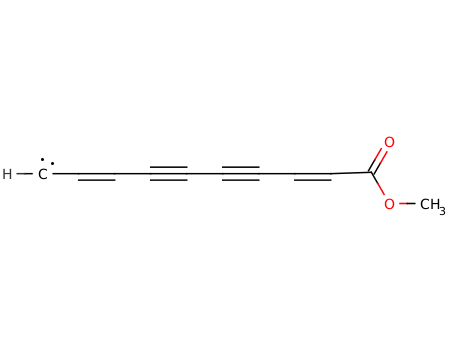 |
| Plant Source | Chrysoma pauciflosculosa (Michx.) Greene Common Name:NR |
| Source Family | Asteraceae (Compositae) |
| Origin | NR |
| Plant Part Used | Root |
| Extract | NR |
| Target Bacteria | Mycobacterium tuberculosis H37Rv |
| Assay / Test Done | Radiorespirometric Bioassay |
| Positive Control Used (conc.) | NR |
| Inhibition [%] | NR |
| Activity [MIC] µg/ml | 50 µg/ml |
| Activity (In terms of dilution) | NR |
| Activity (Zone of inhibition in mm) | NR |
| Active Compound Identified | (2E, 8Z) Matricaria ester |
| PubChem ID | NR |
| Ethnomedicinal Information | NR |
| PubMed ID [Source Literature] | 9810277 |
| Extract Preparation | NR |
| Chemical Classification [Active Compound] | Aliphatic, Alkene, Alkyne, Ester |
| Media / Broth Used [Antimicrobial Assay/Test] | NR |
| Cytotoxicity Assay [AID] | NR |
| Molecular Weight | 174.068 |
| Molecular Formula | C11H8O2 |
| SMILES | C(#CC#C/C=C/[CH])/C=C/C(=O)OC |
| XLogP | 3.071 |
| PSA | 26.300 |
| H-bond Donor | 0 |
| H-bond Acceptor | 2 |
| No. of Rotatable Bond Count | 2 |
| No. of Rings | 0 |
| No. of N | 0 |
| No. of O | 2 |
| No. of S | 0 |
| Reference(s) | 1) Lu T, Cantrell CL, Robbs SL, Franzblau SG, Fischer NH.Antimycobacterial matricaria esters and lactones from Astereae species.Planta Med. 1998 Oct;64(7):665-7
|
| Curator | Farzana-shamsudeen, vikramjitmandal |
| Compound ID | 3389 |
| Compound Structure | 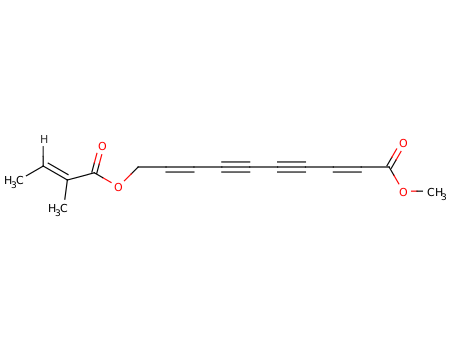 |
| Plant Source | Chrysoma pauciflosculosa (Michx.) Greene Common Name:NR |
| Source Family | Asteraceae (Compositae) |
| Origin | NR |
| Plant Part Used | Root |
| Extract | NR |
| Target Bacteria | Mycobacterium tuberculosis H37Rv |
| Assay / Test Done | Radiorespirometric Bioassay |
| Positive Control Used (conc.) | NR |
| Inhibition [%] | NR |
| Activity [MIC] µg/ml | 50 µg/ml |
| Activity (In terms of dilution) | NR |
| Activity (Zone of inhibition in mm) | NR |
| Active Compound Identified | (2Z, 8Z) Matricaria ester |
| PubChem ID | NR |
| Ethnomedicinal Information | NR |
| PubMed ID [Source Literature] | 9810277 |
| Extract Preparation | NR |
| Chemical Classification [Active Compound] | Aliphatic, Alkene, Alkyne, Ester, Acyl |
| Media / Broth Used [Antimicrobial Assay/Test] | NR |
| Cytotoxicity Assay [AID] | NR |
| Molecular Weight | 272.105 |
| Molecular Formula | C16H16O4 |
| SMILES | C(#CC#C/C=C/COC(=O)/C(=C/C)/C)/C=C/C(=O)OC |
| XLogP | 3.138 |
| PSA | 52.600 |
| H-bond Donor | 0 |
| H-bond Acceptor | 4 |
| No. of Rotatable Bond Count | 6 |
| No. of Rings | 0 |
| No. of N | 0 |
| No. of O | 4 |
| No. of S | 0 |
| Reference(s) | 1) Lu T, Cantrell CL, Robbs SL, Franzblau SG, Fischer NH.Antimycobacterial matricaria esters and lactones from Astereae species.Planta Med. 1998 Oct;64(7):665-7
|
| Curator | Farzana-shamsudeen, vikramjitmandal |
| Compound ID | 3400 |
| Compound Structure | 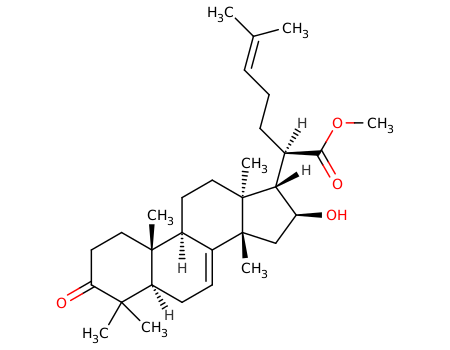 |
| Plant Source | Melia volkensii Gurke Common Name: |
| Source Family | Meliaceae |
| Origin | Voi, Kenya |
| Plant Part Used | Seed |
| Extract | Methanol |
| Target Bacteria | Mycobacterium tuberculosis H37Rv (ATCC 27 294) |
| Assay / Test Done | Radiorespirometric BACTEC Assay |
| Positive Control Used (conc.) | |
| Inhibition [%] | 99 % |
| Activity [MIC] µg/ml | 16 µg/ml |
| Activity (In terms of dilution) | |
| Activity (Zone of inhibition in mm) | |
| Active Compound Identified | Kulonate |
| PubChem ID | 490539 |
| Ethnomedicinal Information | Used in folk medicine to alleviate pain - tea prepared from bark |
| PubMed ID [Source Literature] | 10217705 |
| Extract Preparation | Crushed seeds (1 kg) were allowed to stand in 2 l of MeOH for 1 week |
| Chemical Classification [Active Compound] | Alicyclic, Tetracyclic, Steroid, Ester, Ketone, Alcohol |
| Media / Broth Used [Antimicrobial Assay/Test] | |
| Cytotoxicity Assay [AID] | |
| Molecular Weight | 526.366 |
| Molecular Formula | C33H50O5
|
| SMILES | O1[C@@H]2[C@H]([C@]3([C@](C2)(C2=CC[C@@H]4[C@@](C2CC3)(CCC(=O)C4(C)C)C)C)C)[C@@H]([C@H]1O)[C@@H](CCC=C(C)C)C(=O)OC |
| XLogP | 6.712 |
| PSA | 72.830 |
| H-bond Donor | 1 |
| H-bond Acceptor | 5 |
| No. of Rotatable Bond Count | 6 |
| No. of Rings | 5 |
| No. of N | 0 |
| No. of O | 5 |
| No. of S | 0 |
| Reference(s) | 1) Cantrell CL, Rajab MS, Franzblau SG, Fischer NH.Antimycobacterial triterpenes from Melia volkensii.J Nat Prod. 1999 Apr;62(4):546-8
|
| Curator | Vikramjitmandal |
| Compound ID | 3591 |
| Compound Structure |  |
| Plant Source | Ruprechtia trifolia Griseb Common Name: |
| Source Family | Polynaceae |
| Origin | |
| Plant Part Used | Aerial |
| Extract | Dichloromethane:Methanol |
| Target Bacteria | Mycobacterium tuberculosis H37Rv (ATCC 27294) |
| Assay / Test Done | Microplate Alamar Blue Assay (MABA) |
| Positive Control Used (conc.) | Rifampin (0.06 µg/ml) |
| Inhibition [%] | |
| Activity [MIC] µg/ml | 4 µg/ml |
| Activity (In terms of dilution) | |
| Activity (Zone of inhibition in mm) | |
| Active Compound Identified | 5α, 8α - Epidioxyergosta - 6, 22 - Dien - 3β - Yl Stearate |
| PubChem ID | NR |
| Ethnomedicinal Information | |
| PubMed ID [Source Literature] | 12898418 |
| Extract Preparation | |
| Chemical Classification [Active Compound] | Alicyclic, Tetracyclic, Steroid, Peroxy, Ester, Stearate |
| Media / Broth Used [Antimicrobial Assay/Test] | |
| Cytotoxicity Assay [AID] | |
| Molecular Weight | 694.590 |
| Molecular Formula | C46H78O4 |
| SMILES | C12[C@@]3([C@@]4(C=C[C@@]1(C1[C@](CC2)([C@H](CC1)[C@@H](/C=C/[C@@H](C(C)C)C)C)C)OO4)C[C@H](CC3)OC(=O)CCCCCCCCCCCCCCCCC)C |
| XLogP | 17.911 |
| PSA | 44.760 |
| H-bond Donor | 0 |
| H-bond Acceptor | 4 |
| No. of Rotatable Bond Count | 22 |
| No. of Rings | 3 |
| No. of N | 0 |
| No. of O | 4 |
| No. of S | 0 |
| Reference(s) | 1) Woldemichael GM, Franzblau SG, Zhang F, Wang Y, Timmermann BN.Inhibitory effect of sterols from Ruprechtia triflora and diterpenes from Calceolaria pinnifolia on the growth of Mycobacterium tuberculosis.Planta Med. 2003 Jul;69(7):628-31
|
| Curator | Rachana, vikramjitmandal |
| Compound ID | 3617 |
| Compound Structure |  |
| Plant Source | Piper sanctum (Miq.) Schl. Common Name: |
| Source Family | Piperaceae |
| Origin | Southcentral region of Mexico |
| Plant Part Used | Leaf |
| Extract | Dichloromethane:Methanol (1:1) |
| Target Bacteria | Mycobacterium tuberculosis H37Rv |
| Assay / Test Done | Microplate Alamar Blue Assay (MABA) |
| Positive Control Used (conc.) | Rifampin (0.25 µg/ml) |
| Inhibition [%] | |
| Activity [MIC] µg/ml | > 128 µg/ml |
| Activity (In terms of dilution) | |
| Activity (Zone of inhibition in mm) | |
| Active Compound Identified | Methyl [6 - (10 - Phenyldecanyl) Tetrahydropyran - 2 - Yl] Acetate |
| PubChem ID | 5273615 |
| Ethnomedicinal Information | |
| PubMed ID [Source Literature] | 15620234 |
| Extract Preparation | |
| Chemical Classification [Active Compound] | Aromatic, Alkyl, Pyran, Ester |
| Media / Broth Used [Antimicrobial Assay/Test] | |
| Cytotoxicity Assay [AID] | Against Vero cells (ATCCCCL-
81) in the CellTiter 96 aqueous nonradioactive cell
proliferation assay |
| Molecular Weight | 374.282 |
| Molecular Formula | C24H38O3 |
| SMILES | O1C(CCCC1CC(=O)OC)CCCCCCCCCCc1ccccc1 |
| XLogP | 9.628 |
| PSA | 35.530 |
| H-bond Donor | 0 |
| H-bond Acceptor | 3 |
| No. of Rotatable Bond Count | 14 |
| No. of Rings | 2 |
| No. of N | 0 |
| No. of O | 3 |
| No. of S | 0 |
| Reference(s) | 1) Mata R, Morales I, Pérez O, Rivero-Cruz I, Acevedo L, Enriquez-Mendoza I, Bye R, Franzblau S, Timmermann B.Antimycobacterial compounds from Piper sanctum.J Nat Prod. 2004 Dec;67(12):1961-8
|
| Curator | Rachana, Keyamukherjee, vikramjitmandal |
| Compound ID | 3618 |
| Compound Structure | 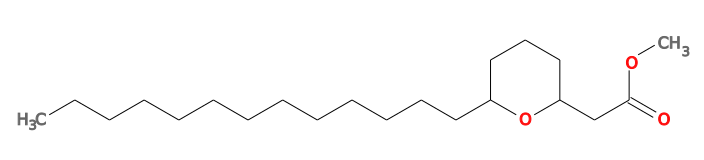 |
| Plant Source | Piper sanctum (Miq.) Schl. Common Name: |
| Source Family | Piperaceae |
| Origin | Southcentral region of Mexico |
| Plant Part Used | Leaf |
| Extract | Dichloromethane:Methanol (1:1) |
| Target Bacteria | Mycobacterium tuberculosis H37Rv |
| Assay / Test Done | Microplate Alamar Blue Assay (MABA) |
| Positive Control Used (conc.) | Rifampin (0.25 µg/ml) |
| Inhibition [%] | |
| Activity [MIC] µg/ml | > 128 µg/ml |
| Activity (In terms of dilution) | |
| Activity (Zone of inhibition in mm) | |
| Active Compound Identified | Methyl 2 - (6 - Tridecyltetrahydro - 2H - Pyran - 2 - Yl) Acetate |
| PubChem ID | 5273616 |
| Ethnomedicinal Information | |
| PubMed ID [Source Literature] | 15620234 |
| Extract Preparation | |
| Chemical Classification [Active Compound] | Alicyclic, Pyran, Ester |
| Media / Broth Used [Antimicrobial Assay/Test] | |
| Cytotoxicity Assay [AID] | Against Vero cells (ATCCCCL-
81) in the CellTiter 96 aqueous nonradioactive cell
proliferation assay |
| Molecular Weight | 340.298 |
| Molecular Formula | C21H40O3 |
| SMILES | O1C(CCCC1CC(=O)OC)CCCCCCCCCCCCC |
| XLogP | 7.859 |
| PSA | 35.530 |
| H-bond Donor | 0 |
| H-bond Acceptor | 3 |
| No. of Rotatable Bond Count | 15 |
| No. of Rings | 1 |
| No. of N | 0 |
| No. of O | 3 |
| No. of S | 0 |
| Reference(s) | 1) Mata R, Morales I, Pérez O, Rivero-Cruz I, Acevedo L, Enriquez-Mendoza I, Bye R, Franzblau S, Timmermann B.Antimycobacterial compounds from Piper sanctum.J Nat Prod. 2004 Dec;67(12):1961-8
|
| Curator | Rachana, Keyamukherjee, vikramjitmandal |
| Compound ID | 3619 |
| Compound Structure | 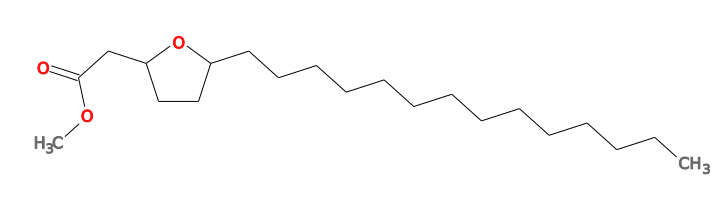 |
| Plant Source | Piper sanctum (Miq.) Schl. Common Name: |
| Source Family | Piperaceae |
| Origin | Southcentral region of Mexico |
| Plant Part Used | Leaf |
| Extract | Dichloromethane:Methanol (1:1) |
| Target Bacteria | Mycobacterium tuberculosis H37Rv |
| Assay / Test Done | Microplate Alamar Blue Assay (MABA) |
| Positive Control Used (conc.) | Rifampin (0.25 µg/ml) |
| Inhibition [%] | |
| Activity [MIC] µg/ml | > 128 µg/ml |
| Activity (In terms of dilution) | |
| Activity (Zone of inhibition in mm) | |
| Active Compound Identified | Methyl 2 - (5 - Tetradecyltetrahydro - 2 - Furanyl) Acetate |
| PubChem ID | 5273617 |
| Ethnomedicinal Information | |
| PubMed ID [Source Literature] | 15620234 |
| Extract Preparation | |
| Chemical Classification [Active Compound] | Alkylated Furan, Ester, Alicyclic |
| Media / Broth Used [Antimicrobial Assay/Test] | |
| Cytotoxicity Assay [AID] | Against Vero cells (ATCCCCL-
81) in the CellTiter 96 aqueous nonradioactive cell
proliferation assay |
| Molecular Weight | 340.298 |
| Molecular Formula | C21H40O3 |
| SMILES | O1C(CCC1CC(=O)OC)CCCCCCCCCCCCCC |
| XLogP | 8.070 |
| PSA | 35.530 |
| H-bond Donor | 0 |
| H-bond Acceptor | 3 |
| No. of Rotatable Bond Count | 16 |
| No. of Rings | 1 |
| No. of N | 0 |
| No. of O | 3 |
| No. of S | 0 |
| Reference(s) | 1) Mata R, Morales I, Pérez O, Rivero-Cruz I, Acevedo L, Enriquez-Mendoza I, Bye R, Franzblau S, Timmermann B.Antimycobacterial compounds from Piper sanctum.J Nat Prod. 2004 Dec;67(12):1961-8
|
| Curator | Rachana, Keyamukherjee, vikramjitmandal |
| Compound ID | 3667 |
| Compound Structure | 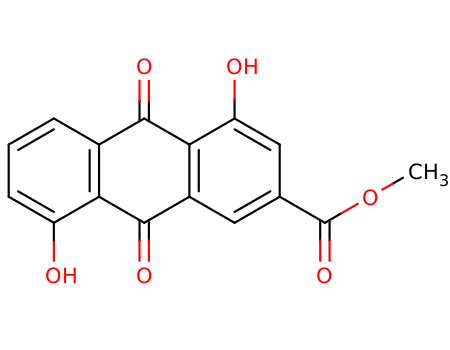 |
| Plant Source | Engelhardia roxburghiana Hay Common Name: |
| Source Family | Juglandaceae |
| Origin | |
| Plant Part Used | |
| Extract | |
| Target Bacteria | Mycobacterium tuberculosis H37Rv |
| Assay / Test Done | Agar - Dilution Test |
| Positive Control Used (conc.) | |
| Inhibition [%] | |
| Activity [MIC] µg/ml | NR |
| Activity (In terms of dilution) | |
| Activity (Zone of inhibition in mm) | |
| Active Compound Identified | 3-Methoxycarbonyl-1,5-dihydroxyanthraquinone |
| PubChem ID | NR |
| Ethnomedicinal Information | |
| PubMed ID [Source Literature] | 15729627 |
| Extract Preparation | |
| Chemical Classification [Active Compound] | Aromatic, Tricyclic, Anthraquinone, Ester, Phenol |
| Media / Broth Used [Antimicrobial Assay/Test] | |
| Cytotoxicity Assay [AID] | |
| Molecular Weight | 298.048 |
| Molecular Formula | C16H10O6 |
| SMILES | C1ccc(c2c1C(=O)c1c(C2=O)cc(cc1O)C(=O)OC)O |
| XLogP | 0.862 |
| PSA | 100.900 |
| H-bond Donor | 2 |
| H-bond Acceptor | 6 |
| No. of Rotatable Bond Count | 2 |
| No. of Rings | 3 |
| No. of N | 0 |
| No. of O | 6 |
| No. of S | 0 |
| Reference(s) | 1) Lin WY, Peng CF, Tsai IL, Chen JJ, Cheng MJ, Chen IS.Antitubercular constituents from the roots of Engelhardia roxburghiana.Planta Med. 2005 Feb;71(2):171-5
|
| Curator | Vsheeba, vikramjitmandal |
| Compound ID | 3674 |
| Compound Structure | 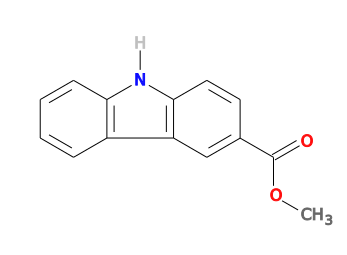 |
| Plant Source | Micromelum hirsutum Common Name: |
| Source Family | Rutaceae |
| Origin | |
| Plant Part Used | Stem bark |
| Extract | Dichloromethane |
| Target Bacteria | Mycobacterium tuberculosis H37Rv |
| Assay / Test Done | Fluorometric Alamar Blue Microassay (FMABA) |
| Positive Control Used (conc.) | Rifampin (0.040 ± 0.017 µg/ml) |
| Inhibition [%] | > 90 % |
| Activity [MIC] µg/ml | > 128 µg/ml |
| Activity (In terms of dilution) | NR |
| Activity (Zone of inhibition in mm) | NR |
| Active Compound Identified | Methyl Carbazole - 3 - Carboxylate |
| PubChem ID | 504069 |
| Ethnomedicinal Information | |
| PubMed ID [Source Literature] | 15770548 |
| Extract Preparation | The dried, milled stem bark of Micromelum hirsutum was extracted with CH2Cl2 to yield 45.5 g extract, of which 32.1 g were chromatographed by vacuum liquid chromatography over a silica gel column |
| Chemical Classification [Active Compound] | Aromatic, Tricyclic, Alkaloid, Carbazole, Ester |
| Media / Broth Used [Antimicrobial Assay/Test] | |
| Cytotoxicity Assay [AID] | Against Vero cells (ATCCCCL-
81) in the CellTiter 96 aqueous nonradioactive cell
proliferation assay |
| Molecular Weight | 225.079 |
| Molecular Formula | C14H11NO2 |
| SMILES | O(C(=O)c1cc2c3c([nH]c2cc1)cccc3)C |
| XLogP | 3.425 |
| PSA | 42.090 |
| H-bond Donor | 1 |
| H-bond Acceptor | 3 |
| No. of Rotatable Bond Count | 2 |
| No. of Rings | 3 |
| No. of N | 1 |
| No. of O | 2 |
| No. of S | 0 |
| Reference(s) | 1) Ma C, Case RJ, Wang Y, Zhang HJ, Tan GT, Van Hung N, Cuong NM, Franzblau SG, Soejarto DD, Fong HH, Pauli GF.Anti-tuberculosis constituents from the stem bark of Micromelum hirsutum.Planta Med. 2005 Mar;71(3):261-7
|
| Curator | Vikramjitmandal |
| Compound ID | 3972 |
| Compound Structure | |
| Plant Source | Solidago canadensis L. Common Name:Goldenrod, Woundwort |
| Source Family | Asteraceae (Compositae) |
| Origin | North America |
| Plant Part Used | |
| Extract | |
| Target Bacteria | Mycobacterium avium |
| Assay / Test Done | Radiorespirometric Bioassay |
| Positive Control Used (conc.) | Clarithroycin (1 - 2 µg/ml) |
| Inhibition [%] | |
| Activity [MIC] µg/ml | 25 µg/ml |
| Activity (In terms of dilution) | |
| Activity (Zone of inhibition in mm) | |
| Active Compound Identified | (2Z)-8-dehydromatricaria ester |
| PubChem ID | NR |
| Ethnomedicinal Information | Urinary and kidney infections and stones, catarrh. The plant has a cleansing action on the kidneys, and a reputation for clearing upper respiratory mucus |
| PubMed ID [Source Literature] | 9810277 |
| Extract Preparation | |
| Chemical Classification [Active Compound] | Aliphatic, Alkene, Alkyne, Ester |
| Media / Broth Used [Antimicrobial Assay/Test] | |
| Cytotoxicity Assay [AID] | |
| Molecular Weight | 174.068 |
| Molecular Formula | C11H10O2
|
| SMILES | C(=O)(OC)/C=C/C#CC#C/C=C/C |
| XLogP | 3.071 |
| PSA | 26.300 |
| H-bond Donor | 0 |
| H-bond Acceptor | 2 |
| No. of Rotatable Bond Count | 2 |
| No. of Rings | 0 |
| No. of N | 0 |
| No. of O | 2 |
| No. of S | 0 |
| Reference(s) | 1) Lu T, Cantrell CL, Robbs SL, Franzblau SG, Fischer NH.Antimycobacterial matricaria esters and lactones from Astereae species.Planta Med. 1998 Oct;64(7):665-7
2) http://www.anniesremedy.com/herb_detail365.php
|
| Curator | |
| Compound ID | 3806 |
| Compound Structure | 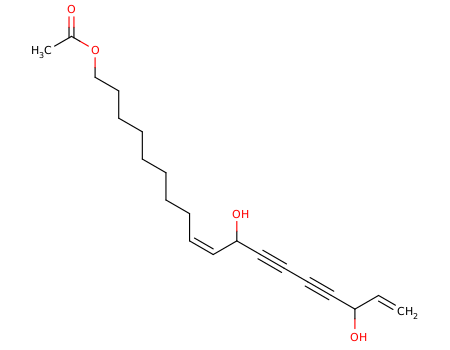 |
| Plant Source | Angelica sinensis Common Name:Dang Gui |
| Source Family | Apiaceae (Umbelliferae) |
| Origin | Northwest China |
| Plant Part Used | Root |
| Extract | NR |
| Target Bacteria | Mycobacterium tuberculosis H37Rv |
| Assay / Test Done | Microplate Alamar Blue Assay (MABA) |
| Positive Control Used (conc.) | Rifampin (0.06 µg/ml) |
| Inhibition [%] | NR |
| Activity [MIC] µg/ml | 25.3 µg/ml |
| Activity (In terms of dilution) | NR |
| Activity (Zone of inhibition in mm) | NR |
| Active Compound Identified | 9Z, 17 - Octadecadiene - 12, 14 - Diyne - 1, 11, 16 - Triol, 1 - Acetate |
| PubChem ID | NR |
| Ethnomedicinal Information | NR |
| PubMed ID [Source Literature] | 18567055 |
| Extract Preparation | 8 kg of the pulverized roots of Angelica sinensis Diels were extracted with methanol and the extract sequentially partitioned with petroleum ether, CHCl3, and BuOH |
| Chemical Classification [Active Compound] | Aliphatic, Alkene, Alkyne, Ester, Alcohol, O-Acetyl |
| Media / Broth Used [Antimicrobial Assay/Test] | Middlebrook 7H12 medium |
| Cytotoxicity Assay [AID] | Against Vero cells |
| Molecular Weight | 332.199 |
| Molecular Formula | C20H28O4 |
| SMILES | C(=O)(C)OCCCCCCCC/C=C\C(O)C#CC#CC(C=C)O |
| XLogP | 4.117 |
| PSA | 66.760 |
| H-bond Donor | 2 |
| H-bond Acceptor | 4 |
| No. of Rotatable Bond Count | 12 |
| No. of Rings | 0 |
| No. of N | 0 |
| No. of O | 4 |
| No. of S | 0 |
| Reference(s) | 1) Deng S, Wang Y, Inui T, Chen SN, Farnsworth NR, Cho S, Franzblau SG, Pauli GF.Anti-TB polyynes from the roots of Angelica sinensis.Phytother Res. 2008 Jul;22(7):878-82
|
| Curator | KeyaMukherjee, reshmi, Farzana Shamsudeen, Vikramjitmandal |
| Compound ID | 3811 |
| Compound Structure | |
| Plant Source | Angelica sinensis Common Name:Dang Gui |
| Source Family | Apiaceae (Umbelliferae) |
| Origin | Northwest China |
| Plant Part Used | Root |
| Extract | NR |
| Target Bacteria | Mycobacterium tuberculosis (Erdman) |
| Assay / Test Done | Microplate Alamar Blue Assay (MABA) |
| Positive Control Used (conc.) | Rifampin (0.05 µg/ml) |
| Inhibition [%] | NR |
| Activity [MIC] µg/ml | 1.4 µg/ml |
| Activity (In terms of dilution) | NR |
| Activity (Zone of inhibition in mm) | NR |
| Active Compound Identified | 9Z, 17 - Octadecadiene - 12, 14 - Diyne - 1, 11, 16 - Triol, 1 - Acetate |
| PubChem ID | NR |
| Ethnomedicinal Information | NR |
| PubMed ID [Source Literature] | 18567055 |
| Extract Preparation | 8 kg of the pulverized roots of Angelica sinensis Diels were extracted with methanol and the extract sequentially partitioned with petroleum ether, CHCl3, and BuOH |
| Chemical Classification [Active Compound] | Aliphatic, Alkene, Alkyne, Ester, Alcohol, O-Acetyl |
| Media / Broth Used [Antimicrobial Assay/Test] | Middlebrook 7H12 medium |
| Cytotoxicity Assay [AID] | Against Vero cells |
| Molecular Weight | 332.199 |
| Molecular Formula | C20H28O4 |
| SMILES | C(=O)(C)OCCCCCCCC/C=C\C(O)C#CC#CC(C=C)O |
| XLogP | 4.117 |
| PSA | 66.760 |
| H-bond Donor | 2 |
| H-bond Acceptor | 4 |
| No. of Rotatable Bond Count | 12 |
| No. of Rings | 0 |
| No. of N | 0 |
| No. of O | 4 |
| No. of S | 0 |
| Reference(s) | 1) Deng S, Wang Y, Inui T, Chen SN, Farnsworth NR, Cho S, Franzblau SG, Pauli GF.Anti-TB polyynes from the roots of Angelica sinensis.Phytother Res. 2008 Jul;22(7):878-82
|
| Curator | KeyaMukherjee, reshmi, Farzana Shamsudeen, Vikramjitmandal |
| Compound ID | 3874 |
| Compound Structure |  |
| Plant Source | Cananga odorata Common Name:Ylang - Ylang Tree |
| Source Family | Annonaceae |
| Origin | Colombia |
| Plant Part Used | Flower |
| Extract | Essential oil (1.2 %) |
| Target Bacteria | Mycobacterium tuberculosis H37Rv |
| Assay / Test Done | Macrodilution method in glass tubes |
| Positive Control Used (conc.) | Isoniazid (0.19 ± 0.07 µg/ml), Rifampin (0.3 ± 0.21 µg/ml) |
| Inhibition [%] | NR |
| Activity [MIC] µg/ml | 300 ± 217 µg/ml |
| Activity (In terms of dilution) | NR |
| Activity (Zone of inhibition in mm) | NR |
| Active Compound Identified | Benzyl benzoate (14.2 %) |
| PubChem ID | 2345 |
| Ethnomedicinal Information | Stomach ailment, fever, inflammation, burning sensation, malarial fever, asthma with aromatherapy, hypertension, anxiety, depression and as a sexual stimulant |
| PubMed ID [Source Literature] | 19753839 |
| Extract Preparation | The essential oils were extracted from a 300 g sample of plant leaves and stems by microwave - assisted hydrodistillation (30 min, 250 ml water), using a Clevenger - type distillation apparatus and a Dean - Stark distillation trap in a domestic microwave oven. Sodium sulfate was added as a drying agent to the decanted essential oil |
| Chemical Classification [Active Compound] | Aromatic, Ester
|
| Media / Broth Used [Antimicrobial Assay/Test] | Lowestein - Jensenn medium, Middlebrook 7H9 medium [The later was supplemented with 10 % OADC (Oleic Acid - Albumin - Dextrose - Catalase) and 0.001 % Tween 80] |
| Cytotoxicity Assay [AID] | NR |
| Molecular Weight | 212.084 |
| Molecular Formula | C14H12O2 |
| SMILES | O(Cc1ccccc1)C(=O)c1ccccc1 |
| XLogP | 5.895 |
| PSA | 26.300 |
| H-bond Donor | 0 |
| H-bond Acceptor | 2 |
| No. of Rotatable Bond Count | 4 |
| No. of Rings | 2 |
| No. of N | 0 |
| No. of O | 2 |
| No. of S | 0 |
| Reference(s) | 1) Bueno-Sánchez JG, Martínez-Morales JR, Stashenko EE, Ribón W.Anti-tubercular activity of eleven aromatic and medicinal plants occurring in Colombia.Biomedica. 2009 Mar;29(1):51-60
2) http://ayurvedicmedicinalplants.com/index.php?option=com_zoom&Itemid=26&page=view&catid=3&key=10&hit=1
|
| Curator | KeyaMukherjee, Farzana Shamsudeen |
| Compound ID | 3878 |
| Compound Structure | |
| Plant Source | Cananga odorata Common Name:Ylang - Ylang Tree |
| Source Family | Annonaceae |
| Origin | Colombia |
| Plant Part Used | Flower |
| Extract | Essential oil (1.2 %) |
| Target Bacteria | Mycobacterium tuberculosis H37Rv |
| Assay / Test Done | Macrodilution method in glass tubes |
| Positive Control Used (conc.) | Isoniazid (0.19 ± 0.07 µg/ml), Rifampin (0.3 ± 0.21 µg/ml) |
| Inhibition [%] | NR |
| Activity [MIC] µg/ml | 300 ± 217 µg/ml |
| Activity (In terms of dilution) | NR |
| Activity (Zone of inhibition in mm) | NR |
| Active Compound Identified | Geranyl acetate (2.9 %) |
| PubChem ID | 1549026 |
| Ethnomedicinal Information | Stomach ailment, fever, inflammation, burning sensation, malarial fever, asthma with aromatherapy, hypertension, anxiety, depression and as a sexual stimulant |
| PubMed ID [Source Literature] | 19753839 |
| Extract Preparation | The essential oils were extracted from a 300 g sample of plant leaves and stems by microwave - assisted hydrodistillation (30 min, 250 ml water), using a Clevenger - type distillation apparatus and a Dean - Stark distillation trap in a domestic microwave oven. Sodium sulfate was added as a drying agent to the decanted essential oil |
| Chemical Classification [Active Compound] | Aliphatic, Alkene, Ester |
| Media / Broth Used [Antimicrobial Assay/Test] | Lowestein - Jensenn medium, Middlebrook 7H9 medium [The later was supplemented with 10 % OADC (Oleic Acid - Albumin - Dextrose - Catalase) and 0.001 % Tween 80] |
| Cytotoxicity Assay [AID] | NR |
| Molecular Weight | 196.146 |
| Molecular Formula | C12H20O2 |
| SMILES | O(C/C=C(/CCC=C(C)C)C)C(=O)C |
| XLogP | 3.264 |
| PSA | 26.300 |
| H-bond Donor | 0 |
| H-bond Acceptor | 2 |
| No. of Rotatable Bond Count | 6 |
| No. of Rings | 0 |
| No. of N | 0 |
| No. of O | 2 |
| No. of S | 0 |
| Reference(s) | 1) Bueno-Sánchez JG, Martínez-Morales JR, Stashenko EE, Ribón W.Anti-tubercular activity of eleven aromatic and medicinal plants occurring in Colombia.Biomedica. 2009 Mar;29(1):51-60
2) http://ayurvedicmedicinalplants.com/index.php?option=com_zoom&Itemid=26&page=view&catid=3&key=10&hit=1
|
| Curator | KeyaMukherjee, Farzana Shamsudeen |
| Compound ID | 3881 |
| Compound Structure | 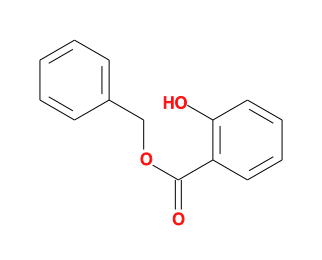 |
| Plant Source | Cananga odorata Common Name:Ylang - Ylang Tree |
| Source Family | Annonaceae |
| Origin | Colombia |
| Plant Part Used | Flower |
| Extract | Essential oil (1.2 %) |
| Target Bacteria | Mycobacterium tuberculosis H37Rv |
| Assay / Test Done | Macrodilution method in glass tubes |
| Positive Control Used (conc.) | Isoniazid (0.19 ± 0.07 µg/ml), Rifampin (0.3 ± 0.21 µg/ml) |
| Inhibition [%] | NR |
| Activity [MIC] µg/ml | 125 ± 0.01 µg/ml |
| Activity (In terms of dilution) | NR |
| Activity (Zone of inhibition in mm) | NR |
| Active Compound Identified | Benzyl salicylate (2.3 %) |
| PubChem ID | 8363 |
| Ethnomedicinal Information | Stomach ailment, fever, inflammation, burning sensation, malarial fever, asthma with aromatherapy, hypertension, anxiety, depression and as a sexual stimulant |
| PubMed ID [Source Literature] | 19753839 |
| Extract Preparation | The essential oils were extracted from a 300 g sample of plant leaves and stems by microwave - assisted hydrodistillation (30 min, 250 ml water), using a Clevenger - type distillation apparatus and a Dean - Stark distillation trap in a domestic microwave oven. Sodium sulfate was added as a drying agent to the decanted essential oil |
| Chemical Classification [Active Compound] | Aromatic, Ester, Phenol |
| Media / Broth Used [Antimicrobial Assay/Test] | Lowestein - Jensenn medium, Middlebrook 7H9 medium [The later was supplemented with 10 % OADC (Oleic Acid - Albumin - Dextrose - Catalase) and 0.001 % Tween 80] |
| Cytotoxicity Assay [AID] | NR |
| Molecular Weight | 228.079 |
| Molecular Formula | C14H12O3 |
| SMILES | O(Cc1ccccc1)C(=O)c1c(O)cccc1 |
| XLogP | 5.493 |
| PSA | 46.530 |
| H-bond Donor | 1 |
| H-bond Acceptor | 3 |
| No. of Rotatable Bond Count | 4 |
| No. of Rings | 2 |
| No. of N | 0 |
| No. of O | 3 |
| No. of S | 0 |
| Reference(s) | 1) Bueno-Sánchez JG, Martínez-Morales JR, Stashenko EE, Ribón W.Anti-tubercular activity of eleven aromatic and medicinal plants occurring in Colombia.Biomedica. 2009 Mar;29(1):51-60
2) http://ayurvedicmedicinalplants.com/index.php?option=com_zoom&Itemid=26&page=view&catid=3&key=10&hit=1
|
| Curator | KeyaMukherjee, Farzana Shamsudeen |