| Compound ID | 2537 |
| Compound Structure | 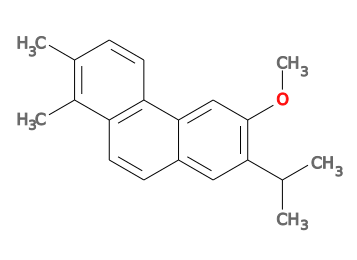 |
| Plant Source | Salvia multicaulis Vahl Common Name: |
| Source Family | Lamiaceae |
| Origin | Turkey |
| Plant Part Used | Root |
| Extract | Acetone |
| Target Bacteria | Mycobacterium tuberculosis H37Ra |
| Assay / Test Done | Micro Broth Dilution Method |
| Positive Control Used (conc.) | Rifampin (0.0047 – 0.0095 µg/ml), Isoniazid (0.05 – 0.1 µg/ml), Kanamycin (2.5 – 5.0 µg/ml) |
| Inhibition [%] | |
| Activity [MIC] µg/ml | 5.6 µg/ml |
| Activity (In terms of dilution) | |
| Activity (Zone of inhibition in mm) | |
| Active Compound Identified | Multicaulin |
| PubChem ID | 467782 |
| Ethnomedicinal Information | Used in traditional medicine and have been associated with antibacterial, antituberculous and antiphlogistic activities |
| PubMed ID [Source Literature] | 9428161 |
| Extract Preparation | The powdered roots of S. multicaulis (940 g) were extracted with acetone in a Soxhlet apparatus. The extract was evaporated in vacuo to give 23 g of a residue. The residue was fractionated by column chromatography on a silica gel column, eluted with petroleum ether, followed by a gradient of EtOAc up to 100% and then with EtOH. After TLC analysis, the combined fractions were purified by vacuum-liquid chromatography (VLC), eluting with petroleum ether and ethyl acetate |
| Chemical Classification [Active Compound] | Aromatic, Tricyclic, Phenanthrene, Ether |
| Media / Broth Used [Antimicrobial Assay/Test] | N/A |
| Cytotoxicity Assay [AID] | N/A |
| Molecular Weight | 278.167 |
| Molecular Formula | C20H22O
|
| SMILES | O(c1c(C(C)C)cc2c(c3c(c(c(cc3)C)C)cc2)c1)C |
| XLogP | 8.150 |
| PSA | 9.230 |
| H-bond Donor | 0 |
| H-bond Acceptor | 1 |
| No. of Rotatable Bond Count | 2 |
| No. of Rings | 3 |
| No. of N | 0 |
| No. of O | 1 |
| No. of S | 0 |
| Reference(s) | 1) Ulubelen A, Topcu G, Johansson CB.Norditerpenoids and diterpenoids from Salvia multicaulis with antituberculous activity.J Nat Prod. 1997 Dec;60(12):1275-80
|
| Curator | |
| Compound ID | 2538 |
| Compound Structure | 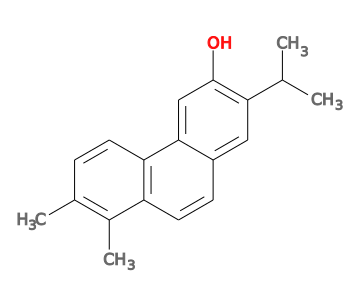 |
| Plant Source | Salvia multicaulis Vahl Common Name: |
| Source Family | Lamiaceae |
| Origin | Turkey |
| Plant Part Used | Root |
| Extract | Acetone |
| Target Bacteria | Mycobacterium tuberculosis H37Ra |
| Assay / Test Done | Micro Broth Dilution Method |
| Positive Control Used (conc.) | |
| Inhibition [%] | |
| Activity [MIC] µg/ml | 0.46 µg/ml |
| Activity (In terms of dilution) | |
| Activity (Zone of inhibition in mm) | |
| Active Compound Identified | 12 - demethylmulticauline |
| PubChem ID | 467783 |
| Ethnomedicinal Information | Used in traditional medicine and have been associated with antibacterial, antituberculous and antiphlogistic activities |
| PubMed ID [Source Literature] | 9428161 |
| Extract Preparation | The powdered roots of S. multicaulis (940 g) were extracted with acetone in a Soxhlet apparatus. The extract was evaporated in vacuo to give 23 g of a residue. The residue was fractionated by column chromatography on a silica gel column, eluted with petroleum ether, followed by a gradient of EtOAc up to 100% and then with EtOH. After TLC analysis, the combined fractions were purified by vacuum-liquid chromatography (VLC), eluting with petroleum ether and ethyl acetate |
| Chemical Classification [Active Compound] | Aromatic, Tricyclic, Phenanthrene, Phenol |
| Media / Broth Used [Antimicrobial Assay/Test] | N/A |
| Cytotoxicity Assay [AID] | N/A |
| Molecular Weight | 264.151 |
| Molecular Formula | C19H20O
|
| SMILES | Oc1c(C(C)C)cc2c(c3c(c(c(cc3)C)C)cc2)c1 |
| XLogP | 7.631 |
| PSA | 20.230 |
| H-bond Donor | 1 |
| H-bond Acceptor | 1 |
| No. of Rotatable Bond Count | 1 |
| No. of Rings | 3 |
| No. of N | 0 |
| No. of O | 1 |
| No. of S | 0 |
| Reference(s) | 1) Ulubelen A, Topcu G, Johansson CB.Norditerpenoids and diterpenoids from Salvia multicaulis with antituberculous activity.J Nat Prod. 1997 Dec;60(12):1275-80
|
| Curator | |
| Compound ID | 2539 |
| Compound Structure | 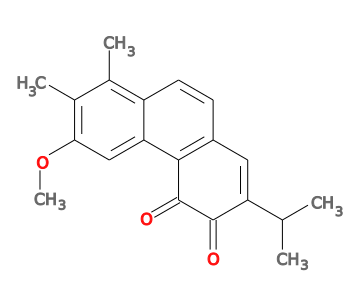 |
| Plant Source | Salvia multicaulis Vahl Common Name: |
| Source Family | Lamiaceae |
| Origin | Turkey |
| Plant Part Used | Root |
| Extract | Acetone |
| Target Bacteria | Mycobacterium tuberculosis H37Ra |
| Assay / Test Done | Micro Broth Dilution Method |
| Positive Control Used (conc.) | |
| Inhibition [%] | |
| Activity [MIC] µg/ml | 2 µg/ml |
| Activity (In terms of dilution) | |
| Activity (Zone of inhibition in mm) | |
| Active Compound Identified | Multiorthoquinone |
| PubChem ID | 467784 |
| Ethnomedicinal Information | Used in traditional medicine and have been associated with antibacterial, antituberculous and antiphlogistic activities |
| PubMed ID [Source Literature] | 9428161 |
| Extract Preparation | The powdered roots of S. multicaulis (940 g) were extracted with acetone in a Soxhlet apparatus. The extract was evaporated in vacuo to give 23 g of a residue. The residue was fractionated by column chromatography on a silica gel column, eluted with petroleum ether, followed by a gradient of EtOAc up to 100% and then with EtOH. After TLC analysis, the combined fractions were purified by vacuum-liquid chromatography (VLC), eluting with petroleum ether and ethyl acetate |
| Chemical Classification [Active Compound] | Aromatic, Phenanthrene, Quinone, Ether |
| Media / Broth Used [Antimicrobial Assay/Test] | N/A |
| Cytotoxicity Assay [AID] | N/A |
| Molecular Weight | 308.141 |
| Molecular Formula | C20H20O3
|
| SMILES | O(c1c(c(c2c(c3c(C=C(C(C)C)C(=O)C3=O)cc2)c1)C)C)C |
| XLogP | 4.636 |
| PSA | 43.370 |
| H-bond Donor | 0 |
| H-bond Acceptor | 3 |
| No. of Rotatable Bond Count | 2 |
| No. of Rings | 3 |
| No. of N | 0 |
| No. of O | 3 |
| No. of S | 0 |
| Reference(s) | 1) Ulubelen A, Topcu G, Johansson CB.Norditerpenoids and diterpenoids from Salvia multicaulis with antituberculous activity.J Nat Prod. 1997 Dec;60(12):1275-80
|
| Curator | |
| Compound ID | 2540 |
| Compound Structure | 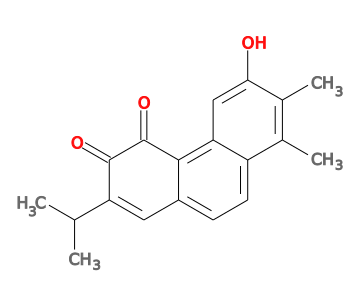 |
| Plant Source | Salvia multicaulis Vahl Common Name: |
| Source Family | Lamiaceae |
| Origin | Turkey |
| Plant Part Used | Root |
| Extract | Acetone |
| Target Bacteria | Mycobacterium tuberculosis H37Ra |
| Assay / Test Done | Micro Broth Dilution Method |
| Positive Control Used (conc.) | |
| Inhibition [%] | |
| Activity [MIC] µg/ml | 1.2 µg/ml |
| Activity (In terms of dilution) | |
| Activity (Zone of inhibition in mm) | |
| Active Compound Identified | 12 - Demethylmultiorthoquinone |
| PubChem ID | 467785 |
| Ethnomedicinal Information | Used in traditional medicine and have been associated with antibacterial, antituberculous and antiphlogistic activities |
| PubMed ID [Source Literature] | 9428161 |
| Extract Preparation | The powdered roots of S. multicaulis (940 g) were extracted with acetone in a Soxhlet apparatus. The extract was evaporated in vacuo to give 23 g of a residue. The residue was fractionated by column chromatography on a silica gel column, eluted with petroleum ether, followed by a gradient of EtOAc up to 100% and then with EtOH. After TLC analysis, the combined fractions were purified by vacuum-liquid chromatography (VLC), eluting with petroleum ether and ethyl acetate |
| Chemical Classification [Active Compound] | Aromatic, Phenanthrene, Quinone, Phenol |
| Media / Broth Used [Antimicrobial Assay/Test] | N/A |
| Cytotoxicity Assay [AID] | N/A |
| Molecular Weight | 294.126 |
| Molecular Formula | C19H18O3
|
| SMILES | O=C1c2c3c(c(c(c(O)c3)C)C)ccc2C=C(C(C)C)C1=O |
| XLogP | 4.117 |
| PSA | 54.370 |
| H-bond Donor | 1 |
| H-bond Acceptor | 3 |
| No. of Rotatable Bond Count | 1 |
| No. of Rings | 3 |
| No. of N | 0 |
| No. of O | 3 |
| No. of S | 0 |
| Reference(s) | 1) Ulubelen A, Topcu G, Johansson CB.Norditerpenoids and diterpenoids from Salvia multicaulis with antituberculous activity.J Nat Prod. 1997 Dec;60(12):1275-80
|
| Curator | |
| Compound ID | 3627 |
| Compound Structure |  |
| Plant Source | Piper sanctum (Miq.) Schl. Common Name: |
| Source Family | Piperaceae |
| Origin | Southcentral region of Mexico |
| Plant Part Used | Leaf |
| Extract | Dichloromethane:Methanol (1:1) |
| Target Bacteria | Mycobacterium tuberculosis H37Rv |
| Assay / Test Done | Microplate Alamar Blue Assay (MABA) |
| Positive Control Used (conc.) | Rifampin (0.25 µg/ml) |
| Inhibition [%] | |
| Activity [MIC] µg/ml | 12 µg/ml |
| Activity (In terms of dilution) | |
| Activity (Zone of inhibition in mm) | |
| Active Compound Identified | Cepharanone B |
| PubChem ID | 162739 |
| Ethnomedicinal Information | |
| PubMed ID [Source Literature] | 15620234 |
| Extract Preparation | |
| Chemical Classification [Active Compound] | Aromatic, Tetracyclic, Alkaloid, Phenanthrene, Amide, Ether, |
| Media / Broth Used [Antimicrobial Assay/Test] | |
| Cytotoxicity Assay [AID] | Against Vero cells (ATCCCCL-
81) in the CellTiter 96 aqueous nonradioactive cell
proliferation assay |
| Molecular Weight | 279.090 |
| Molecular Formula | C17H13NO3 |
| SMILES | O(c1c2c3c([nH]c(=O)c3cc1OC)cc1c2cccc1)C |
| XLogP | 3.379 |
| PSA | 47.560 |
| H-bond Donor | 1 |
| H-bond Acceptor | 4 |
| No. of Rotatable Bond Count | 2 |
| No. of Rings | 4 |
| No. of N | 1 |
| No. of O | 3 |
| No. of S | 0 |
| Reference(s) | 1) Mata R, Morales I, Pérez O, Rivero-Cruz I, Acevedo L, Enriquez-Mendoza I, Bye R, Franzblau S, Timmermann B.Antimycobacterial compounds from Piper sanctum.J Nat Prod. 2004 Dec;67(12):1961-8
|
| Curator | Rachana, Keyamukherjee, vikramjitmandal |
| Compound ID | 3634 |
| Compound Structure |  |
| Plant Source | Piper sanctum (Miq.) Schl. Common Name: |
| Source Family | Piperaceae |
| Origin | Southcentral region of Mexico |
| Plant Part Used | Stem |
| Extract | Dichloromethane:Methanol (1:1) |
| Target Bacteria | Mycobacterium tuberculosis H37Rv |
| Assay / Test Done | Microplate Alamar Blue Assay (MABA) |
| Positive Control Used (conc.) | Rifampin (0.25 µg/ml) |
| Inhibition [%] | |
| Activity [MIC] µg/ml | 8 µg/ml |
| Activity (In terms of dilution) | |
| Activity (Zone of inhibition in mm) | |
| Active Compound Identified | Piperolactam A |
| PubChem ID | 3081016 |
| Ethnomedicinal Information | |
| PubMed ID [Source Literature] | 15620234 |
| Extract Preparation | Leaves (1 kg) and stems (2.95 kg) of Piper sanctum were separately air - dried, ground and extracted by maceration with a mixture of CH2Cl2 - MeOH, 1:1 (12 l x 5, respectively), at room temperature. The extracts were concentrated in vacuo to yield 162.4 and 95 g of dry residues, respectively |
| Chemical Classification [Active Compound] | Aromatic, Tetracyclic, Alkaloid, Phenanthrene, Amide, Ether, Phenol |
| Media / Broth Used [Antimicrobial Assay/Test] | |
| Cytotoxicity Assay [AID] | |
| Molecular Weight | 265.074 |
| Molecular Formula | C16H11NO3 |
| SMILES | O(c1c(O)c2c3c([nH]c(=O)c3c1)cc1c2cccc1)C |
| XLogP | 2.860 |
| PSA | 58.560 |
| H-bond Donor | 2 |
| H-bond Acceptor | 4 |
| No. of Rotatable Bond Count | 1 |
| No. of Rings | 4 |
| No. of N | 1 |
| No. of O | 3 |
| No. of S | 0 |
| Reference(s) | 1) Mata R, Morales I, Pérez O, Rivero-Cruz I, Acevedo L, Enriquez-Mendoza I, Bye R, Franzblau S, Timmermann B.Antimycobacterial compounds from Piper sanctum.J Nat Prod. 2004 Dec;67(12):1961-8
|
| Curator | Rachana, Keyamukherjee, vikramjitmandal |
