| Compound ID | 1923 |
| Compound Structure | |
| Plant Source | Inula racemosa Hook. f. syn. Inula helenium L. Common Name:Elecampane (English), Pushkaramula, Pushkara, Paushkara, Padmapatra, Kaashmira, Kushtha - bheda (Sanskrit) |
| Source Family | Asteraceae (Compositae) |
| Origin | India |
| Plant Part Used | Root |
| Extract | Hexane, dichloromethane |
| Target Bacteria | Mycobacterium tuberculosis |
| Assay / Test Done | Radiorespirometric Bioassay |
| Positive Control Used (conc.) | Rifampin (0.25 – 0.125 µg/ml) |
| Inhibition [%] | 100 % |
| Activity [MIC] µg/ml | 100 µg/ml |
| Activity (In terms of dilution) | |
| Activity (Zone of inhibition in mm) | |
| Active Compound Identified | |
| PubChem ID | NR |
| Ethnomedicinal Information | Tuberculosis, lung disorders, cough, expectorant, random screening, bronchitis |
| PubMed ID [Source Literature] | 10364842 |
| Extract Preparation | N/A |
| Chemical Classification [Active Compound] | N/A |
| Media / Broth Used [Antimicrobial Assay/Test] | N/A |
| Cytotoxicity Assay [AID] | N/A |
| Reference(s) | 1) Cantrell CL, Abate L, Fronczek FR, Franzblau SG, Quijano L, Fischer NH.Antimycobacterial eudesmanolides from Inula helenium and Rudbeckia subtomentosa.Planta Med. 1999 May;65(4):351-5
2) Kirtikar, K.R., Basu, B.D., 1935. Indian Medicinal Plants, vols. 1–4. Lalit Mohan Basu, Allahabad, India
|
| Curator | |
| Compound ID | 1993 |
| Compound Structure | |
| Plant Source | Lantana trifolia L. Common Name:Shrub Verbena |
| Source Family | Verbenaceae |
| Origin | America, Kenya |
| Plant Part Used | Leaf |
| Extract | Hexane, dichloromethane |
| Target Bacteria | Mycobacterium tuberculosis H37Rv (ATCC 27 294) |
| Assay / Test Done | Microplate Alamar Blue Assay (MABA) |
| Positive Control Used (conc.) | Rifampin |
| Inhibition [%] | |
| Activity [MIC] µg/ml | 100 µg/ml |
| Activity (In terms of dilution) | |
| Activity (Zone of inhibition in mm) | |
| Active Compound Identified | |
| PubChem ID | NR |
| Ethnomedicinal Information | Heart problems, gonorrhea, tuberculosis, coughs |
| PubMed ID [Source Literature] | |
| Extract Preparation | N/A |
| Chemical Classification [Active Compound] | N/A |
| Media / Broth Used [Antimicrobial Assay/Test] | N/A |
| Cytotoxicity Assay [AID] | N/A |
| Reference(s) | 1) LEITAO, Suzana G. et al. Screening of Central and South American plant extracts for antimycobacterial activity by the Alamar Blue test. Rev. bras. farmacogn. [online]. 2006, vol.16, n.1, pp. 6-11
|
| Curator | |
| Compound ID | 2066 |
| Compound Structure | |
| Plant Source | Lippia lacunosa Common Name: |
| Source Family | Verbenaceae |
| Origin | USA |
| Plant Part Used | Leaf |
| Extract | Hexane, dichloromethane |
| Target Bacteria | Mycobacterium tuberculosis (ATCC 27294 H37Rv) |
| Assay / Test Done | Microplate Alamar Blue Assay (MABA) |
| Positive Control Used (conc.) | Rifampin |
| Inhibition [%] | |
| Activity [MIC] µg/ml | 100 µg/ml |
| Activity (In terms of dilution) | |
| Activity (Zone of inhibition in mm) | |
| Active Compound Identified | |
| PubChem ID | NR |
| Ethnomedicinal Information | Tuberculosis |
| PubMed ID [Source Literature] | |
| Extract Preparation | N/A |
| Chemical Classification [Active Compound] | N/A |
| Media / Broth Used [Antimicrobial Assay/Test] | N/A |
| Cytotoxicity Assay [AID] | N/A |
| Reference(s) | 1) LEITAO, Suzana G. et al. Screening of Central and South American plant extracts for antimycobacterial activity by the Alamar Blue test. Rev. bras. farmacogn. [online]. 2006, vol.16, n.1, pp. 6-11
|
| Curator | |
| Compound ID | 2078 |
| Compound Structure | |
| Plant Source | Lippia rotundifolia Common Name: |
| Source Family | Verbenaceae |
| Origin | USA |
| Plant Part Used | Leaf |
| Extract | Hexane, dichloromethane |
| Target Bacteria | Mycobacterium tuberculosis (ATCC 27294 H37Rv) |
| Assay / Test Done | Microplate Alamar Blue Assay (MABA) |
| Positive Control Used (conc.) | Rifampin |
| Inhibition [%] | |
| Activity [MIC] µg/ml | 100 µg/ml |
| Activity (In terms of dilution) | |
| Activity (Zone of inhibition in mm) | |
| Active Compound Identified | |
| PubChem ID | NR |
| Ethnomedicinal Information | Tuberculosis |
| PubMed ID [Source Literature] | |
| Extract Preparation | N/A |
| Chemical Classification [Active Compound] | N/A |
| Media / Broth Used [Antimicrobial Assay/Test] | N/A |
| Cytotoxicity Assay [AID] | N/A |
| Reference(s) | 1) LEITAO, Suzana G. et al. Screening of Central and South American plant extracts for antimycobacterial activity by the Alamar Blue test. Rev. bras. farmacogn. [online]. 2006, vol.16, n.1, pp. 6-11
|
| Curator | |
| Compound ID | 3090 |
| Compound Structure | 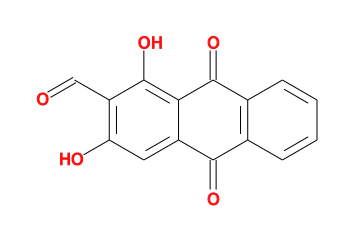 |
| Plant Source | Prismatomeris fragrans E.T. Geddes Common Name:Khao - San |
| Source Family | Rubiaceae |
| Origin | Northeastern, Eastern and Southeastern parts of Thailand and in the Northwest of Laos |
| Plant Part Used | Root, stem |
| Extract | Hexane, dichloromethane |
| Target Bacteria | Mycobacterium tuberculosis H37Ra |
| Assay / Test Done | Microplate Alamar Blue Assay (MABA) |
| Positive Control Used (conc.) | Kanamycin Sulphate (2.5 µg/ml), Isoniazid (0.05 µg/ml) |
| Inhibition [%] | NR |
| Activity [MIC] µg/ml | 100 µg/ml |
| Activity (In terms of dilution) | NR |
| Activity (Zone of inhibition in mm) | NR |
| Active Compound Identified | Nordamnacanthal |
| PubChem ID | 160712 |
| Ethnomedicinal Information | Antimalarial, antifungal |
| PubMed ID [Source Literature] | 15885942 |
| Extract Preparation | Air dried roots and stems ground and extracted with solvents hexane and dichloromethane |
| Chemical Classification [Active Compound] | Aromatic, Tricyclic, Quinone, Phenol, Aldehyde |
| Media / Broth Used [Antimicrobial Assay/Test] | NR |
| Cytotoxicity Assay [AID] | Against human epidermoid carcinoma in the mouth (KB), human breast cancer cells (BC), human lung cancer cells (NCI - H187) |
| Molecular Weight | 268.037 |
| Molecular Formula | C15H8O5 |
| SMILES | Oc1c2c(C(=O)c3c(C2=O)cccc3)cc(O)c1C=O |
| XLogP | 2.235 |
| PSA | 91.670 |
| H-bond Donor | 2 |
| H-bond Acceptor | 5 |
| No. of Rotatable Bond Count | 1 |
| No. of Rings | 3 |
| No. of N | 0 |
| No. of O | 5 |
| No. of S | 0 |
| Reference(s) | 1) Kanokmedhakul K, Kanokmedhakul S, Phatchana R.Biological activity of Anthraquinones and Triterpenoids from Prismatomeris fragrans.J Ethnopharmacol. 2005 Sep 14;100(3):284-8
|
| Curator | KeyaMukherjee |
| Compound ID | 3091 |
| Compound Structure |  |
| Plant Source | Prismatomeris fragrans E.T. Geddes Common Name:Khao - San |
| Source Family | Rubiaceae |
| Origin | Northeastern, Eastern and Southeastern parts of Thailand and in the Northwest of Laos |
| Plant Part Used | Root, stem |
| Extract | Hexane, dichloromethane |
| Target Bacteria | Mycobacterium tuberculosis H37Ra |
| Assay / Test Done | Microplate Alamar Blue Assay (MABA) |
| Positive Control Used (conc.) | Kanamycin Sulphate (2.5 µg/ml), Isoniazid (0.05 µg/ml) |
| Inhibition [%] | NR |
| Activity [MIC] µg/ml | 25 µg/ml |
| Activity (In terms of dilution) | NR |
| Activity (Zone of inhibition in mm) | NR |
| Active Compound Identified | Damnacanthal |
| PubChem ID | 2948 |
| Ethnomedicinal Information | Antimalarial, antifungal |
| PubMed ID [Source Literature] | 15885942 |
| Extract Preparation | Air dried roots and stems ground and extracted with solvents hexane and dichloromethane |
| Chemical Classification [Active Compound] | Aromatic, Tricyclic, Alkaloid, Anthraquinone, Aldehyde |
| Media / Broth Used [Antimicrobial Assay/Test] | NR |
| Cytotoxicity Assay [AID] | Against human epidermoid carcinoma in the mouth (KB), human breast cancer cells (BC), human lung cancer cells (NCI - H187) |
| Molecular Weight | 282.053 |
| Molecular Formula | C16H10O5 |
| SMILES | O(c1c2c(C(=O)c3c(C2=O)cccc3)cc(O)c1C=O)C |
| XLogP | 2.325 |
| PSA | 80.670 |
| H-bond Donor | 1 |
| H-bond Acceptor | 5 |
| No. of Rotatable Bond Count | 2 |
| No. of Rings | 3 |
| No. of N | 0 |
| No. of O | 5 |
| No. of S | 0 |
| Reference(s) | 1) Kanokmedhakul K, Kanokmedhakul S, Phatchana R.Biological activity of Anthraquinones and Triterpenoids from Prismatomeris fragrans.J Ethnopharmacol. 2005 Sep 14;100(3):284-8
|
| Curator | KeyaMukherjee |
