| Compound ID | 1069 |
| Compound Structure |  |
| Plant Source | Agelica sinensis Common Name:Female Ginseng |
| Source Family | Apiaceae (Umbelliferae) |
| Origin | China |
| Plant Part Used | Root |
| Extract | Petroleum ether, chloroform |
| Target Bacteria | Mycobacterium tuberculosis (Erdman) |
| Assay / Test Done | Microplate Alamar Blue Assay (MABA) |
| Positive Control Used (conc.) | Rifampin (0.05 µg/ml) |
| Inhibition [%] | >= 90 % |
| Activity [MIC] µg/ml | 49.5 µg/ml |
| Activity (In terms of dilution) | |
| Activity (Zone of inhibition in mm) | |
| Active Compound Identified | Oplopandiol |
| PubChem ID | 6474833 |
| Ethnomedicinal Information | To treat gynecological ailments, fatigue, mild anemia and high blood pressure |
| PubMed ID [Source Literature] | 18567055, 12696940 |
| Extract Preparation | N/A |
| Chemical Classification [Active Compound] | Aliphatic, Alkene, Alkyne, Alcohol |
| Media / Broth Used [Antimicrobial Assay/Test] | N/A |
| Cytotoxicity Assay [AID] | N/A |
| Molecular Weight | 262.193 |
| Molecular Formula | C17H26O2
|
| SMILES | O[C@@H](/C=CCCCCCCC)C#CC#C[C@@H](O)CC |
| XLogP | 4.977 |
| PSA | 40.460 |
| H-bond Donor | 2 |
| H-bond Acceptor | 2 |
| No. of Rotatable Bond Count | 8 |
| No. of Rings | 0 |
| No. of N | 0 |
| No. of O | 2 |
| No. of S | 0 |
| Reference(s) | 1) Deng S, Wang Y, Inui T, Chen SN, Farnsworth NR, Cho S, Franzblau SG, Pauli GF.Anti-TB polyynes from the roots of Angelica sinensis.Phytother Res. 2008 Jul;22(7):878-82
2) Zhao KJ, Dong TT, Tu PF, Song ZH, Lo CK, Tsim KW (April 2003).Molecular genetic and chemical assessment of radix Angelica (Danggui) in China. J. Agric. Food Chem. 51 (9): 2576.83
|
| Curator | |
| Compound ID | 3744 |
| Compound Structure | 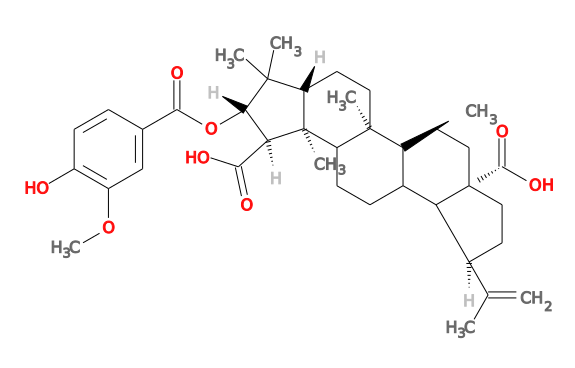 |
| Plant Source | Ziziphus cambodiana Pierre Common Name:NR |
| Source Family | Rhamnaceae |
| Origin | Northeast of Thailand |
| Plant Part Used | Root bark |
| Extract | NR |
| Target Bacteria | Mycobacterium tuberculosis H37Ra |
| Assay / Test Done | Microplate Alamar Blue Assay (MABA) |
| Positive Control Used (conc.) | Rifampin (0.004 µg/ml), Isoniazid (0.06 µg/ml), Kanamycin sulphate (2.5 µg/ml) |
| Inhibition [%] | >= 90 % |
| Activity [MIC] µg/ml | 25 µg/ml |
| Activity (In terms of dilution) | |
| Activity (Zone of inhibition in mm) | NR |
| Active Compound Identified | 3-O-Vanillylceanothic acid |
| PubChem ID | 11988338 |
| Ethnomedicinal Information | Malaria, tuberculosis |
| PubMed ID [Source Literature] | 16595959 |
| Extract Preparation | Pulverized, dry root bark (4.85 kg) of Ziziphus cambodiana was defatted with hexane and then extracted successively with ethyl acetate (EtOAc) and Methanol (MeOH) at 50°C for 50 h, and the solvents were evaporated to yield EtOAc (60.4 g) and MeOH (629.3 g) extracts, respectively |
| Chemical Classification [Active Compound] | Alicyclic, Pentacyclic, Terpene, Triterpene, Vanillyl, Acid |
| Media / Broth Used [Antimicrobial Assay/Test] | |
| Cytotoxicity Assay [AID] | N/A |
| Molecular Weight | 636.366 |
| Molecular Formula | C38H52O8 |
| SMILES | O([C@@H]1C([C@H]2[C@@](C3[C@]([C@]4(C(C5[C@@](CC4)(CC[C@H]5C(=C)C)C(=O)O)CC3)C)(CC2)C)([C@H]1C(=O)O)C)(C)C)C(=O)c1cc(OC)c(O)cc1 |
| XLogP | 9.336 |
| PSA | 130.360 |
| H-bond Donor | 3 |
| H-bond Acceptor | 8 |
| No. of Rotatable Bond Count | 7 |
| No. of Rings | 6 |
| No. of N | 0 |
| No. of O | 8 |
| No. of S | 0 |
| Reference(s) | 1) Suksamrarn S, Panseeta P, Kunchanawatta S, Distaporn T, Ruktasing S, Suksamrarn A.Ceanothane- and lupane-type triterpenes with antiplasmodial and antimycobacterial activities from Ziziphus cambodiana.Chem Pharm Bull (Tokyo). 2006 Apr;54(4):535-7
|
| Curator | Vikramjitmandal, rachanake |
| Compound ID | 3745 |
| Compound Structure | 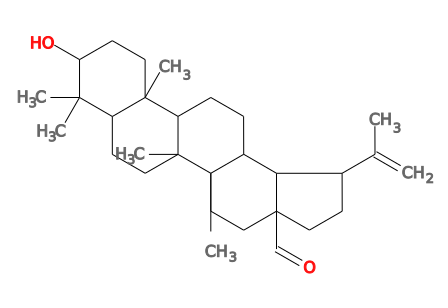 |
| Plant Source | Ziziphus cambodiana Pierre Common Name:NR |
| Source Family | Rhamnaceae |
| Origin | Northeast of Thailand |
| Plant Part Used | Root bark |
| Extract | NR |
| Target Bacteria | Mycobacterium tuberculosis H37Ra |
| Assay / Test Done | Microplate Alamar Blue Assay (MABA) |
| Positive Control Used (conc.) | Rifampin (0.004 µg/ml), Isoniazid (0.06 µg/ml), Kanamycin sulphate (2.5 µg/ml) |
| Inhibition [%] | >= 90 % |
| Activity [MIC] µg/ml | 25 µg/ml |
| Activity (In terms of dilution) | |
| Activity (Zone of inhibition in mm) | NR |
| Active Compound Identified | Betulinaldehyde |
| PubChem ID | 317607 |
| Ethnomedicinal Information | Malaria, tuberculosis |
| PubMed ID [Source Literature] | 16595959 |
| Extract Preparation | Pulverized, dry root bark (4.85 kg) of Ziziphus cambodiana was defatted with hexane and then extracted successively with ethyl acetate (EtOAc) and Methanol (MeOH) at 50°C for 50 h, and the solvents were evaporated to yield EtOAc (60.4 g) and MeOH (629.3 g) extracts, respectively |
| Chemical Classification [Active Compound] | Alicyclic, Pentacyclic, Terpene, Triterpene, Aldehyde, Alcohol |
| Media / Broth Used [Antimicrobial Assay/Test] | |
| Cytotoxicity Assay [AID] | N/A |
| Molecular Weight | 440.365 |
| Molecular Formula | C30H48O2 |
| SMILES | OC1C(C2C(C3C(C4(C(C5C(CC4)(CCC5C(=C)C)C=O)CC3)C)(CC2)C)(CC1)C)(C)C |
| XLogP | 9.821 |
| PSA | 37.300 |
| H-bond Donor | 1 |
| H-bond Acceptor | 2 |
| No. of Rotatable Bond Count | 2 |
| No. of Rings | 5 |
| No. of N | 0 |
| No. of O | 2 |
| No. of S | 0 |
| Reference(s) | 1) Suksamrarn S, Panseeta P, Kunchanawatta S, Distaporn T, Ruktasing S, Suksamrarn A.Ceanothane- and lupane-type triterpenes with antiplasmodial and antimycobacterial activities from Ziziphus cambodiana.Chem Pharm Bull (Tokyo). 2006 Apr;54(4):535-7
|
| Curator | Vikramjitmandal, rachanake |
| Compound ID | 3746 |
| Compound Structure |  |
| Plant Source | Ziziphus cambodiana Pierre Common Name:NR |
| Source Family | Rhamnaceae |
| Origin | Northeast of Thailand |
| Plant Part Used | Root bark |
| Extract | NR |
| Target Bacteria | Mycobacterium tuberculosis H37Ra |
| Assay / Test Done | Microplate Alamar Blue Assay (MABA) |
| Positive Control Used (conc.) | Rifampin (0.004 µg/ml), Isoniazid (0.06 µg/ml), Kanamycin sulphate (2.5 µg/ml) |
| Inhibition [%] | >= 90 % |
| Activity [MIC] µg/ml | 25 µg/ml |
| Activity (In terms of dilution) | |
| Activity (Zone of inhibition in mm) | NR |
| Active Compound Identified | Betulinic acid |
| PubChem ID | 64971 |
| Ethnomedicinal Information | Malaria, tuberculosis |
| PubMed ID [Source Literature] | 16595959 |
| Extract Preparation | Pulverized, dry root bark (4.85 kg) of Ziziphus cambodiana was defatted with hexane and then extracted successively with ethyl acetate (EtOAc) and Methanol (MeOH) at 50°C for 50 h, and the solvents were evaporated to yield EtOAc (60.4 g) and MeOH (629.3 g) extracts, respectively |
| Chemical Classification [Active Compound] | Alicyclic, Pentacyclic, Terpene, Triterpene, Alcohol, Acid |
| Media / Broth Used [Antimicrobial Assay/Test] | |
| Cytotoxicity Assay [AID] | N/A |
| Molecular Weight | 456.360 |
| Molecular Formula | C30H48O3 |
| SMILES | O[C@@H]1C([C@H]2[C@@]([C@@H]3[C@]([C@]4([C@@H]([C@@H]5[C@@](CC4)(CC[C@H]5C(=C)C)C(=O)O)CC3)C)(CC2)C)(CC1)C)(C)C |
| XLogP | 9.407 |
| PSA | 57.530 |
| H-bond Donor | 2 |
| H-bond Acceptor | 3 |
| No. of Rotatable Bond Count | 2 |
| No. of Rings | 5 |
| No. of N | 0 |
| No. of O | 3 |
| No. of S | 0 |
| Reference(s) | 1) Suksamrarn S, Panseeta P, Kunchanawatta S, Distaporn T, Ruktasing S, Suksamrarn A.Ceanothane- and lupane-type triterpenes with antiplasmodial and antimycobacterial activities from Ziziphus cambodiana.Chem Pharm Bull (Tokyo). 2006 Apr;54(4):535-7
|
| Curator | Vikramjitmandal, rachanake |
| Compound ID | 3747 |
| Compound Structure |  |
| Plant Source | Ziziphus cambodiana Pierre Common Name:NR |
| Source Family | Rhamnaceae |
| Origin | Northeast of Thailand |
| Plant Part Used | Root bark |
| Extract | NR |
| Target Bacteria | Mycobacterium tuberculosis H37Ra |
| Assay / Test Done | Microplate Alamar Blue Assay (MABA) |
| Positive Control Used (conc.) | Rifampin (0.004 µg/ml), Isoniazid (0.06 µg/ml), Kanamycin sulphate (2.5 µg/ml) |
| Inhibition [%] | >= 90 % |
| Activity [MIC] µg/ml | 12.5 µg/ml (IC50 : 0.9) |
| Activity (In terms of dilution) | |
| Activity (Zone of inhibition in mm) | NR |
| Active Compound Identified | 2-O-E-p-Coumaroylalphitolic |
| PubChem ID | 15958446 |
| Ethnomedicinal Information | |
| PubMed ID [Source Literature] | 16595959 |
| Extract Preparation | Pulverized, dry root bark (4.85 kg) of Ziziphus cambodiana was defatted with hexane and then extracted successively with ethyl acetate (EtOAc) and Methanol (MeOH) at 50°C for 50 h, and the solvents were evaporated to yield EtOAc (60.4 g) and MeOH (629.3 g) extracts, respectively |
| Chemical Classification [Active Compound] | Alicyclic, Pentacyclic, Terpene, Triterpene, Alcohol, Acid, Cinnamoyl, Phenol |
| Media / Broth Used [Antimicrobial Assay/Test] | |
| Cytotoxicity Assay [AID] | |
| Molecular Weight | 618.392 |
| Molecular Formula | C39H54O6 |
| SMILES | O([C@@H]1C[C@@]2(C3[C@]([C@]4(C(C5[C@@](CC4)(CC[C@H]5C(=C)C)C(=O)O)CC3)C)(CC[C@H]2C([C@H]1O)(C)C)C)C)C(=O)/C=C/c1ccc(O)cc1 |
| XLogP | 10.872 |
| PSA | 104.060 |
| H-bond Donor | 3 |
| H-bond Acceptor | 6 |
| No. of Rotatable Bond Count | 6 |
| No. of Rings | 6 |
| No. of N | 0 |
| No. of O | 6 |
| No. of S | 0 |
| Reference(s) | 1) Suksamrarn S, Panseeta P, Kunchanawatta S, Distaporn T, Ruktasing S, Suksamrarn A.Ceanothane- and lupane-type triterpenes with antiplasmodial and antimycobacterial activities from Ziziphus cambodiana.Chem Pharm Bull (Tokyo). 2006 Apr;54(4):535-7
|
| Curator | Vikramjitmandal, rachanake |
| Compound ID | 3748 |
| Compound Structure |  |
| Plant Source | Ziziphus cambodiana Pierre Common Name:NR |
| Source Family | Rhamnaceae |
| Origin | Northeast of Thailand |
| Plant Part Used | Root bark |
| Extract | NR |
| Target Bacteria | Mycobacterium tuberculosis H37Ra |
| Assay / Test Done | Microplate Alamar Blue Assay (MABA) |
| Positive Control Used (conc.) | Rifampin (0.004 µg/ml), Isoniazid (0.06 µg/ml), Kanamycin sulphate (2.5 µg/ml) |
| Inhibition [%] | >= 90 % |
| Activity [MIC] µg/ml | 50 µg/ml |
| Activity (In terms of dilution) | NR |
| Activity (Zone of inhibition in mm) | NR |
| Active Compound Identified | Alphitolic acid |
| PubChem ID | 470606 |
| Ethnomedicinal Information | Malaria, tuberculosis |
| PubMed ID [Source Literature] | 16595959 |
| Extract Preparation | Pulverized, dry root bark (4.85 kg) of Ziziphus cambodiana was defatted with hexane and then extracted successively with ethyl acetate (EtOAc) and Methanol (MeOH) at 50°C for 50 h, and the solvents were evaporated to yield EtOAc (60.4 g) and MeOH (629.3 g) extracts, respectively |
| Chemical Classification [Active Compound] | Alicyclic, Pentacyclic, Terpene, Triterpene, Alcohol, Acid |
| Media / Broth Used [Antimicrobial Assay/Test] | |
| Cytotoxicity Assay [AID] | N/A |
| Molecular Weight | 470.340 |
| Molecular Formula | C30H46O4 |
| SMILES | O[C@@H]1C(C2[C@@](C3[C@]([C@]4(C(=CC3)C3[C@@](CC4)(CC[C@H]3C(=C)C)C(=O)O)C)(CC2)C)(C[C@H]1O)C)(C)C |
| XLogP | 7.326 |
| PSA | 77.760 |
| H-bond Donor | 3 |
| H-bond Acceptor | 4 |
| No. of Rotatable Bond Count | 2 |
| No. of Rings | 5 |
| No. of N | 0 |
| No. of O | 4 |
| No. of S | 0 |
| Reference(s) | 1) Suksamrarn S, Panseeta P, Kunchanawatta S, Distaporn T, Ruktasing S, Suksamrarn A.Ceanothane- and lupane-type triterpenes with antiplasmodial and antimycobacterial activities from Ziziphus cambodiana.Chem Pharm Bull (Tokyo). 2006 Apr;54(4):535-7
|
| Curator | Vikramjitmandal, rachanake |
| Compound ID | 3749 |
| Compound Structure |  |
| Plant Source | Ziziphus cambodiana Pierre Common Name:NR |
| Source Family | Rhamnaceae |
| Origin | Northeast of Thailand |
| Plant Part Used | Root bark |
| Extract | NR |
| Target Bacteria | Mycobacterium tuberculosis H37Ra |
| Assay / Test Done | Microplate Alamar Blue Assay (MABA) |
| Positive Control Used (conc.) | Rifampin (0.004 µg/ml), Isoniazid (0.06 µg/ml), Kanamycin sulphate (2.5 µg/ml) |
| Inhibition [%] | >= 90 % |
| Activity [MIC] µg/ml | 50 µg/ml |
| Activity (In terms of dilution) | |
| Activity (Zone of inhibition in mm) | NR |
| Active Compound Identified | Zizyberanalic acid |
| PubChem ID | 15958447 |
| Ethnomedicinal Information | Malaria, tuberculosis |
| PubMed ID [Source Literature] | 16595959 |
| Extract Preparation | Pulverized, dry root bark (4.85 kg) of Ziziphus cambodiana was defatted with hexane and then extracted successively with ethyl acetate (EtOAc) and Methanol (MeOH) at 50°C for 50 h, and the solvents were evaporated to yield EtOAc (60.4 g) and MeOH (629.3 g) extracts, respectively |
| Chemical Classification [Active Compound] | Alicyclic, Pentacyclic, Terpene, Triterpene, Alcohol, Aldehyde, Acid |
| Media / Broth Used [Antimicrobial Assay/Test] | |
| Cytotoxicity Assay [AID] | N/A |
| Molecular Weight | 470.340 |
| Molecular Formula | C30H46O4 |
| SMILES | O[C@H]1C([C@H]2[C@@](C3[C@]([C@]4(C(C5[C@@](CC4)(CC[C@H]5C(=C)C)C(=O)O)CC3)C)(CC2)C)([C@@H]1C=O)C)(C)C |
| XLogP | 8.733 |
| PSA | 74.600 |
| H-bond Donor | 2 |
| H-bond Acceptor | 4 |
| No. of Rotatable Bond Count | 3 |
| No. of Rings | 5 |
| No. of N | 0 |
| No. of O | 4 |
| No. of S | 0 |
| Reference(s) | 1) Suksamrarn S, Panseeta P, Kunchanawatta S, Distaporn T, Ruktasing S, Suksamrarn A.Ceanothane- and lupane-type triterpenes with antiplasmodial and antimycobacterial activities from Ziziphus cambodiana.Chem Pharm Bull (Tokyo). 2006 Apr;54(4):535-7
|
| Curator | Vikramjitmandal, rachanake |
| Compound ID | 3750 |
| Compound Structure | |
| Plant Source | Ziziphus cambodiana Pierre Common Name:NR |
| Source Family | Rhamnaceae |
| Origin | Northeast of Thailand |
| Plant Part Used | Root bark |
| Extract | NR |
| Target Bacteria | Mycobacterium tuberculosis H37Ra |
| Assay / Test Done | Microplate Alamar Blue Assay (MABA) |
| Positive Control Used (conc.) | Rifampin (0.004 µg/ml), Isoniazid (0.06 µg/ml), Kanamycin sulphate (2.5 µg/ml) |
| Inhibition [%] | >= 90 % |
| Activity [MIC] µg/ml | 100 µg/ml |
| Activity (In terms of dilution) | |
| Activity (Zone of inhibition in mm) | NR |
| Active Compound Identified | Zizyberenalic acid |
| PubChem ID | 15958447 |
| Ethnomedicinal Information | Malaria, tuberculosis |
| PubMed ID [Source Literature] | 16595959 |
| Extract Preparation | Pulverized, dry root bark (4.85 kg) of Ziziphus cambodiana was defatted with hexane and then extracted successively with ethyl acetate (EtOAc) and Methanol (MeOH) at 50°C for 50 h, and the solvents were evaporated to yield EtOAc (60.4 g) and MeOH (629.3 g) extracts, respectively |
| Chemical Classification [Active Compound] | Alicyclic, Pentacyclic, Terpene, Triterpene, Alcohol, Aldehyde, Acid |
| Media / Broth Used [Antimicrobial Assay/Test] | |
| Cytotoxicity Assay [AID] | N/A |
| Molecular Weight | 470.340 |
| Molecular Formula | C30H46O4 |
| SMILES | O[C@H]1C([C@H]2[C@@](C3[C@]([C@]4(C(C5[C@@](CC4)(CC[C@H]5C(=C)C)C(=O)O)CC3)C)(CC2)C)([C@@H]1C=O)C)(C)C |
| XLogP | 8.733 |
| PSA | 74.600 |
| H-bond Donor | 2 |
| H-bond Acceptor | 4 |
| No. of Rotatable Bond Count | 3 |
| No. of Rings | 5 |
| No. of N | 0 |
| No. of O | 4 |
| No. of S | 0 |
| Reference(s) | 1) Suksamrarn S, Panseeta P, Kunchanawatta S, Distaporn T, Ruktasing S, Suksamrarn A.Ceanothane- and lupane-type triterpenes with antiplasmodial and antimycobacterial activities from Ziziphus cambodiana.Chem Pharm Bull (Tokyo). 2006 Apr;54(4):535-7
|
| Curator | Vikramjitmandal, rachanake |
| Compound ID | 1074 |
| Compound Structure | |
| Plant Source | Agelica sinensis Common Name:Female Ginseng |
| Source Family | Apiaceae (Umbelliferae) |
| Origin | China |
| Plant Part Used | Root |
| Extract | Petroleum ether, chloroform |
| Target Bacteria | Mycobacterium tuberculosis H37Rv |
| Assay / Test Done | Microplate Alamar Blue Assay (MABA) |
| Positive Control Used (conc.) | Rifampin (0.06 µg/ml) |
| Inhibition [%] | >= 90 % |
| Activity [MIC] µg/ml | 50.2 µg/ml |
| Activity (In terms of dilution) | |
| Activity (Zone of inhibition in mm) | |
| Active Compound Identified | Oplopandiol |
| PubChem ID | 6474833 |
| Ethnomedicinal Information | To treat gynecological ailments, fatigue, mild anemia and high blood pressure |
| PubMed ID [Source Literature] | 18567055, 12696940 |
| Extract Preparation | N/A |
| Chemical Classification [Active Compound] | Aliphatic, Alkene, Alkyne, Alcohol |
| Media / Broth Used [Antimicrobial Assay/Test] | N/A |
| Cytotoxicity Assay [AID] | N/A |
| Molecular Weight | 262.193 |
| Molecular Formula | C17H26O2
|
| SMILES | O[C@@H](/C=CCCCCCCC)C#CC#C[C@@H](O)CC |
| XLogP | 4.977 |
| PSA | 40.460 |
| H-bond Donor | 2 |
| H-bond Acceptor | 2 |
| No. of Rotatable Bond Count | 8 |
| No. of Rings | 0 |
| No. of N | 0 |
| No. of O | 2 |
| No. of S | 0 |
| Reference(s) | 1) Deng S, Wang Y, Inui T, Chen SN, Farnsworth NR, Cho S, Franzblau SG, Pauli GF.Anti-TB polyynes from the roots of Angelica sinensis.Phytother Res. 2008 Jul;22(7):878-82
2) Zhao KJ, Dong TT, Tu PF, Song ZH, Lo CK, Tsim KW (April 2003).Molecular genetic and chemical assessment of radix Angelica (Danggui) in China. J. Agric. Food Chem. 51 (9): 2576.83
|
| Curator | |
