| Compound ID | 3715 |
| Compound Structure |  |
| Plant Source | Harrisonia perforata Common Name: |
| Source Family | Simaroubaceae |
| Origin | Hainan, Cambodia, Cochin, China, Burma and West Malaysia |
| Plant Part Used | Branch |
| Extract | Ethanol (95 %) |
| Target Bacteria | Mycobacterium tuberculosis H37Ra |
| Assay / Test Done | Microplate Alamar Blue Assay (MABA) |
| Positive Control Used (conc.) | Isoniazid (0.04 - 0.09 µg/ml), Kanamycin sulphate (2.0 - 5.1 µg/ml) |
| Inhibition [%] | NR |
| Activity [MIC] µg/ml | 50 µg/ml |
| Activity (In terms of dilution) | NR |
| Activity (Zone of inhibition in mm) | NR |
| Active Compound Identified | Peucenin - 7 - Methyl Ether |
| PubChem ID | NR |
| Ethnomedicinal Information | Antimalarial activity, Tuberculosis |
| PubMed ID [Source Literature] | 16394547 |
| Extract Preparation | The branches of Harrisonia perforata (5.1 kg) were extracted with 95 % EtOH at room temperature. The ethanolic extract was filtered and evaporated to a dark brown viscous oil (186.3 g). The extract was partitioned between water (500 ml) and EtOAc (3 x 500 ml) and the water layer was further extracted with n-BuOH (3 x 400 ml). After evaporation, the EtOAc-, n-BuOH- and water - soluble fractions gave a brown viscous oil (69.8 g), a dark brown viscous oil (25.7 g) and a light brown viscous oil (50.8 g), respectively. The ethyl acetate soluble fraction is separated by flash column chromatography using silica gel |
| Chemical Classification [Active Compound] | Aromatic, Bicyclic, Chromone, Prenylated, Ether, Phenol |
| Media / Broth Used [Antimicrobial Assay/Test] | |
| Cytotoxicity Assay [AID] | |
| Molecular Weight | 274.121 |
| Molecular Formula | C16H18O4 |
| SMILES | C1(c(c(cc2c1c(=O)cc(o2)C)OC)CC=C(C)C)O |
| XLogP | 1.989 |
| PSA | 46.530 |
| H-bond Donor | 1 |
| H-bond Acceptor | 3 |
| No. of Rotatable Bond Count | 3 |
| No. of Rings | 2 |
| No. of N | 0 |
| No. of O | 4 |
| No. of S | 0 |
| Reference(s) | 1) Tuntiwachwuttikul P, Phansa P, Pootaeng-On Y, Taylor WC.Chromones from the branches of Harrisonia perforata.Chem Pharm Bull (Tokyo). 2006 Jan;54(1):44-7
|
| Curator | Vikramjitmandal, Reshmi |
| Compound ID | 3717 |
| Compound Structure |  |
| Plant Source | Harrisonia perforata Common Name: |
| Source Family | Simaroubaceae |
| Origin | Hainan, Cambodia, Cochin, China, Burma and West Malaysia |
| Plant Part Used | Branch |
| Extract | Ethanol (95 %) |
| Target Bacteria | Mycobacterium tuberculosis H37Ra |
| Assay / Test Done | Microplate Alamar Blue Assay (MABA) |
| Positive Control Used (conc.) | Isoniazid (0.04 - 0.09 µg/ml), Kanamycin sulphate (2.0 - 5.3 µg/ml) |
| Inhibition [%] | NR |
| Activity [MIC] µg/ml | 200 µg/ml |
| Activity (In terms of dilution) | NR |
| Activity (Zone of inhibition in mm) | NR |
| Active Compound Identified | Perforamone A |
| PubChem ID | 11572850 |
| Ethnomedicinal Information | Antimalarial activity |
| PubMed ID [Source Literature] | 16394547 |
| Extract Preparation | The branches of Harrisonia perforata (5.1 kg) were extracted with 95 % EtOH at room temperature. The ethanolic extract was filtered and evaporated to a dark brown viscous oil (186.3 g). The extract was partitioned between water (500 ml) and EtOAc (3 x 500 ml) and the water layer was further extracted with n-BuOH (3 x 400 ml). After evaporation, the EtOAc-, n-BuOH- and water - soluble fractions gave a brown viscous oil (69.8 g), a dark brown viscous oil (25.7 g) and a light brown viscous oil (50.8 g), respectively. The ethyl acetate soluble fraction is separated by flash column chromatography using silica gel |
| Chemical Classification [Active Compound] | Aromatic, Bicyclic, Chromone, Epoxy, Ether, Phenol |
| Media / Broth Used [Antimicrobial Assay/Test] | |
| Cytotoxicity Assay [AID] | |
| Molecular Weight | 290.115 |
| Molecular Formula | C16H18O5 |
| SMILES | O1C(C1Cc1c2oc(cc(=O)c2c(O)cc1OC)C)(C)C |
| XLogP | 1.056 |
| PSA | 59.060 |
| H-bond Donor | 1 |
| H-bond Acceptor | 4 |
| No. of Rotatable Bond Count | 3 |
| No. of Rings | 3 |
| No. of N | 0 |
| No. of O | 5 |
| No. of S | 0 |
| Reference(s) | 1) Tuntiwachwuttikul P, Phansa P, Pootaeng-On Y, Taylor WC.Chromones from the branches of Harrisonia perforata.Chem Pharm Bull (Tokyo). 2006 Jan;54(1):44-7
|
| Curator | Vikramjitmandal, Reshmi |
| Compound ID | 3718 |
| Compound Structure | 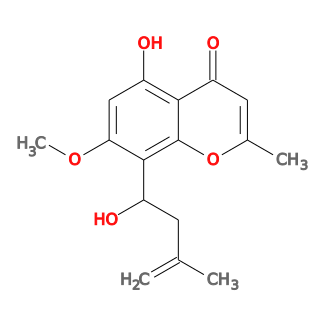 |
| Plant Source | Harrisonia perforata Common Name: |
| Source Family | Simaroubaceae |
| Origin | Hainan, Cambodia, Cochin, China, Burma and West Malaysia |
| Plant Part Used | Branch |
| Extract | Ethanol (95 %) |
| Target Bacteria | Mycobacterium tuberculosis H37Ra |
| Assay / Test Done | Microplate Alamar Blue Assay (MABA) |
| Positive Control Used (conc.) | Isoniazid (0.04 - 0.09 µg/ml), Kanamycin sulphate (2.0 - 5.4 µg/ml) |
| Inhibition [%] | NR |
| Activity [MIC] µg/ml | 25 µg/ml |
| Activity (In terms of dilution) | NR |
| Activity (Zone of inhibition in mm) | NR |
| Active Compound Identified | Perforamone B |
| PubChem ID | 11608981 |
| Ethnomedicinal Information | Antimalarial activity |
| PubMed ID [Source Literature] | 16394547 |
| Extract Preparation | The branches of Harrisonia perforata (5.1 kg) were extracted with 95 % EtOH at room temperature. The ethanolic extract was filtered and evaporated to a dark brown viscous oil (186.3 g). The extract was partitioned between water (500 ml) and EtOAc (3 x 500 ml) and the water layer was further extracted with n-BuOH (3 x 400 ml). After evaporation, the EtOAc-, n-BuOH- and water - soluble fractions gave a brown viscous oil (69.8 g), a dark brown viscous oil (25.7 g) and a light brown viscous oil (50.8 g), respectively. The ethyl acetate soluble fraction is separated by flash column chromatography using silica gel |
| Chemical Classification [Active Compound] | Aromatic, Bicyclic, Chromone, Ether, Alcohol |
| Media / Broth Used [Antimicrobial Assay/Test] | |
| Cytotoxicity Assay [AID] | |
| Molecular Weight | 290.115 |
| Molecular Formula | C16H18O5 |
| SMILES | O1c2c(C(O)CC(=C)C)c(OC)cc(O)c2c(=O)cc1C |
| XLogP | 0.558 |
| PSA | 66.760 |
| H-bond Donor | 2 |
| H-bond Acceptor | 4 |
| No. of Rotatable Bond Count | 4 |
| No. of Rings | 2 |
| No. of N | 0 |
| No. of O | 5 |
| No. of S | 0 |
| Reference(s) | 1) Tuntiwachwuttikul P, Phansa P, Pootaeng-On Y, Taylor WC.Chromones from the branches of Harrisonia perforata.Chem Pharm Bull (Tokyo). 2006 Jan;54(1):44-7
|
| Curator | Vikramjitmandal, Reshmi |
| Compound ID | 3722 |
| Compound Structure | 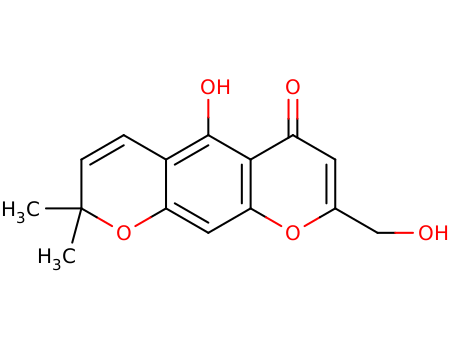 |
| Plant Source | Harrisonia perforata Common Name: |
| Source Family | Simaroubaceae |
| Origin | Hainan, Cambodia, Cochin, China, Burma and West Malaysia |
| Plant Part Used | Branch |
| Extract | Ethanol (95 %) |
| Target Bacteria | Mycobacterium tuberculosis H37Ra |
| Assay / Test Done | Microplate Alamar Blue Assay (MABA) |
| Positive Control Used (conc.) | Isoniazid (0.04 - 0.09 µg/ml) and Kanamycin sulphate (2.0 - 5.8 µg/ml) |
| Inhibition [%] | NR |
| Activity [MIC] µg/ml | 50 µg/ml |
| Activity (In terms of dilution) | NR |
| Activity (Zone of inhibition in mm) | NR |
| Active Compound Identified | Greveichromenol |
| PubChem ID | NR |
| Ethnomedicinal Information | Antimalarial activity, Tuberculosis |
| PubMed ID [Source Literature] | 16394547 |
| Extract Preparation | The branches of Harrisonia perforata (5.1 kg) were extracted with 95 % EtOH at room temperature. The ethanolic extract was filtered and evaporated to a dark brown viscous oil (186.3 g). The extract was partitioned between water (500 ml) and EtOAc (3 x 500 ml) and the water layer was further extracted with n-BuOH (3 x 400 ml). After evaporation, the EtOAc-, n-BuOH- and water - soluble fractions gave a brown viscous oil (69.8 g), a dark brown viscous oil (25.7 g) and a light brown viscous oil (50.8 g), respectively. The ethyl acetate soluble fraction is separated by flash column chromatography using silica gel |
| Chemical Classification [Active Compound] | Aromatic, Tricyclic, Flavonoid, Benzopyran, Phenol, Alcohol |
| Media / Broth Used [Antimicrobial Assay/Test] | |
| Cytotoxicity Assay [AID] | |
| Molecular Weight | 274.084 |
| Molecular Formula | C15H14O5 |
| SMILES | O1c(cc(=O)c2c1cc1c(c2O)C=CC(O1)(C)C)CO |
| XLogP | 0.339 |
| PSA | 66.760 |
| H-bond Donor | 2 |
| H-bond Acceptor | 4 |
| No. of Rotatable Bond Count | 1 |
| No. of Rings | 3 |
| No. of N | 0 |
| No. of O | 5 |
| No. of S | 0 |
| Reference(s) | 1) Tuntiwachwuttikul P, Phansa P, Pootaeng-On Y, Taylor WC.Chromones from the branches of Harrisonia perforata.Chem Pharm Bull (Tokyo). 2006 Jan;54(1):44-7
|
| Curator | Vikramjitmandal, Reshmi |
