| Compound ID | 1657 |
| Compound Structure | 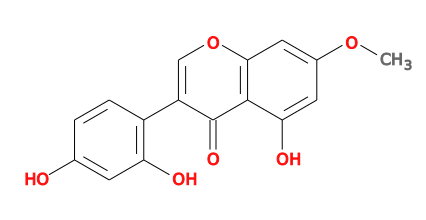 |
| Plant Source | Erythrina indica Common Name: |
| Source Family | Leguminosae |
| Origin | Ibadan, Nigeria |
| Plant Part Used | Root bark |
| Extract | Phenol |
| Target Bacteria | Mycobacterium smegmatis (ATCC 607) |
| Assay / Test Done | Agar Dilution - Streak Assay |
| Positive Control Used (conc.) | Streptomycin (1.7 µg/ml) |
| Inhibition [%] | |
| Activity [MIC] µg/ml | > 400 µg/ml |
| Activity (In terms of dilution) | |
| Activity (Zone of inhibition in mm) | |
| Active Compound Identified | Cajanin |
| PubChem ID | 5281706 |
| Ethnomedicinal Information | Trachoma, Elephantiasis, Microbial infections |
| PubMed ID [Source Literature] | 10820816 |
| Extract Preparation | Dried and ground root bark of Erythrina indica was successively extracted with a mixture of dichloro-methane-MeOH (1:1) and methanol. The dichloro-methane-MeOH (1:1) extract was concentrated to dryness |
| Chemical Classification [Active Compound] | Aromatic, Tricyclic, Flavonoid, Ether, Phenol |
| Media / Broth Used [Antimicrobial Assay/Test] | N/A |
| Cytotoxicity Assay [AID] | N/A |
| Molecular Weight | 300.063 |
| Molecular Formula | C16H12O6
|
| SMILES | O1c2c(c(=O)c(c3c(O)cc(O)cc3)c1)c(O)cc(OC)c2 |
| XLogP | 0.781 |
| PSA | 86.990 |
| H-bond Donor | 3 |
| H-bond Acceptor | 5 |
| No. of Rotatable Bond Count | 2 |
| No. of Rings | 3 |
| No. of N | 0 |
| No. of O | 6 |
| No. of S | 0 |
| Reference(s) | 1) Waffo AK, Azebaze GA, Nkengfack AE, Fomum ZT, Meyer M, Bodo B, van Heerden FR.Indicanines B and C, two isoflavonoid derivatives from the root bark of Erythrina indica.Phytochemistry. 2000 Apr;53(8):981-5
|
| Curator | |
| Compound ID | 3113 |
| Compound Structure | 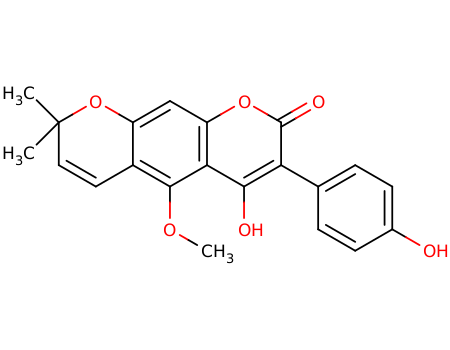 |
| Plant Source | Erythrina indica Common Name:Indian Coral Tree (English), Paaribhadra, Paaribhadraka, Paarijaataka, Mandaara (Sanskrit) |
| Source Family | Leguminosae |
| Origin | Ibadan, Nigeria |
| Plant Part Used | Root bark |
| Extract | Phenol |
| Target Bacteria | Mycobacterium smegmatis (ATCC 607) |
| Assay / Test Done | Agar Dilution - Streak Assay |
| Positive Control Used (conc.) | Streptomycin (1.7 µg/ml) |
| Inhibition [%] | NR |
| Activity [MIC] µg/ml | 18.5 µg/ml |
| Activity (In terms of dilution) | NR |
| Activity (Zone of inhibition in mm) | NR |
| Active Compound Identified | Indicanine B |
| PubChem ID | NR |
| Ethnomedicinal Information | Trachoma, Elephantiasis, Microbial infections |
| PubMed ID [Source Literature] | 10820816 |
| Extract Preparation | Dichloromethane - methanol (1:1) |
| Chemical Classification [Active Compound] | Aromatic, Tetracyclic, Flavonoid, Coumarin, Benzopyran, Ether, Phenol |
| Media / Broth Used [Antimicrobial Assay/Test] | NR |
| Cytotoxicity Assay [AID] | NR |
| Molecular Weight | 366.110 |
| Molecular Formula | C21H18O6 |
| SMILES | O1C(C=Cc2c1cc1c(c2OC)c(c(c(=O)o1)c1ccc(cc1)O)O)(C)C |
| XLogP | 4.028 |
| PSA | 75.990 |
| H-bond Donor | 2 |
| H-bond Acceptor | 5 |
| No. of Rotatable Bond Count | 2 |
| No. of Rings | 4 |
| No. of N | 0 |
| No. of O | 6 |
| No. of S | 0 |
| Reference(s) | 1) Waffo AK, Azebaze GA, Nkengfack A E, Fomum ZT, Meyer M, Bodo B, Heerden FR. Indicanines B and C, two isoflavonoids derivatives from the root bark of Erythrina indica. Phytochemistry. 2003;53:981–985. 2000.
|
| Curator | KeyaMukherjee, vsheeba |
| Compound ID | 3114 |
| Compound Structure |  |
| Plant Source | Erythrina indica Common Name:NR |
| Source Family | Fabaceae |
| Origin | Ibadan, Nigeria |
| Plant Part Used | Root bark |
| Extract | Phenol |
| Target Bacteria | Mycobacterium smegmatis (ATCC 607) |
| Assay / Test Done | Agar Dilution - Streak Assay |
| Positive Control Used (conc.) | Streptomycin (1.7 µg/ml) |
| Inhibition [%] | NR |
| Activity [MIC] µg/ml | > 150 µg/ml |
| Activity (In terms of dilution) | NR |
| Activity (Zone of inhibition in mm) | NR |
| Active Compound Identified | Indicanine C |
| PubChem ID | 10736576 |
| Ethnomedicinal Information | Trachoma, Elephantiasis, Microbial infections |
| PubMed ID [Source Literature] | 10820816 |
| Extract Preparation | Dichloromethane - methanol (1:1) |
| Chemical Classification [Active Compound] | Aromatic, Tetracyclic, Flavonoid, Benzopyran, Ether, Phenol |
| Media / Broth Used [Antimicrobial Assay/Test] | NR |
| Cytotoxicity Assay [AID] | NR |
| Molecular Weight | 350.115 |
| Molecular Formula | C21H18O5 |
| SMILES | O1C(C=Cc2c1cc1occ(c(=O)c1c2OC)c1ccc(O)cc1)(C)C |
| XLogP | 3.144 |
| PSA | 55.760 |
| H-bond Donor | 1 |
| H-bond Acceptor | 4 |
| No. of Rotatable Bond Count | 2 |
| No. of Rings | 4 |
| No. of N | 0 |
| No. of O | 5 |
| No. of S | 0 |
| Reference(s) | 1) Waffo AK, Azebaze GA, Nkengfack A E, Fomum ZT, Meyer M, Bodo B, Heerden FR. Indicanines B and C, two isoflavonoids derivatives from the root bark of Erythrina indica. Phytochemistry. 2003;53:981–985. 2000.
|
| Curator | KeyaMukherjee, vsheeba |
| Compound ID | 3115 |
| Compound Structure |  |
| Plant Source | Erythrina indica Common Name:NR |
| Source Family | Fabaceae |
| Origin | Ibadan, Nigeria |
| Plant Part Used | Root bark |
| Extract | NR |
| Target Bacteria | Mycobacterium smegmatis (ATCC 607) |
| Assay / Test Done | Agar Dilution - Streak Assay |
| Positive Control Used (conc.) | Streptomycin (1.7 µg/ml) |
| Inhibition [%] | NR |
| Activity [MIC] µg/ml | > 450 µg/ml |
| Activity (In terms of dilution) | NR |
| Activity (Zone of inhibition in mm) | NR |
| Active Compound Identified | Dimethyl Alpinumisoflavone |
| PubChem ID | 10384155 |
| Ethnomedicinal Information | Trachoma, Elephantiasis, Microbial infections |
| PubMed ID [Source Literature] | 10820816 |
| Extract Preparation | Dichloromethane - methanol (1:1) |
| Chemical Classification [Active Compound] | Aromatic, Tetracyclic, Flavonoid, Benzopyran, Ether |
| Media / Broth Used [Antimicrobial Assay/Test] | NR |
| Cytotoxicity Assay [AID] | NR |
| Molecular Weight | 364.131 |
| Molecular Formula | C22H20O5 |
| SMILES | O1C(C=Cc2c1cc1occ(c(=O)c1c2OC)c1ccc(OC)cc1)(C)C |
| XLogP | 3.663 |
| PSA | 44.760 |
| H-bond Donor | 0 |
| H-bond Acceptor | 4 |
| No. of Rotatable Bond Count | 3 |
| No. of Rings | 4 |
| No. of N | 0 |
| No. of O | 5 |
| No. of S | 0 |
| Reference(s) | 1) Waffo AK, Azebaze GA, Nkengfack A E, Fomum ZT, Meyer M, Bodo B, Heerden FR. Indicanines B and C, two isoflavonoids derivatives from the root bark of Erythrina indica. Phytochemistry. 2003;53:981–985. 2000.
|
| Curator | KeyaMukherjee, vsheeba |
