| Compound ID | 3805 |
| Compound Structure | 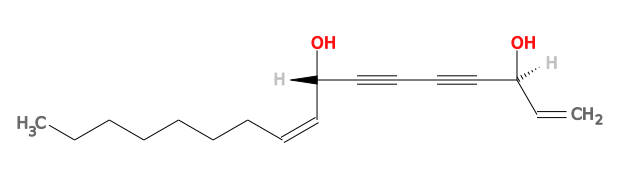 |
| Plant Source | Angelica sinensis Common Name:Dang Gui |
| Source Family | Apiaceae (Umbelliferae) |
| Origin | Northwest China |
| Plant Part Used | Root |
| Extract | NR |
| Target Bacteria | Mycobacterium tuberculosis H37Rv |
| Assay / Test Done | Microplate Alamar Blue Assay (MABA) |
| Positive Control Used (conc.) | Rifampin (0.06 µg/ml) |
| Inhibition [%] | NR |
| Activity [MIC] µg/ml | 26.7 µg/ml |
| Activity (In terms of dilution) | NR |
| Activity (Zone of inhibition in mm) | NR |
| Active Compound Identified | Falcarindiol |
| PubChem ID | 6436239 |
| Ethnomedicinal Information | NR |
| PubMed ID [Source Literature] | 18567055 |
| Extract Preparation | 8 kg of the pulverized roots of Angelica sinensis Diels were extracted with methanol and the extract sequentially partitioned with petroleum ether, CHCl3, and BuOH |
| Chemical Classification [Active Compound] | Aliphatic, Alkene, Alkyne, Alcohol |
| Media / Broth Used [Antimicrobial Assay/Test] | Middlebrook 7H12 medium |
| Cytotoxicity Assay [AID] | Against Vero cells |
| Molecular Weight | 260.178 |
| Molecular Formula | C17H24O2 |
| SMILES | O[C@@H](/C=CCCCCCCC)C#CC#C[C@@H](O)C=C |
| XLogP | 4.573 |
| PSA | 40.460 |
| H-bond Donor | 2 |
| H-bond Acceptor | 2 |
| No. of Rotatable Bond Count | 8 |
| No. of Rings | 0 |
| No. of N | 0 |
| No. of O | 2 |
| No. of S | 0 |
| Reference(s) | 1) Deng S, Wang Y, Inui T, Chen SN, Farnsworth NR, Cho S, Franzblau SG, Pauli GF.Anti-TB polyynes from the roots of Angelica sinensis.Phytother Res. 2008 Jul;22(7):878-82
|
| Curator | KeyaMukherjee, reshmi, Farzana Shamsudeen, Vikramjitmandal |
| Compound ID | 3806 |
| Compound Structure | 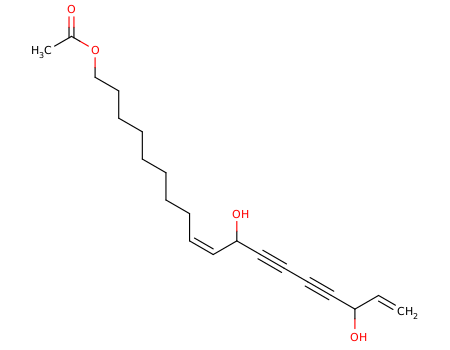 |
| Plant Source | Angelica sinensis Common Name:Dang Gui |
| Source Family | Apiaceae (Umbelliferae) |
| Origin | Northwest China |
| Plant Part Used | Root |
| Extract | NR |
| Target Bacteria | Mycobacterium tuberculosis H37Rv |
| Assay / Test Done | Microplate Alamar Blue Assay (MABA) |
| Positive Control Used (conc.) | Rifampin (0.06 µg/ml) |
| Inhibition [%] | NR |
| Activity [MIC] µg/ml | 25.3 µg/ml |
| Activity (In terms of dilution) | NR |
| Activity (Zone of inhibition in mm) | NR |
| Active Compound Identified | 9Z, 17 - Octadecadiene - 12, 14 - Diyne - 1, 11, 16 - Triol, 1 - Acetate |
| PubChem ID | NR |
| Ethnomedicinal Information | NR |
| PubMed ID [Source Literature] | 18567055 |
| Extract Preparation | 8 kg of the pulverized roots of Angelica sinensis Diels were extracted with methanol and the extract sequentially partitioned with petroleum ether, CHCl3, and BuOH |
| Chemical Classification [Active Compound] | Aliphatic, Alkene, Alkyne, Ester, Alcohol, O-Acetyl |
| Media / Broth Used [Antimicrobial Assay/Test] | Middlebrook 7H12 medium |
| Cytotoxicity Assay [AID] | Against Vero cells |
| Molecular Weight | 332.199 |
| Molecular Formula | C20H28O4 |
| SMILES | C(=O)(C)OCCCCCCCC/C=C\C(O)C#CC#CC(C=C)O |
| XLogP | 4.117 |
| PSA | 66.760 |
| H-bond Donor | 2 |
| H-bond Acceptor | 4 |
| No. of Rotatable Bond Count | 12 |
| No. of Rings | 0 |
| No. of N | 0 |
| No. of O | 4 |
| No. of S | 0 |
| Reference(s) | 1) Deng S, Wang Y, Inui T, Chen SN, Farnsworth NR, Cho S, Franzblau SG, Pauli GF.Anti-TB polyynes from the roots of Angelica sinensis.Phytother Res. 2008 Jul;22(7):878-82
|
| Curator | KeyaMukherjee, reshmi, Farzana Shamsudeen, Vikramjitmandal |
| Compound ID | 3808 |
| Compound Structure |  |
| Plant Source | Angelica sinensis Common Name:Dang Gui |
| Source Family | Apiaceae (Umbelliferae) |
| Origin | Northwest China |
| Plant Part Used | Root |
| Extract | NR |
| Target Bacteria | Mycobacterium tuberculosis H37Rv |
| Assay / Test Done | Microplate Alamar Blue Assay (MABA) |
| Positive Control Used (conc.) | Rifampin (0.06 µg/ml) |
| Inhibition [%] | NR |
| Activity [MIC] µg/ml | > 60 µg/ml |
| Activity (In terms of dilution) | NR |
| Activity (Zone of inhibition in mm) | NR |
| Active Compound Identified | Heptadeca - 1 - Ene - 9, 10 - Epoxy - 4, 6 - Diyne - 3, 8 - Diol |
| PubChem ID | NR |
| Ethnomedicinal Information | NR |
| PubMed ID [Source Literature] | 18567055 |
| Extract Preparation | 8 kg of the pulverized roots of Angelica sinensis Diels were extracted with methanol and the extract sequentially partitioned with petroleum ether, CHCl3, and BuOH |
| Chemical Classification [Active Compound] | Aliphatic, Alkene, Alkyne, Epoxy, Alcohol |
| Media / Broth Used [Antimicrobial Assay/Test] | Middlebrook 7H12 medium |
| Cytotoxicity Assay [AID] | Against Vero cells |
| Molecular Weight | 276.173 |
| Molecular Formula | C17H24O3 |
| SMILES | C(#CC(C=C)O)C#CC(O)C1C(CCCCCCC)O1 |
| XLogP | 3.663 |
| PSA | 52.990 |
| H-bond Donor | 2 |
| H-bond Acceptor | 3 |
| No. of Rotatable Bond Count | 8 |
| No. of Rings | 1 |
| No. of N | 0 |
| No. of O | 3 |
| No. of S | 0 |
| Reference(s) | 1) Deng S, Wang Y, Inui T, Chen SN, Farnsworth NR, Cho S, Franzblau SG, Pauli GF.Anti-TB polyynes from the roots of Angelica sinensis.Phytother Res. 2008 Jul;22(7):878-82
|
| Curator | KeyaMukherjee, reshmi, Farzana Shamsudeen, Vikramjitmandal |
| Compound ID | 3809 |
| Compound Structure | 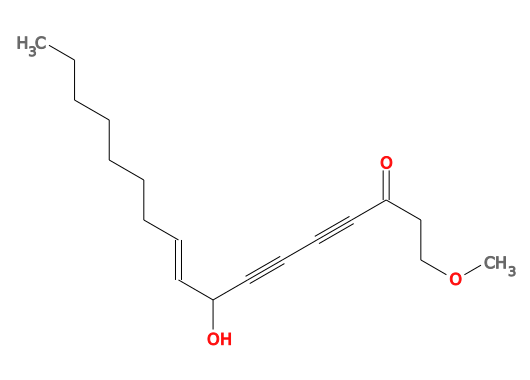 |
| Plant Source | Angelica sinensis Common Name:Dang Gui |
| Source Family | Apiaceae (Umbelliferae) |
| Origin | Northwest China |
| Plant Part Used | Root |
| Extract | NR |
| Target Bacteria | Mycobacterium tuberculosis H37Rv |
| Assay / Test Done | Microplate Alamar Blue Assay (MABA) |
| Positive Control Used (conc.) | Rifampin (0.06 µg/ml) |
| Inhibition [%] | NR |
| Activity [MIC] µg/ml | > 60 µg/ml |
| Activity (In terms of dilution) | NR |
| Activity (Zone of inhibition in mm) | NR |
| Active Compound Identified | 8 - Hydroxy - 1 - Methoxy - (Z) - 9 - Heptadecene 4, 6 - Diyn - 3 - One |
| PubChem ID | NR |
| Ethnomedicinal Information | NR |
| PubMed ID [Source Literature] | 18567055 |
| Extract Preparation | 8 kg of the pulverized roots of Angelica sinensis Diels were extracted with methanol and the extract sequentially partitioned with petroleum ether, CHCl3, and BuOH |
| Chemical Classification [Active Compound] | Aliphatic, Alkene, Alkyne, Ketone, Ether, Alcohol |
| Media / Broth Used [Antimicrobial Assay/Test] | Middlebrook 7H12 medium |
| Cytotoxicity Assay [AID] | Against Vero cells |
| Molecular Weight | 290.188 |
| Molecular Formula | C18H26O3 |
| SMILES | COCCC(=O)C#CC#CC(/C=CCCCCCCC)O |
| XLogP | 4.421 |
| PSA | 46.530 |
| H-bond Donor | 1 |
| H-bond Acceptor | 3 |
| No. of Rotatable Bond Count | 10 |
| No. of Rings | 0 |
| No. of N | 0 |
| No. of O | 3 |
| No. of S | 0 |
| Reference(s) | 1) Deng S, Wang Y, Inui T, Chen SN, Farnsworth NR, Cho S, Franzblau SG, Pauli GF.Anti-TB polyynes from the roots of Angelica sinensis.Phytother Res. 2008 Jul;22(7):878-82
|
| Curator | KeyaMukherjee, reshmi, Farzana Shamsudeen, Vikramjitmandal |
| Compound ID | 3810 |
| Compound Structure | |
| Plant Source | Angelica sinensis Common Name:Dang Gui |
| Source Family | Apiaceae (Umbelliferae) |
| Origin | Northwest China |
| Plant Part Used | Root |
| Extract | NR |
| Target Bacteria | Mycobacterium tuberculosis (Erdman) |
| Assay / Test Done | Microplate Alamar Blue Assay (MABA) |
| Positive Control Used (conc.) | Rifampin (0.05 µg/ml) |
| Inhibition [%] | NR |
| Activity [MIC] µg/ml | 6 µg/ml |
| Activity (In terms of dilution) | NR |
| Activity (Zone of inhibition in mm) | NR |
| Active Compound Identified | Falcarindiol |
| PubChem ID | 6436239 |
| Ethnomedicinal Information | NR |
| PubMed ID [Source Literature] | 18567055 |
| Extract Preparation | 8 kg of the pulverized roots of Angelica sinensis Diels were extracted with methanol and the extract sequentially partitioned with petroleum ether, CHCl3, and BuOH |
| Chemical Classification [Active Compound] | Aliphatic, Alkene, Alkyne, Alcohol |
| Media / Broth Used [Antimicrobial Assay/Test] | Middlebrook 7H12 medium |
| Cytotoxicity Assay [AID] | Against Vero cells |
| Molecular Weight | 260.178 |
| Molecular Formula | C17H24O2 |
| SMILES | O[C@@H](/C=CCCCCCCC)C#CC#C[C@@H](O)C=C |
| XLogP | 4.573 |
| PSA | 40.460 |
| H-bond Donor | 2 |
| H-bond Acceptor | 2 |
| No. of Rotatable Bond Count | 8 |
| No. of Rings | 0 |
| No. of N | 0 |
| No. of O | 2 |
| No. of S | 0 |
| Reference(s) | 1) Deng S, Wang Y, Inui T, Chen SN, Farnsworth NR, Cho S, Franzblau SG, Pauli GF.Anti-TB polyynes from the roots of Angelica sinensis.Phytother Res. 2008 Jul;22(7):878-82
|
| Curator | KeyaMukherjee, reshmi, Farzana Shamsudeen, Vikramjitmandal |
| Compound ID | 3811 |
| Compound Structure | |
| Plant Source | Angelica sinensis Common Name:Dang Gui |
| Source Family | Apiaceae (Umbelliferae) |
| Origin | Northwest China |
| Plant Part Used | Root |
| Extract | NR |
| Target Bacteria | Mycobacterium tuberculosis (Erdman) |
| Assay / Test Done | Microplate Alamar Blue Assay (MABA) |
| Positive Control Used (conc.) | Rifampin (0.05 µg/ml) |
| Inhibition [%] | NR |
| Activity [MIC] µg/ml | 1.4 µg/ml |
| Activity (In terms of dilution) | NR |
| Activity (Zone of inhibition in mm) | NR |
| Active Compound Identified | 9Z, 17 - Octadecadiene - 12, 14 - Diyne - 1, 11, 16 - Triol, 1 - Acetate |
| PubChem ID | NR |
| Ethnomedicinal Information | NR |
| PubMed ID [Source Literature] | 18567055 |
| Extract Preparation | 8 kg of the pulverized roots of Angelica sinensis Diels were extracted with methanol and the extract sequentially partitioned with petroleum ether, CHCl3, and BuOH |
| Chemical Classification [Active Compound] | Aliphatic, Alkene, Alkyne, Ester, Alcohol, O-Acetyl |
| Media / Broth Used [Antimicrobial Assay/Test] | Middlebrook 7H12 medium |
| Cytotoxicity Assay [AID] | Against Vero cells |
| Molecular Weight | 332.199 |
| Molecular Formula | C20H28O4 |
| SMILES | C(=O)(C)OCCCCCCCC/C=C\C(O)C#CC#CC(C=C)O |
| XLogP | 4.117 |
| PSA | 66.760 |
| H-bond Donor | 2 |
| H-bond Acceptor | 4 |
| No. of Rotatable Bond Count | 12 |
| No. of Rings | 0 |
| No. of N | 0 |
| No. of O | 4 |
| No. of S | 0 |
| Reference(s) | 1) Deng S, Wang Y, Inui T, Chen SN, Farnsworth NR, Cho S, Franzblau SG, Pauli GF.Anti-TB polyynes from the roots of Angelica sinensis.Phytother Res. 2008 Jul;22(7):878-82
|
| Curator | KeyaMukherjee, reshmi, Farzana Shamsudeen, Vikramjitmandal |
| Compound ID | 3813 |
| Compound Structure | |
| Plant Source | Angelica sinensis Common Name:Dang Gui |
| Source Family | Apiaceae (Umbelliferae) |
| Origin | Northwest China |
| Plant Part Used | Root |
| Extract | NR |
| Target Bacteria | Mycobacterium tuberculosis (Erdman) |
| Assay / Test Done | Microplate Alamar Blue Assay (MABA) |
| Positive Control Used (conc.) | Rifampin (0.05 µg/ml) |
| Inhibition [%] | NR |
| Activity [MIC] µg/ml | > 60 µg/ml |
| Activity (In terms of dilution) | NR |
| Activity (Zone of inhibition in mm) | NR |
| Active Compound Identified | Heptadeca - 1 - Ene - 9, 10 - Epoxy - 4, 6 - Diyne - 3, 8 - Diol |
| PubChem ID | NR |
| Ethnomedicinal Information | NR |
| PubMed ID [Source Literature] | 18567055 |
| Extract Preparation | 8 kg of the pulverized roots of Angelica sinensis Diels were extracted with methanol and the extract sequentially partitioned with petroleum ether, CHCl3, and BuOH |
| Chemical Classification [Active Compound] | Aliphatic, Alkene, Alkyne, Epoxy, Alcohol |
| Media / Broth Used [Antimicrobial Assay/Test] | Middlebrook 7H12 medium |
| Cytotoxicity Assay [AID] | Against Vero cells |
| Molecular Weight | 276.173 |
| Molecular Formula | C17H24O3 |
| SMILES | C(#CC(C=C)O)C#CC(O)C1C(CCCCCCC)O1 |
| XLogP | 3.663 |
| PSA | 52.990 |
| H-bond Donor | 2 |
| H-bond Acceptor | 3 |
| No. of Rotatable Bond Count | 8 |
| No. of Rings | 1 |
| No. of N | 0 |
| No. of O | 3 |
| No. of S | 0 |
| Reference(s) | 1) Deng S, Wang Y, Inui T, Chen SN, Farnsworth NR, Cho S, Franzblau SG, Pauli GF.Anti-TB polyynes from the roots of Angelica sinensis.Phytother Res. 2008 Jul;22(7):878-82
|
| Curator | KeyaMukherjee, reshmi, Farzana Shamsudeen, Vikramjitmandal |
| Compound ID | 3814 |
| Compound Structure | |
| Plant Source | Angelica sinensis Common Name:Dang Gui |
| Source Family | Apiaceae (Umbelliferae) |
| Origin | Northwest China |
| Plant Part Used | Root |
| Extract | NR |
| Target Bacteria | Mycobacterium tuberculosis (Erdman) |
| Assay / Test Done | Microplate Alamar Blue Assay (MABA) |
| Positive Control Used (conc.) | Rifampin (0.05 µg/ml) |
| Inhibition [%] | NR |
| Activity [MIC] µg/ml | > 60 µg/ml |
| Activity (In terms of dilution) | NR |
| Activity (Zone of inhibition in mm) | NR |
| Active Compound Identified | 8 - Hydroxy - 1 - Methoxy - (Z) - 9 - Heptadecene 4, 6 - Diyn - 3 - One |
| PubChem ID | NR |
| Ethnomedicinal Information | NR |
| PubMed ID [Source Literature] | 18567055 |
| Extract Preparation | 8 kg of the pulverized roots of Angelica sinensis Diels were extracted with methanol and the extract sequentially partitioned with petroleum ether, CHCl3, and BuOH |
| Chemical Classification [Active Compound] | Aliphatic, Alkene, Alkyne, Ketone, Ether, Alcohol |
| Media / Broth Used [Antimicrobial Assay/Test] | Middlebrook 7H12 medium |
| Cytotoxicity Assay [AID] | Against Vero cells |
| Molecular Weight | 290.188 |
| Molecular Formula | C18H26O3 |
| SMILES | COCCC(=O)C#CC#CC(/C=CCCCCCCC)O |
| XLogP | 4.421 |
| PSA | 46.530 |
| H-bond Donor | 1 |
| H-bond Acceptor | 3 |
| No. of Rotatable Bond Count | 10 |
| No. of Rings | 0 |
| No. of N | 0 |
| No. of O | 3 |
| No. of S | 0 |
| Reference(s) | 1) Deng S, Wang Y, Inui T, Chen SN, Farnsworth NR, Cho S, Franzblau SG, Pauli GF.Anti-TB polyynes from the roots of Angelica sinensis.Phytother Res. 2008 Jul;22(7):878-82
|
| Curator | KeyaMukherjee, reshmi, Farzana Shamsudeen, Vikramjitmandal |
| Compound ID | 3815 |
| Compound Structure | NR |
| Plant Source | Angelica sinensis Common Name:Dang Gui |
| Source Family | Apiaceae (Umbelliferae) |
| Origin | Northwest China |
| Plant Part Used | Root |
| Extract | Methanol |
| Target Bacteria | Mycobacterium tuberculosis H37Rv |
| Assay / Test Done | Microplate Alamar Blue Assay (MABA) |
| Positive Control Used (conc.) | Rifampin (0.06 µg/ml) |
| Inhibition [%] | NR |
| Activity [MIC] µg/ml | 85.1 µg/ml |
| Activity (In terms of dilution) | NR |
| Activity (Zone of inhibition in mm) | NR |
| Active Compound Identified | |
| PubChem ID | NR |
| Ethnomedicinal Information | NR |
| PubMed ID [Source Literature] | 18567055 |
| Extract Preparation | 8 kg of the pulverized roots of Angelica sinensis Diels were extracted with methanol and the extract sequentially partitioned with petroleum ether, CHCl3, and BuOH |
| Chemical Classification [Active Compound] | |
| Media / Broth Used [Antimicrobial Assay/Test] | Middlebrook 7H12 medium |
| Cytotoxicity Assay [AID] | Against Vero cells |
| Reference(s) | 1) Deng S, Wang Y, Inui T, Chen SN, Farnsworth NR, Cho S, Franzblau SG, Pauli GF.Anti-TB polyynes from the roots of Angelica sinensis.Phytother Res. 2008 Jul;22(7):878-82
|
| Curator | KeyaMukherjee, reshmi, Farzana Shamsudeen, Vikramjitmandal |
| Compound ID | 3816 |
| Compound Structure | NR |
| Plant Source | Angelica sinensis Common Name:Dang Gui |
| Source Family | Apiaceae (Umbelliferae) |
| Origin | Northwest China |
| Plant Part Used | Root |
| Extract | Petroleum ether |
| Target Bacteria | Mycobacterium tuberculosis H37Rv |
| Assay / Test Done | Microplate Alamar Blue Assay (MABA) |
| Positive Control Used (conc.) | Rifampin (0.06 µg/ml) |
| Inhibition [%] | NR |
| Activity [MIC] µg/ml | 64 µg/ml |
| Activity (In terms of dilution) | NR |
| Activity (Zone of inhibition in mm) | NR |
| Active Compound Identified | |
| PubChem ID | NR |
| Ethnomedicinal Information | NR |
| PubMed ID [Source Literature] | 18567055 |
| Extract Preparation | 8 kg of the pulverized roots of Angelica sinensis Diels were extracted with methanol and the extract sequentially partitioned with petroleum ether, CHCl3, and BuOH |
| Chemical Classification [Active Compound] | |
| Media / Broth Used [Antimicrobial Assay/Test] | Middlebrook 7H12 medium |
| Cytotoxicity Assay [AID] | Against Vero cells |
| Reference(s) | 1) Deng S, Wang Y, Inui T, Chen SN, Farnsworth NR, Cho S, Franzblau SG, Pauli GF.Anti-TB polyynes from the roots of Angelica sinensis.Phytother Res. 2008 Jul;22(7):878-82
|
| Curator | KeyaMukherjee, reshmi, Farzana Shamsudeen, Vikramjitmandal |
| Compound ID | 3817 |
| Compound Structure | NR |
| Plant Source | Angelica sinensis Common Name:Dang Gui |
| Source Family | Apiaceae (Umbelliferae) |
| Origin | Northwest China |
| Plant Part Used | Root |
| Extract | Chloroform |
| Target Bacteria | Mycobacterium tuberculosis H37Rv |
| Assay / Test Done | Microplate Alamar Blue Assay (MABA) |
| Positive Control Used (conc.) | Rifampin (0.06 µg/ml) |
| Inhibition [%] | NR |
| Activity [MIC] µg/ml | 63.1 µg/ml |
| Activity (In terms of dilution) | NR |
| Activity (Zone of inhibition in mm) | NR |
| Active Compound Identified | |
| PubChem ID | NR |
| Ethnomedicinal Information | NR |
| PubMed ID [Source Literature] | 18567055 |
| Extract Preparation | 8 kg of the pulverized roots of Angelica sinensis Diels were extracted with methanol and the extract sequentially partitioned with petroleum ether, CHCl3, and BuOH |
| Chemical Classification [Active Compound] | |
| Media / Broth Used [Antimicrobial Assay/Test] | Middlebrook 7H12 medium |
| Cytotoxicity Assay [AID] | Against Vero cells |
| Reference(s) | 1) Deng S, Wang Y, Inui T, Chen SN, Farnsworth NR, Cho S, Franzblau SG, Pauli GF.Anti-TB polyynes from the roots of Angelica sinensis.Phytother Res. 2008 Jul;22(7):878-82
|
| Curator | KeyaMukherjee, reshmi, Farzana Shamsudeen, Vikramjitmandal |
| Compound ID | 3818 |
| Compound Structure | NR |
| Plant Source | Angelica sinensis Common Name:Dang Gui |
| Source Family | Apiaceae (Umbelliferae) |
| Origin | Northwest China |
| Plant Part Used | Root |
| Extract | Chloroform |
| Target Bacteria | Mycobacterium tuberculosis (Erdman) |
| Assay / Test Done | Microplate Alamar Blue Assay (MABA) |
| Positive Control Used (conc.) | Rifampin (0.05 µg/ml) |
| Inhibition [%] | NR |
| Activity [MIC] µg/ml | 124.6 µg/ml |
| Activity (In terms of dilution) | NR |
| Activity (Zone of inhibition in mm) | NR |
| Active Compound Identified | |
| PubChem ID | NR |
| Ethnomedicinal Information | NR |
| PubMed ID [Source Literature] | 18567055 |
| Extract Preparation | 8 kg of the pulverized roots of Angelica sinensis Diels were extracted with methanol and the extract sequentially partitioned with petroleum ether, CHCl3, and BuOH |
| Chemical Classification [Active Compound] | |
| Media / Broth Used [Antimicrobial Assay/Test] | Middlebrook 7H12 medium |
| Cytotoxicity Assay [AID] | Against Vero cells |
| Reference(s) | 1) Deng S, Wang Y, Inui T, Chen SN, Farnsworth NR, Cho S, Franzblau SG, Pauli GF.Anti-TB polyynes from the roots of Angelica sinensis.Phytother Res. 2008 Jul;22(7):878-82
|
| Curator | KeyaMukherjee, reshmi, Farzana Shamsudeen, Vikramjitmandal |
