| Compound ID | 1084 |
| Compound Structure | 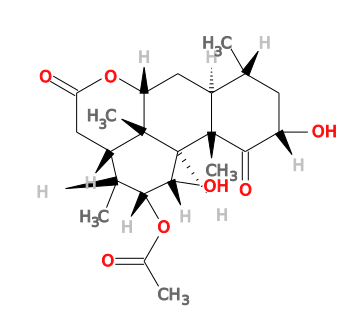 |
| Plant Source | Ailanthus altissima (Mill.) Swingle syn. Altissima glandulsa Desf. Common Name:Tree of Heaven, Ailanto (English), Aralu (Sanskrit) |
| Source Family | Simaroubaceae |
| Origin | India, China |
| Plant Part Used | Mother tinture |
| Extract | |
| Target Bacteria | Mycobacterium tuberculosis |
| Assay / Test Done | |
| Positive Control Used (conc.) | Rifampin (0.031 µg/ml) |
| Inhibition [%] | 19 % |
| Activity [MIC] µg/ml | 12.5 µg/ml |
| Activity (In terms of dilution) | |
| Activity (Zone of inhibition in mm) | |
| Active Compound Identified | Shinjulactone K |
| PubChem ID | 460541 |
| Ethnomedicinal Information | Used for treating mental illness, nausea and headache, treating cardiac palpitation, asthma and epilepsy |
| PubMed ID [Source Literature] | 17276637 |
| Extract Preparation | N/A |
| Chemical Classification [Active Compound] | Alicyclic, Tetracyclic, Terpene, Triterpene, Quassinoid, Lactone, O-Acetyl, Alcohol |
| Media / Broth Used [Antimicrobial Assay/Test] | N/A |
| Cytotoxicity Assay [AID] | N/A |
| Molecular Weight | 408.215 |
| Molecular Formula | C22H32O7 |
| SMILES | O1[C@H]2[C@@]3([C@@H]([C@@]4([C@@H](C2)[C@@H](C[C@H](O)C4=O)C)C)[C@H](O)[C@H](OC(=O)C)[C@@H]([C@@H]3CC1=O)C)C |
| XLogP | 1.595 |
| PSA | 110.130 |
| H-bond Donor | 2 |
| H-bond Acceptor | 7 |
| No. of Rotatable Bond Count | 2 |
| No. of Rings | 4 |
| No. of N | 0 |
| No. of O | 7 |
| No. of S | 0 |
| Reference(s) | 1) Gautam R, Saklani A, Jachak SM.Indian medicinal plants as a source of antimycobacterial agents.J Ethnopharmacol. 2007 Mar 21;110(2):200-34
2) Rahman S, Fukamiya N, Okano M, Tagahara K, Lee KH.Anti-tuberculosis activity of quassinoids.Chem Pharm Bull (Tokyo). 1997 Sep;45(9):1527-9
|
| Curator | |
| Compound ID | 1085 |
| Compound Structure |  |
| Plant Source | Ailanthus altissima (Mill.) Swingle syn. Altissima glandulsa Desf. Common Name:Tree of Heaven, Ailanto (English), Aralu (Sanskrit) |
| Source Family | Simaroubaceae |
| Origin | India, China |
| Plant Part Used | Mother tinture |
| Extract | |
| Target Bacteria | Mycobacterium tuberculosis |
| Assay / Test Done | |
| Positive Control Used (conc.) | Rifampin (0.031 µg/ml) |
| Inhibition [%] | 17 % |
| Activity [MIC] µg/ml | 12.5 µg/ml |
| Activity (In terms of dilution) | |
| Activity (Zone of inhibition in mm) | |
| Active Compound Identified | Ailanthone |
| PubChem ID | 72965 |
| Ethnomedicinal Information | Used for treating mental illness, nausea and headache, treating cardiac palpitation, asthma and epilepsy |
| PubMed ID [Source Literature] | 17276637 |
| Extract Preparation | N/A |
| Chemical Classification [Active Compound] | Alicyclic, Pentacyclic, Terpene, Triterpene, Quassinoid, Furanoid, Lactone, Alcohol |
| Media / Broth Used [Antimicrobial Assay/Test] | N/A |
| Cytotoxicity Assay [AID] | N/A |
| Molecular Weight | 376.152 |
| Molecular Formula | C20H24O7 |
| SMILES | O1[C@]2(O)[C@H]3[C@]4([C@H](OC(=O)C[C@H]4C(=C)[C@H]2O)C[C@@H]2[C@@]3([C@H](O)C(=O)C=C2C)C)C1 |
| XLogP | -0.429 |
| PSA | 113.290 |
| H-bond Donor | 3 |
| H-bond Acceptor | 7 |
| No. of Rotatable Bond Count | 0 |
| No. of Rings | 5 |
| No. of N | 0 |
| No. of O | 7 |
| No. of S | 0 |
| Reference(s) | 1) Gautam R, Saklani A, Jachak SM.Indian medicinal plants as a source of antimycobacterial agents.J Ethnopharmacol. 2007 Mar 21;110(2):200-34
2) Rahman S, Fukamiya N, Okano M, Tagahara K, Lee KH.Anti-tuberculosis activity of quassinoids.Chem Pharm Bull (Tokyo). 1997 Sep;45(9):1527-9
|
| Curator | |
| Compound ID | 1086 |
| Compound Structure | 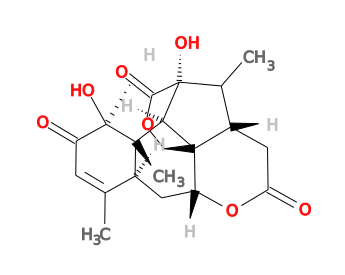 |
| Plant Source | Ailanthus altissima (Mill.) Swingle syn. Altissima glandulsa Desf. Common Name:Tree of Heaven, Ailanto (English), Aralu (Sanskrit) |
| Source Family | Simaroubaceae |
| Origin | India, China |
| Plant Part Used | Mother tinture |
| Extract | |
| Target Bacteria | Mycobacterium tuberculosis |
| Assay / Test Done | |
| Positive Control Used (conc.) | Rifampin (0.031 µg/ml) |
| Inhibition [%] | 15 % |
| Activity [MIC] µg/ml | 12.5 µg/ml |
| Activity (In terms of dilution) | |
| Activity (Zone of inhibition in mm) | |
| Active Compound Identified | Shinjudilactone |
| PubChem ID | 460534 |
| Ethnomedicinal Information | Used for treating mental illness, nausea and headache, treating cardiac palpitation, asthma and epilepsy |
| PubMed ID [Source Literature] | 17276637 |
| Extract Preparation | N/A |
| Chemical Classification [Active Compound] | Alicyclic, Pentacyclic, Terpene, Triterpene, Quassinoid, Lactone |
| Media / Broth Used [Antimicrobial Assay/Test] | N/A |
| Cytotoxicity Assay [AID] | N/A |
| Molecular Weight | 376.152 |
| Molecular Formula | C20H24O7 |
| SMILES | O1[C@H]2[C@]34[C@@H]([C@@]5([C@@H](C2)C(=CC(=O)[C@H]5O)C)C)[C@](O)(C([C@@H]3CC1=O)C)C(=O)OC4 |
| XLogP | 0.413 |
| PSA | 110.130 |
| H-bond Donor | 2 |
| H-bond Acceptor | 7 |
| No. of Rotatable Bond Count | 0 |
| No. of Rings | 5 |
| No. of N | 0 |
| No. of O | 7 |
| No. of S | 0 |
| Reference(s) | 1) Gautam R, Saklani A, Jachak SM.Indian medicinal plants as a source of antimycobacterial agents.J Ethnopharmacol. 2007 Mar 21;110(2):200-34
2) Rahman S, Fukamiya N, Okano M, Tagahara K, Lee KH.Anti-tuberculosis activity of quassinoids.Chem Pharm Bull (Tokyo). 1997 Sep;45(9):1527-9
|
| Curator | |
| Compound ID | 1296 |
| Compound Structure | |
| Plant Source | Brucea antidysenterica Common Name: |
| Source Family | Simaroubaceae |
| Origin | Nigeria |
| Plant Part Used | |
| Extract | |
| Target Bacteria | Mycobacterium tuberculosis |
| Assay / Test Done | |
| Positive Control Used (conc.) | Rifampin (0.03 µg/ml) |
| Inhibition [%] | |
| Activity [MIC] µg/ml | |
| Activity (In terms of dilution) | |
| Activity (Zone of inhibition in mm) | |
| Active Compound Identified | |
| PubChem ID | NR |
| Ethnomedicinal Information | Tuberculosis |
| PubMed ID [Source Literature] | |
| Extract Preparation | N/A |
| Chemical Classification [Active Compound] | N/A |
| Media / Broth Used [Antimicrobial Assay/Test] | N/A |
| Cytotoxicity Assay [AID] | N/A |
| Reference(s) | 1) Mann, A., Ibrahim, K., Oyewale, A.O., Amupitan, J.O., and Okogun, J.I., 2009, Antimycobacterial activity of some me-dicinal plants in Niger State, Nigeria. Afri. J. Infect. Dis., 3(2), 44-48
|
| Curator | |
| Compound ID | 1297 |
| Compound Structure |  |
| Plant Source | Brucea javanica (L.) Merrill syn. Rhus javanica L. Common Name:Java Brucea |
| Source Family | Simaroubaceae |
| Origin | India, China |
| Plant Part Used | |
| Extract | |
| Target Bacteria | Mycobacterium tuberculosis |
| Assay / Test Done | |
| Positive Control Used (conc.) | Rifampin |
| Inhibition [%] | 7 % |
| Activity [MIC] µg/ml | 12.5 µg/ml |
| Activity (In terms of dilution) | |
| Activity (Zone of inhibition in mm) | |
| Active Compound Identified | Bruceoside D |
| PubChem ID | 460525 |
| Ethnomedicinal Information | Treatment of amoebic dysentery and malaria, stomach complaints |
| PubMed ID [Source Literature] | 9332005 |
| Extract Preparation | N/A |
| Chemical Classification [Active Compound] | Alicyclic, Pentacyclic, Terpene, Triterpene, Quassinoid, Sugar |
| Media / Broth Used [Antimicrobial Assay/Test] | N/A |
| Cytotoxicity Assay [AID] | N/A |
| Molecular Weight | 668.232 |
| Molecular Formula | C31H40O16 |
| SMILES | O1C2([C@H]3[C@]4([C@@H]([C@@]5([C@@H](C[C@H]4OC(=O)[C@@H]3OC(=O)C=C(C)C)[C@@H](C(=O)C(=C5)O[C@@H]3O[C@@H]([C@@H](O)[C@H](O)[C@H]3O)CO)C)C)[C@@H](O)[C@@H]2O)C1)C(=O)O |
| XLogP | -0.909 |
| PSA | 256.040 |
| H-bond Donor | 7 |
| H-bond Acceptor | 16 |
| No. of Rotatable Bond Count | 7 |
| No. of Rings | 6 |
| No. of N | 0 |
| No. of O | 16 |
| No. of S | 0 |
| Reference(s) | 1) Rahman S, Fukamiya N, Okano M, Tagahara K, Lee KH.Anti-tuberculosis activity of quassinoids.Chem Pharm Bull (Tokyo). 1997 Sep;45(9):1527-9
2) http://www.hear.org/pier/commonnames/details/brucea_javanica.htm
|
| Curator | |
| Compound ID | 1843 |
| Compound Structure | |
| Plant Source | Harrisonia abyssinica Oliv Common Name: |
| Source Family | Simaroubaceae |
| Origin | Kenya |
| Plant Part Used | Root |
| Extract | Methanol |
| Target Bacteria | Mycobacterium tuberculosis, Mycobacterium avium, Mycobacterium intracellulare, Mycobacterium chelonae / chelonei, Mycobacterium terrae |
| Assay / Test Done | |
| Positive Control Used (conc.) | |
| Inhibition [%] | |
| Activity [MIC] µg/ml | |
| Activity (In terms of dilution) | |
| Activity (Zone of inhibition in mm) | |
| Active Compound Identified | |
| PubChem ID | NR |
| Ethnomedicinal Information | Tuberculosis |
| PubMed ID [Source Literature] | 9533435 |
| Extract Preparation | N/A |
| Chemical Classification [Active Compound] | N/A |
| Media / Broth Used [Antimicrobial Assay/Test] | N/A |
| Cytotoxicity Assay [AID] | N/A |
| Reference(s) | 1) Fabry W, Okemo PO, Ansorg R.Antibacterial activity of East African medicinal plants.J Ethnopharmacol. 1998 Feb;60(1):79-84
|
| Curator | |
| Compound ID | 2337 |
| Compound Structure | |
| Plant Source | Picramnea latifolia Tulasne Common Name: |
| Source Family | Simaroubaceae |
| Origin | Peru |
| Plant Part Used | Leaf, root |
| Extract | Dichloromethane |
| Target Bacteria | Mycobacterium tuberculosis (ATCC 27294) |
| Assay / Test Done | BACTEC 460 (Becton Dickinson Diagnostic Instrument Systems, Sparks MD) Radiometric Assay |
| Positive Control Used (conc.) | Rifampin (2 µg/ml), Ethambutol (7.5 µg/ml) |
| Inhibition [%] | < 50 % |
| Activity [MIC] µg/ml | 50 µg/ml |
| Activity (In terms of dilution) | |
| Activity (Zone of inhibition in mm) | |
| Active Compound Identified | |
| PubChem ID | NR |
| Ethnomedicinal Information | Tuberculosis |
| PubMed ID [Source Literature] | 13678239 |
| Extract Preparation | N/A |
| Chemical Classification [Active Compound] | N/A |
| Media / Broth Used [Antimicrobial Assay/Test] | N/A |
| Cytotoxicity Assay [AID] | N/A |
| Reference(s) | 1) Graham JG, Pendland SL, Prause JL, Danzinger LH, Schunke Vigo J, Cabieses F, Farnsworth NR.Antimycobacterial evaluation of Peruvian plants.Phytomedicine. 2003;10(6-7):528-35
|
| Curator | |
| Compound ID | 2480 |
| Compound Structure | |
| Plant Source | Quassia amara Common Name:Bitter Quassia, Bitterwood |
| Source Family | Simaroubaceae |
| Origin | Brazil |
| Plant Part Used | Bark |
| Extract | Chloroform |
| Target Bacteria | Mycobacterium tuberculosis H37Rv (ATCC 27 294) |
| Assay / Test Done | Microplate Alamar Blue Assay (MABA) |
| Positive Control Used (conc.) | Isoniazid (0.015 - 0.05 µg/ml) |
| Inhibition [%] | 90 % |
| Activity [MIC] µg/ml | 250 µg/ml |
| Activity (In terms of dilution) | 1:25 dilution |
| Activity (Zone of inhibition in mm) | |
| Active Compound Identified | |
| PubChem ID | NR |
| Ethnomedicinal Information | Tuberculosis |
| PubMed ID [Source Literature] | |
| Extract Preparation | N/A |
| Chemical Classification [Active Compound] | N/A |
| Media / Broth Used [Antimicrobial Assay/Test] | N/A |
| Cytotoxicity Assay [AID] | N/A |
| Reference(s) | 1) Pavan FR, Sato DN, Higuchi CT, Santos ACB, Vilegas W, Leite CQE 2009. In vitro anti-Mycobacterium tuberculosis activity of some Brazilian "Cerrado" plants. Rev Bras Farmacogn 19: 204-206
2) http://www.flowersofindia.net/catalog/slides/Bitter%20Quassia.html
|
| Curator | |
| Compound ID | 3715 |
| Compound Structure |  |
| Plant Source | Harrisonia perforata Common Name: |
| Source Family | Simaroubaceae |
| Origin | Hainan, Cambodia, Cochin, China, Burma and West Malaysia |
| Plant Part Used | Branch |
| Extract | Ethanol (95 %) |
| Target Bacteria | Mycobacterium tuberculosis H37Ra |
| Assay / Test Done | Microplate Alamar Blue Assay (MABA) |
| Positive Control Used (conc.) | Isoniazid (0.04 - 0.09 µg/ml), Kanamycin sulphate (2.0 - 5.1 µg/ml) |
| Inhibition [%] | NR |
| Activity [MIC] µg/ml | 50 µg/ml |
| Activity (In terms of dilution) | NR |
| Activity (Zone of inhibition in mm) | NR |
| Active Compound Identified | Peucenin - 7 - Methyl Ether |
| PubChem ID | NR |
| Ethnomedicinal Information | Antimalarial activity, Tuberculosis |
| PubMed ID [Source Literature] | 16394547 |
| Extract Preparation | The branches of Harrisonia perforata (5.1 kg) were extracted with 95 % EtOH at room temperature. The ethanolic extract was filtered and evaporated to a dark brown viscous oil (186.3 g). The extract was partitioned between water (500 ml) and EtOAc (3 x 500 ml) and the water layer was further extracted with n-BuOH (3 x 400 ml). After evaporation, the EtOAc-, n-BuOH- and water - soluble fractions gave a brown viscous oil (69.8 g), a dark brown viscous oil (25.7 g) and a light brown viscous oil (50.8 g), respectively. The ethyl acetate soluble fraction is separated by flash column chromatography using silica gel |
| Chemical Classification [Active Compound] | Aromatic, Bicyclic, Chromone, Prenylated, Ether, Phenol |
| Media / Broth Used [Antimicrobial Assay/Test] | |
| Cytotoxicity Assay [AID] | |
| Molecular Weight | 274.121 |
| Molecular Formula | C16H18O4 |
| SMILES | C1(c(c(cc2c1c(=O)cc(o2)C)OC)CC=C(C)C)O |
| XLogP | 1.989 |
| PSA | 46.530 |
| H-bond Donor | 1 |
| H-bond Acceptor | 3 |
| No. of Rotatable Bond Count | 3 |
| No. of Rings | 2 |
| No. of N | 0 |
| No. of O | 4 |
| No. of S | 0 |
| Reference(s) | 1) Tuntiwachwuttikul P, Phansa P, Pootaeng-On Y, Taylor WC.Chromones from the branches of Harrisonia perforata.Chem Pharm Bull (Tokyo). 2006 Jan;54(1):44-7
|
| Curator | Vikramjitmandal, Reshmi |
| Compound ID | 3716 |
| Compound Structure |  |
| Plant Source | Harrisonia perforata Common Name: |
| Source Family | Simaroubaceae |
| Origin | China |
| Plant Part Used | Branch |
| Extract | Ethanol (95 %) |
| Target Bacteria | Mycobacterium tuberculosis H37Ra |
| Assay / Test Done | Microplate Alamar Blue Assay (MABA) |
| Positive Control Used (conc.) | Isoniazid (0.04 - 0.09 µg/ml, Kanamycin sulphate (2.0 - 5.2 µg/ml) |
| Inhibition [%] | NR |
| Activity [MIC] µg/ml | 100 µg/ml |
| Activity (In terms of dilution) | NR |
| Activity (Zone of inhibition in mm) | NR |
| Active Compound Identified | O - Methylalloptaeroxylin |
| PubChem ID | 441968 |
| Ethnomedicinal Information | Antimalarial activity |
| PubMed ID [Source Literature] | 16394547 |
| Extract Preparation | The branches of Harrisonia perforata (5.1 kg) were extracted with 95 % EtOH at room temperature. The ethanolic extract was filtered and evaporated to a dark brown viscous oil (186.3 g). The extract was partitioned between water (500 ml) and EtOAc (3 x 500 ml) and the water layer was further extracted with n-BuOH (3 x 400 ml). After evaporation, the EtOAc-, n-BuOH- and water - soluble fractions gave a brown viscous oil (69.8 g), a dark brown viscous oil (25.7 g) and a light brown viscous oil (50.8 g), respectively. The ethyl acetate soluble fraction is separated by flash column chromatography using silica gel |
| Chemical Classification [Active Compound] | Aromatic, Tricyclic, Flavonoid, Benzopyran, Ether |
| Media / Broth Used [Antimicrobial Assay/Test] | |
| Cytotoxicity Assay [AID] | |
| Molecular Weight | 272.105 |
| Molecular Formula | C16H16O4 |
| SMILES | O1C(C=Cc2c1cc(OC)c1c2oc(cc1=O)C)(C)C |
| XLogP | 2.212 |
| PSA | 35.530 |
| H-bond Donor | 0 |
| H-bond Acceptor | 3 |
| No. of Rotatable Bond Count | 1 |
| No. of Rings | 3 |
| No. of N | 0 |
| No. of O | 4 |
| No. of S | 0 |
| Reference(s) | 1) Tuntiwachwuttikul P, Phansa P, Pootaeng-On Y, Taylor WC.Chromones from the branches of Harrisonia perforata.Chem Pharm Bull (Tokyo). 2006 Jan;54(1):44-7
|
| Curator | Vikramjitmandal, Reshmi |
| Compound ID | 3717 |
| Compound Structure |  |
| Plant Source | Harrisonia perforata Common Name: |
| Source Family | Simaroubaceae |
| Origin | Hainan, Cambodia, Cochin, China, Burma and West Malaysia |
| Plant Part Used | Branch |
| Extract | Ethanol (95 %) |
| Target Bacteria | Mycobacterium tuberculosis H37Ra |
| Assay / Test Done | Microplate Alamar Blue Assay (MABA) |
| Positive Control Used (conc.) | Isoniazid (0.04 - 0.09 µg/ml), Kanamycin sulphate (2.0 - 5.3 µg/ml) |
| Inhibition [%] | NR |
| Activity [MIC] µg/ml | 200 µg/ml |
| Activity (In terms of dilution) | NR |
| Activity (Zone of inhibition in mm) | NR |
| Active Compound Identified | Perforamone A |
| PubChem ID | 11572850 |
| Ethnomedicinal Information | Antimalarial activity |
| PubMed ID [Source Literature] | 16394547 |
| Extract Preparation | The branches of Harrisonia perforata (5.1 kg) were extracted with 95 % EtOH at room temperature. The ethanolic extract was filtered and evaporated to a dark brown viscous oil (186.3 g). The extract was partitioned between water (500 ml) and EtOAc (3 x 500 ml) and the water layer was further extracted with n-BuOH (3 x 400 ml). After evaporation, the EtOAc-, n-BuOH- and water - soluble fractions gave a brown viscous oil (69.8 g), a dark brown viscous oil (25.7 g) and a light brown viscous oil (50.8 g), respectively. The ethyl acetate soluble fraction is separated by flash column chromatography using silica gel |
| Chemical Classification [Active Compound] | Aromatic, Bicyclic, Chromone, Epoxy, Ether, Phenol |
| Media / Broth Used [Antimicrobial Assay/Test] | |
| Cytotoxicity Assay [AID] | |
| Molecular Weight | 290.115 |
| Molecular Formula | C16H18O5 |
| SMILES | O1C(C1Cc1c2oc(cc(=O)c2c(O)cc1OC)C)(C)C |
| XLogP | 1.056 |
| PSA | 59.060 |
| H-bond Donor | 1 |
| H-bond Acceptor | 4 |
| No. of Rotatable Bond Count | 3 |
| No. of Rings | 3 |
| No. of N | 0 |
| No. of O | 5 |
| No. of S | 0 |
| Reference(s) | 1) Tuntiwachwuttikul P, Phansa P, Pootaeng-On Y, Taylor WC.Chromones from the branches of Harrisonia perforata.Chem Pharm Bull (Tokyo). 2006 Jan;54(1):44-7
|
| Curator | Vikramjitmandal, Reshmi |
| Compound ID | 3718 |
| Compound Structure | 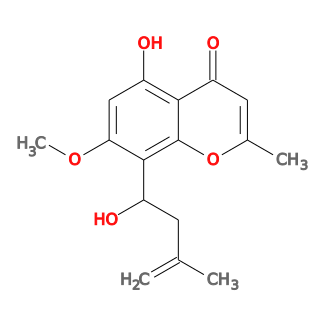 |
| Plant Source | Harrisonia perforata Common Name: |
| Source Family | Simaroubaceae |
| Origin | Hainan, Cambodia, Cochin, China, Burma and West Malaysia |
| Plant Part Used | Branch |
| Extract | Ethanol (95 %) |
| Target Bacteria | Mycobacterium tuberculosis H37Ra |
| Assay / Test Done | Microplate Alamar Blue Assay (MABA) |
| Positive Control Used (conc.) | Isoniazid (0.04 - 0.09 µg/ml), Kanamycin sulphate (2.0 - 5.4 µg/ml) |
| Inhibition [%] | NR |
| Activity [MIC] µg/ml | 25 µg/ml |
| Activity (In terms of dilution) | NR |
| Activity (Zone of inhibition in mm) | NR |
| Active Compound Identified | Perforamone B |
| PubChem ID | 11608981 |
| Ethnomedicinal Information | Antimalarial activity |
| PubMed ID [Source Literature] | 16394547 |
| Extract Preparation | The branches of Harrisonia perforata (5.1 kg) were extracted with 95 % EtOH at room temperature. The ethanolic extract was filtered and evaporated to a dark brown viscous oil (186.3 g). The extract was partitioned between water (500 ml) and EtOAc (3 x 500 ml) and the water layer was further extracted with n-BuOH (3 x 400 ml). After evaporation, the EtOAc-, n-BuOH- and water - soluble fractions gave a brown viscous oil (69.8 g), a dark brown viscous oil (25.7 g) and a light brown viscous oil (50.8 g), respectively. The ethyl acetate soluble fraction is separated by flash column chromatography using silica gel |
| Chemical Classification [Active Compound] | Aromatic, Bicyclic, Chromone, Ether, Alcohol |
| Media / Broth Used [Antimicrobial Assay/Test] | |
| Cytotoxicity Assay [AID] | |
| Molecular Weight | 290.115 |
| Molecular Formula | C16H18O5 |
| SMILES | O1c2c(C(O)CC(=C)C)c(OC)cc(O)c2c(=O)cc1C |
| XLogP | 0.558 |
| PSA | 66.760 |
| H-bond Donor | 2 |
| H-bond Acceptor | 4 |
| No. of Rotatable Bond Count | 4 |
| No. of Rings | 2 |
| No. of N | 0 |
| No. of O | 5 |
| No. of S | 0 |
| Reference(s) | 1) Tuntiwachwuttikul P, Phansa P, Pootaeng-On Y, Taylor WC.Chromones from the branches of Harrisonia perforata.Chem Pharm Bull (Tokyo). 2006 Jan;54(1):44-7
|
| Curator | Vikramjitmandal, Reshmi |
| Compound ID | 3719 |
| Compound Structure |  |
| Plant Source | Harrisonia perforata Common Name: |
| Source Family | Simaroubaceae |
| Origin | China |
| Plant Part Used | Branch |
| Extract | Ethanol (95 %) |
| Target Bacteria | Mycobacterium tuberculosis H37Ra |
| Assay / Test Done | Microplate Alamar Blue Assay (MABA) |
| Positive Control Used (conc.) | Isoniazid (0.04 - 0.09 µg/ml), Kanamycin sulphate (2.0 - 5.5 µg/ml) |
| Inhibition [%] | NR |
| Activity [MIC] µg/ml | 200 µg/ml |
| Activity (In terms of dilution) | NR |
| Activity (Zone of inhibition in mm) | NR |
| Active Compound Identified | Perforamone C |
| PubChem ID | NR |
| Ethnomedicinal Information | Antimalarial activity |
| PubMed ID [Source Literature] | 16394547 |
| Extract Preparation | The branches of Harrisonia perforata (5.1 kg) were extracted with 95 % EtOH at room temperature. The ethanolic extract was filtered and evaporated to a dark brown viscous oil (186.3 g). The extract was partitioned between water (500 ml) and EtOAc (3 x 500 ml) and the water layer was further extracted with n-BuOH (3 x 400 ml). After evaporation, the EtOAc-, n-BuOH- and water - soluble fractions gave a brown viscous oil (69.8 g), a dark brown viscous oil (25.7 g) and a light brown viscous oil (50.8 g), respectively. The ethyl acetate soluble fraction is separated by flash column chromatography using silica gel |
| Chemical Classification [Active Compound] | Aromatic, Bicyclic, Chromone, Ether, Alcohol |
| Media / Broth Used [Antimicrobial Assay/Test] | |
| Cytotoxicity Assay [AID] | |
| Molecular Weight | 290.115 |
| Molecular Formula | C16H18O5 |
| SMILES | C1(cc(c(c2c1c(=O)cc(o2)C)CC(C(=C)C)O)OC)O |
| XLogP | 0.756 |
| PSA | 66.760 |
| H-bond Donor | 2 |
| H-bond Acceptor | 4 |
| No. of Rotatable Bond Count | 4 |
| No. of Rings | 2 |
| No. of N | 0 |
| No. of O | 5 |
| No. of S | 0 |
| Reference(s) | 1) Tuntiwachwuttikul P, Phansa P, Pootaeng-On Y, Taylor WC.Chromones from the branches of Harrisonia perforata.Chem Pharm Bull (Tokyo). 2006 Jan;54(1):44-7
|
| Curator | Vikramjitmandal, Reshmi |
| Compound ID | 3720 |
| Compound Structure |  |
| Plant Source | Harrisonia perforata Common Name: |
| Source Family | Simaroubaceae |
| Origin | China |
| Plant Part Used | Branch |
| Extract | Ethanol (95 %) |
| Target Bacteria | Mycobacterium tuberculosis H37Ra |
| Assay / Test Done | Microplate Alamar Blue Assay (MABA) |
| Positive Control Used (conc.) | Isoniazid (0.04 - 0.09 µg/ml) and Kanamycin sulphate (2.0 - 5.6 µg/ml) |
| Inhibition [%] | NR |
| Activity [MIC] µg/ml | 100 µg/ml |
| Activity (In terms of dilution) | NR |
| Activity (Zone of inhibition in mm) | NR |
| Active Compound Identified | Eugenin |
| PubChem ID | 10189 |
| Ethnomedicinal Information | Antimalarial activity |
| PubMed ID [Source Literature] | 16394547 |
| Extract Preparation | The branches of Harrisonia perforata (5.1 kg) were extracted with 95 % EtOH at room temperature. The ethanolic extract was filtered and evaporated to a dark brown viscous oil (186.3 g). The extract was partitioned between water (500 ml) and EtOAc (3 x 500 ml) and the water layer was further extracted with n-BuOH (3 x 400 ml). After evaporation, the EtOAc-, n-BuOH- and water - soluble fractions gave a brown viscous oil (69.8 g), a dark brown viscous oil (25.7 g) and a light brown viscous oil (50.8 g), respectively. The ethyl acetate soluble fraction is separated by flash column chromatography using silica gel |
| Chemical Classification [Active Compound] | Aromatic, Bicyclic, Chromone, Ether, Phenol |
| Media / Broth Used [Antimicrobial Assay/Test] | |
| Cytotoxicity Assay [AID] | |
| Molecular Weight | 206.058 |
| Molecular Formula | C11H10O4 |
| SMILES | O1c2c(c(O)cc(OC)c2)c(=O)cc1C |
| XLogP | 0.495 |
| PSA | 46.530 |
| H-bond Donor | 1 |
| H-bond Acceptor | 3 |
| No. of Rotatable Bond Count | 1 |
| No. of Rings | 2 |
| No. of N | 0 |
| No. of O | 4 |
| No. of S | 0 |
| Reference(s) | 1) Tuntiwachwuttikul P, Phansa P, Pootaeng-On Y, Taylor WC.Chromones from the branches of Harrisonia perforata.Chem Pharm Bull (Tokyo). 2006 Jan;54(1):44-7
|
| Curator | Vikramjitmandal, Reshmi |
| Compound ID | 3721 |
| Compound Structure |  |
| Plant Source | Harrisonia perforata Common Name: |
| Source Family | Simaroubaceae |
| Origin | China |
| Plant Part Used | Branch |
| Extract | Ethanol (95 %) |
| Target Bacteria | Mycobacterium tuberculosis H37Ra |
| Assay / Test Done | Microplate Alamar Blue Assay (MABA) |
| Positive Control Used (conc.) | Isoniazid (0.04 - 0.09 µg/ml) and Kanamycin sulphate (2.0 - 5.7 µg/ml) |
| Inhibition [%] | NR |
| Activity [MIC] µg/ml | 25 µg/ml |
| Activity (In terms of dilution) | NR |
| Activity (Zone of inhibition in mm) | NR |
| Active Compound Identified | Perforamone D |
| PubChem ID | NR |
| Ethnomedicinal Information | Antimalarial activity |
| PubMed ID [Source Literature] | 16394547 |
| Extract Preparation | The branches of Harrisonia perforata (5.1 kg) were extracted with 95 % EtOH at room temperature. The ethanolic extract was filtered and evaporated to a dark brown viscous oil (186.3 g). The extract was partitioned between water (500 ml) and EtOAc (3 x 500 ml) and the water layer was further extracted with n-BuOH (3 x 400 ml). After evaporation, the EtOAc-, n-BuOH- and water - soluble fractions gave a brown viscous oil (69.8 g), a dark brown viscous oil (25.7 g) and a light brown viscous oil (50.8 g), respectively. The ethyl acetate soluble fraction is separated by flash column chromatography using silica gel |
| Chemical Classification [Active Compound] | Aromatic, Tricyclic, Chromone, Benzopyran, Phenol, Alcohol |
| Media / Broth Used [Antimicrobial Assay/Test] | |
| Cytotoxicity Assay [AID] | |
| Molecular Weight | 274.084 |
| Molecular Formula | C15H14O5 |
| SMILES | C12OC(C=Cc1c1c(c(c2)O)c(=O)cc(o1)CO)(C)C |
| XLogP | 0.339 |
| PSA | 66.760 |
| H-bond Donor | 2 |
| H-bond Acceptor | 4 |
| No. of Rotatable Bond Count | 1 |
| No. of Rings | 3 |
| No. of N | 0 |
| No. of O | 5 |
| No. of S | 0 |
| Reference(s) | 1) Tuntiwachwuttikul P, Phansa P, Pootaeng-On Y, Taylor WC.Chromones from the branches of Harrisonia perforata.Chem Pharm Bull (Tokyo). 2006 Jan;54(1):44-7
|
| Curator | Vikramjitmandal, Reshmi |
| Compound ID | 3722 |
| Compound Structure | 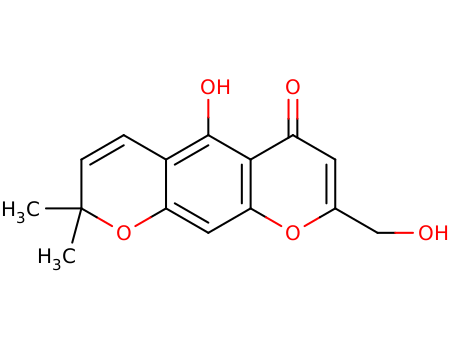 |
| Plant Source | Harrisonia perforata Common Name: |
| Source Family | Simaroubaceae |
| Origin | Hainan, Cambodia, Cochin, China, Burma and West Malaysia |
| Plant Part Used | Branch |
| Extract | Ethanol (95 %) |
| Target Bacteria | Mycobacterium tuberculosis H37Ra |
| Assay / Test Done | Microplate Alamar Blue Assay (MABA) |
| Positive Control Used (conc.) | Isoniazid (0.04 - 0.09 µg/ml) and Kanamycin sulphate (2.0 - 5.8 µg/ml) |
| Inhibition [%] | NR |
| Activity [MIC] µg/ml | 50 µg/ml |
| Activity (In terms of dilution) | NR |
| Activity (Zone of inhibition in mm) | NR |
| Active Compound Identified | Greveichromenol |
| PubChem ID | NR |
| Ethnomedicinal Information | Antimalarial activity, Tuberculosis |
| PubMed ID [Source Literature] | 16394547 |
| Extract Preparation | The branches of Harrisonia perforata (5.1 kg) were extracted with 95 % EtOH at room temperature. The ethanolic extract was filtered and evaporated to a dark brown viscous oil (186.3 g). The extract was partitioned between water (500 ml) and EtOAc (3 x 500 ml) and the water layer was further extracted with n-BuOH (3 x 400 ml). After evaporation, the EtOAc-, n-BuOH- and water - soluble fractions gave a brown viscous oil (69.8 g), a dark brown viscous oil (25.7 g) and a light brown viscous oil (50.8 g), respectively. The ethyl acetate soluble fraction is separated by flash column chromatography using silica gel |
| Chemical Classification [Active Compound] | Aromatic, Tricyclic, Flavonoid, Benzopyran, Phenol, Alcohol |
| Media / Broth Used [Antimicrobial Assay/Test] | |
| Cytotoxicity Assay [AID] | |
| Molecular Weight | 274.084 |
| Molecular Formula | C15H14O5 |
| SMILES | O1c(cc(=O)c2c1cc1c(c2O)C=CC(O1)(C)C)CO |
| XLogP | 0.339 |
| PSA | 66.760 |
| H-bond Donor | 2 |
| H-bond Acceptor | 4 |
| No. of Rotatable Bond Count | 1 |
| No. of Rings | 3 |
| No. of N | 0 |
| No. of O | 5 |
| No. of S | 0 |
| Reference(s) | 1) Tuntiwachwuttikul P, Phansa P, Pootaeng-On Y, Taylor WC.Chromones from the branches of Harrisonia perforata.Chem Pharm Bull (Tokyo). 2006 Jan;54(1):44-7
|
| Curator | Vikramjitmandal, Reshmi |
