| Compound ID | 2052 |
| Compound Structure | 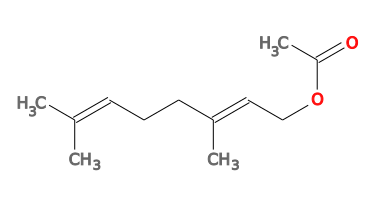 |
| Plant Source | Lippia alba (Miller) N. E.Brown Common Name: |
| Source Family | Verbenaceae |
| Origin | Colombia, Puerto Rico, India |
| Plant Part Used | Leaf, stem |
| Extract | Essential oil (2.5 %) |
| Target Bacteria | Mycobacterium tuberculosis H37Rv |
| Assay / Test Done | Macrodilution method in glass tubes |
| Positive Control Used (conc.) | Rifampin (0.50 µg/ml), Isoniazid (0.03 µg/ml) |
| Inhibition [%] | |
| Activity [MIC] µg/ml | 130 ± 95 µg/ml |
| Activity (In terms of dilution) | |
| Activity (Zone of inhibition in mm) | |
| Active Compound Identified | Geranyl acetate (3.6 %) |
| PubChem ID | 1549026 |
| Ethnomedicinal Information | Digestive troubles in general, nausea, bronchitis, sore throat, flu, cough, cold, hypertension, skin diseases, wounds, stomach ache, nervous complaints, folklore medicine of Puerto Rico |
| PubMed ID [Source Literature] | 19753839 |
| Extract Preparation | N/A |
| Chemical Classification [Active Compound] | Aliphatic, Alkene, Ester |
| Media / Broth Used [Antimicrobial Assay/Test] | N/A |
| Cytotoxicity Assay [AID] | N/A |
| Molecular Weight | 196.146 |
| Molecular Formula | C12H20O2
|
| SMILES | O(C/C=C(/CCC=C(C)C)C)C(=O)C |
| XLogP | 3.264 |
| PSA | 26.300 |
| H-bond Donor | 0 |
| H-bond Acceptor | 2 |
| No. of Rotatable Bond Count | 6 |
| No. of Rings | 0 |
| No. of N | 0 |
| No. of O | 2 |
| No. of S | 0 |
| Reference(s) | 1) Bueno-Sánchez JG, Martínez-Morales JR, Stashenko EE, Ribón W.Anti-tubercular activity of eleven aromatic and medicinal plants occurring in Colombia.Biomedica. 2009 Mar;29(1):51-60
2) Thierry Hennebelle, Sevser Sahpaz, Henry Joseph, François Bailleul.Ethnopharmacology of Lippia alba.Journal of Ethnopharmacology, Volume 116, Issue 2, 5 March 2008, Pages 211-222
|
| Curator | |
| Compound ID | 3878 |
| Compound Structure | |
| Plant Source | Cananga odorata Common Name:Ylang - Ylang Tree |
| Source Family | Annonaceae |
| Origin | Colombia |
| Plant Part Used | Flower |
| Extract | Essential oil (1.2 %) |
| Target Bacteria | Mycobacterium tuberculosis H37Rv |
| Assay / Test Done | Macrodilution method in glass tubes |
| Positive Control Used (conc.) | Isoniazid (0.19 ± 0.07 µg/ml), Rifampin (0.3 ± 0.21 µg/ml) |
| Inhibition [%] | NR |
| Activity [MIC] µg/ml | 300 ± 217 µg/ml |
| Activity (In terms of dilution) | NR |
| Activity (Zone of inhibition in mm) | NR |
| Active Compound Identified | Geranyl acetate (2.9 %) |
| PubChem ID | 1549026 |
| Ethnomedicinal Information | Stomach ailment, fever, inflammation, burning sensation, malarial fever, asthma with aromatherapy, hypertension, anxiety, depression and as a sexual stimulant |
| PubMed ID [Source Literature] | 19753839 |
| Extract Preparation | The essential oils were extracted from a 300 g sample of plant leaves and stems by microwave - assisted hydrodistillation (30 min, 250 ml water), using a Clevenger - type distillation apparatus and a Dean - Stark distillation trap in a domestic microwave oven. Sodium sulfate was added as a drying agent to the decanted essential oil |
| Chemical Classification [Active Compound] | Aliphatic, Alkene, Ester |
| Media / Broth Used [Antimicrobial Assay/Test] | Lowestein - Jensenn medium, Middlebrook 7H9 medium [The later was supplemented with 10 % OADC (Oleic Acid - Albumin - Dextrose - Catalase) and 0.001 % Tween 80] |
| Cytotoxicity Assay [AID] | NR |
| Molecular Weight | 196.146 |
| Molecular Formula | C12H20O2 |
| SMILES | O(C/C=C(/CCC=C(C)C)C)C(=O)C |
| XLogP | 3.264 |
| PSA | 26.300 |
| H-bond Donor | 0 |
| H-bond Acceptor | 2 |
| No. of Rotatable Bond Count | 6 |
| No. of Rings | 0 |
| No. of N | 0 |
| No. of O | 2 |
| No. of S | 0 |
| Reference(s) | 1) Bueno-Sánchez JG, Martínez-Morales JR, Stashenko EE, Ribón W.Anti-tubercular activity of eleven aromatic and medicinal plants occurring in Colombia.Biomedica. 2009 Mar;29(1):51-60
2) http://ayurvedicmedicinalplants.com/index.php?option=com_zoom&Itemid=26&page=view&catid=3&key=10&hit=1
|
| Curator | KeyaMukherjee, Farzana Shamsudeen |
