| Compound ID | 2305 |
| Compound Structure | |
| Plant Source | Pelargonium reniforme Common Name: |
| Source Family | Geraniaceae |
| Origin | Africa |
| Plant Part Used | Tuber |
| Extract | N - hexane |
| Target Bacteria | Mycobacterium aurum, Mycobacterium smegmatis, Mycobacterium fortuitum, Mycobacterium abscessus, Mycobacterium phlei |
| Assay / Test Done | |
| Positive Control Used (conc.) | |
| Inhibition [%] | |
| Activity [MIC] µg/ml | |
| Activity (In terms of dilution) | |
| Activity (Zone of inhibition in mm) | |
| Active Compound Identified | |
| PubChem ID | NR |
| Ethnomedicinal Information | Tuberculosis, coughs |
| PubMed ID [Source Literature] | 15194133 |
| Extract Preparation | N/A |
| Chemical Classification [Active Compound] | N/A |
| Media / Broth Used [Antimicrobial Assay/Test] | N/A |
| Cytotoxicity Assay [AID] | N/A |
| Reference(s) | 1) Seidel V, Taylor PW. In vitro activity of extracts and constituents of Pelagonium against rapidly growing mycobacteria. Int J Antimicrob Agents. 2004, Jun;23(6):613-9
|
| Curator | |
| Compound ID | 2307 |
| Compound Structure | |
| Plant Source | Pelargonium sidoides Common Name:African Geranium |
| Source Family | Geraniaceae |
| Origin | Africa |
| Plant Part Used | Tuber |
| Extract | Unsaturated fatty acids |
| Target Bacteria | Mycobacterium aurum, Mycobacterium smegmatis, Mycobacterium fortuitum, Mycobacterium abscessus, Mycobacterium phlei |
| Assay / Test Done | |
| Positive Control Used (conc.) | |
| Inhibition [%] | |
| Activity [MIC] µg/ml | |
| Activity (In terms of dilution) | |
| Activity (Zone of inhibition in mm) | |
| Active Compound Identified | |
| PubChem ID | NR |
| Ethnomedicinal Information | Tuberculosis, coughs |
| PubMed ID [Source Literature] | 15194133 |
| Extract Preparation | N/A |
| Chemical Classification [Active Compound] | N/A |
| Media / Broth Used [Antimicrobial Assay/Test] | N/A |
| Cytotoxicity Assay [AID] | N/A |
| Reference(s) | 1) Seidel V, Taylor PW. In vitro activity of extracts and constituents of Pelagonium against rapidly growing mycobacteria. Int J Antimicrob Agents. 2004, Jun;23(6):613-9
|
| Curator | |
| Compound ID | 3048 |
| Compound Structure | 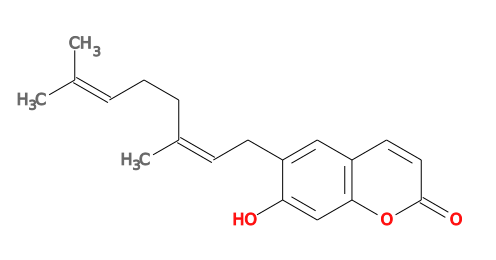 |
| Plant Source | Peucedanum osthruthin Koch Common Name: |
| Source Family | Apiaceae (Umbelliferae) |
| Origin | |
| Plant Part Used | Root |
| Extract | Dichloromethane |
| Target Bacteria | Mycobacterium abscessus (ATCC 19 977) |
| Assay / Test Done | |
| Positive Control Used (conc.) | NR |
| Inhibition [%] | |
| Activity [MIC] µg/ml | 32 µg/ml |
| Activity (In terms of dilution) | |
| Activity (Zone of inhibition in mm) | |
| Active Compound Identified | Ostruthin |
| PubChem ID | 5281420 |
| Ethnomedicinal Information | |
| PubMed ID [Source Literature] | 12709907 |
| Extract Preparation | |
| Chemical Classification [Active Compound] | Aromatic, Bicyclic, Coumarin, Prenylated, Phenol |
| Media / Broth Used [Antimicrobial Assay/Test] | |
| Cytotoxicity Assay [AID] | |
| Molecular Weight | 298.157 |
| Molecular Formula | C19H22O3
|
| SMILES | O1c2c(cc(C/C=C(/CCC=C(C)C)C)c(O)c2)ccc1=O |
| XLogP | 5.348 |
| PSA | 37.300 |
| H-bond Donor | 1 |
| H-bond Acceptor | 2 |
| No. of Rotatable Bond Count | 5 |
| No. of Rings | 2 |
| No. of N | 0 |
| No. of O | 3 |
| No. of S | 0 |
| Reference(s) | 1) Schinkovitz A, Gibbons S, Stavri M, Cocksedge MJ, Bucar F.Ostruthin: an antimycobacterial coumarin from the Roots of Peucedanum ostruthium. Planta Med. 2003 Apr;69(4):369-7
|
| Curator | |
| Compound ID | 3566 |
| Compound Structure | 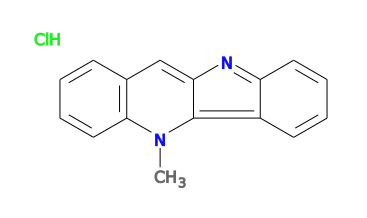 |
| Plant Source | Cryptolepis sanguinolenta Common Name:Nibima |
| Source Family | Apocynaceae |
| Origin | West Africa |
| Plant Part Used | Root |
| Extract | Ammonia moistened chloroform |
| Target Bacteria | Mycobacterium abscessus |
| Assay / Test Done | MTT Assay |
| Positive Control Used (conc.) | Ethambutol (128 µg/ml), Isoniazid (32 µg/ml) |
| Inhibition [%] | NR |
| Activity [MIC] µg/ml | 32 µg/ml |
| Activity (In terms of dilution) | NR |
| Activity (Zone of inhibition in mm) | NR |
| Active Compound Identified | Cryptolepine hydrochloride |
| PubChem ID | 156093 |
| Ethnomedicinal Information | Antimycobacterial, antimalarial |
| PubMed ID [Source Literature] | 12722159 |
| Extract Preparation | Cryptolepine was isolated from Cryptolepis sanguinolenta roots and crystallized as the hydrochloride salt |
| Chemical Classification [Active Compound] | Aromatic, Quinoline, Alkaloid, Indole
|
| Media / Broth Used [Antimicrobial Assay/Test] | Mueller - Hinton broth, Colombia blood agar, 7H9 Middle Brook medium |
| Cytotoxicity Assay [AID] | NR |
| Molecular Weight | 232.100 |
| Molecular Formula | C16H13ClN2 |
| SMILES | Cl.n1(c2c(nc3c2cccc3)cc2c1cccc2)C |
| XLogP | 4.596 |
| PSA | 15.600 |
| H-bond Donor | 0 |
| H-bond Acceptor | 1 |
| No. of Rotatable Bond Count | 0 |
| No. of Rings | 4 |
| No. of N | 2 |
| No. of O | 0 |
| No. of S | 0 |
| Reference(s) | 1) Gibbons S, Fallah F, Wright CW.Cryptolepine hydrochloride: a potent antimycobacterial alkaloid derived from Cryptolepis sanguinolenta.Phytother Res. 2003 Apr;17(4):434-6
|
| Curator | Wvarsha, rachanake |
| Compound ID | 3711 |
| Compound Structure | 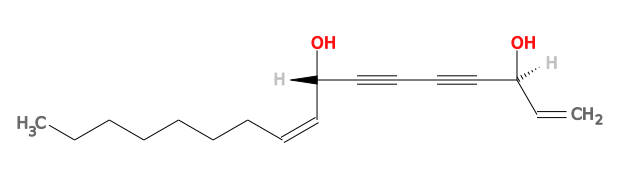 |
| Plant Source | Anethum graveolens L. Common Name:NR |
| Source Family | Apiaceae (Umbelliferae) |
| Origin | NR |
| Plant Part Used | Whole plant |
| Extract | Hexane |
| Target Bacteria | Mycobacterium abscessus (ATCC 19977) |
| Assay / Test Done | Columbia Blood Agar |
| Positive Control Used (conc.) | Ethambutol (128 µg/ml) |
| Inhibition [%] | NR |
| Activity [MIC] µg/ml | 2 µg/ml |
| Activity (In terms of dilution) | NR |
| Activity (Zone of inhibition in mm) | NR |
| Active Compound Identified | Falcarindiol |
| PubChem ID | 6436239 |
| Ethnomedicinal Information | NR |
| PubMed ID [Source Literature] | 16317649 |
| Extract Preparation | NR |
| Chemical Classification [Active Compound] | Aliphatic, Alkene, Alkyne, Alcohol |
| Media / Broth Used [Antimicrobial Assay/Test] | NR |
| Cytotoxicity Assay [AID] | NR |
| Molecular Weight | 260.178 |
| Molecular Formula | C17H24O2 |
| SMILES | O[C@@H](/C=CCCCCCCC)C#CC#C[C@@H](O)C=C |
| XLogP | 4.573 |
| PSA | 40.460 |
| H-bond Donor | 2 |
| H-bond Acceptor | 2 |
| No. of Rotatable Bond Count | 8 |
| No. of Rings | 0 |
| No. of N | 0 |
| No. of O | 2 |
| No. of S | 0 |
| Reference(s) | 1) Stavri M, Gibbons S.The antimycobacterial constituents of dill (Anethum graveolens).Phytother Res. 2005 Nov;19(11):938-41
|
| Curator | Najiya-beegum, vikramjitmandal |
| Compound ID | 4148 |
| Compound Structure |  |
| Plant Source | Anethum graveolens Common Name: |
| Source Family | Apiaceae (Umbelliferae) |
| Origin | |
| Plant Part Used | |
| Extract | |
| Target Bacteria | Mycobacterium fortuitum ATCC 6841, Mycobacterium smegmatis ATCC 14468, Mycobacterium phlei ATCC 11758, Mycobacterium aurum Pasteur Institute 104482, Mycobacterium abscessus ATCC 19977 |
| Assay / Test Done | |
| Positive Control Used (conc.) | |
| Inhibition [%] | |
| Activity [MIC] µg/ml | 2-4 µg/ml |
| Activity (In terms of dilution) | |
| Activity (Zone of inhibition in mm) | |
| Active Compound Identified | NPMC3 |
| PubChem ID | NR |
| Ethnomedicinal Information | |
| PubMed ID [Source Literature] | |
| Extract Preparation | |
| Chemical Classification [Active Compound] | Aliphatic, Alkene, Alkyne, Alcohol |
| Media / Broth Used [Antimicrobial Assay/Test] | |
| Cytotoxicity Assay [AID] | |
| Molecular Weight | 260.178 |
| Molecular Formula | C17H24O2
|
| SMILES | O[C@H](C#CC#C[C@H](O)/C=C/CCCCCCC)C=C |
| XLogP | 4.573 |
| PSA | 40.460 |
| H-bond Donor | 2 |
| H-bond Acceptor | 2 |
| No. of Rotatable Bond Count | 8 |
| No. of Rings | 0 |
| No. of N | 0 |
| No. of O | 2 |
| No. of S | 0 |
| Reference(s) | 1) In silico Comparison of Antimycobacterial Natural Products with Known Antituberculosis Drugs. Marlene Espinoza-Moraga, Nicholas M. Njuguna, Grace Mugumbate, Julio Caballero, and Kelly Chibale. Journal of Chemical Information and Modeling 2013 53 (3), 649-660
2) Rogoza, L. N.; Salakhutdinov, N. F.; Tolstikov, G. A. Anti-tubercular Activity of Natural Products: Recent Developments. In Opportunity, Challenge and Scope of Natural Products in Medicinal Chemistry; Tiwari, V. K. Ed.; Research Signpost: India, 2011; pp 103-120
|
| Curator | |
